Junagadh Rock Inscription - Art and Culture Notes
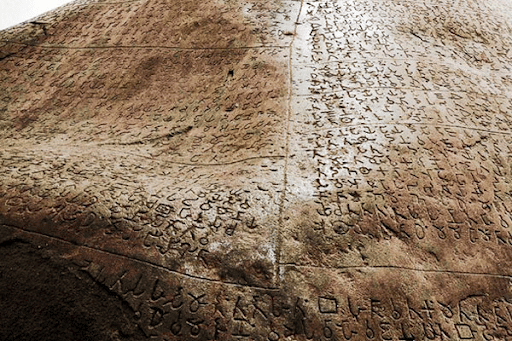
Rudradaman's Junagarh rock inscription, also known as Rudradaman's Girnar rock inscription, is a Sanskrit prose inscription engraved on a rock by the Western Satraps emperor Rudradaman I. It holds a key position in understanding the history of ancient India. The inscription was written about the year 150 CE. The Junagarh inscription has inscriptions of Ashoka (one of fourteen Major Rock Edicts of Ashoka), Rudradaman I, and Skandagupta. Here we will discuss the features of Junagarh Rock Inscription, which will be helpful for UPSC IAS Exam preparation.
|
Table of Contents |
Junagadh Rock Inscription - Background
- It is in Gujarat, near Girnar Hill, near Junagadh.
- The inscription is dated shortly after 150 CE.
- Inscriptions of Ashoka (one of fourteen Major Rock Edicts of Ashoka), Rudradaman I and Skandagupta can be seen on the Junagadh rock.
- It states that Pushyagupta, one of Chandragupta Maurya's governors, was in charge of constructing a dam on Sudarshana Lake near Girnar in Kathiawar.
- It is learned from another Skandgupta inscription that this dam was restored during his reign, about 800 years after it was erected.
- The Girnar inscriptions were discovered in 1822 by British military officer and scholar James Todd and were translated in 1837 by scholar and Orientalist James Princep.

| Other Relevant Links | |
|---|---|
| Temple Architecture | Nasik Inscription |
| Mehrauli Inscription / Garuda Pillar | Nanaghat Inscription |
| Allahabad Pillar Inscription (Prayag Prasasti) | Mandsaur Inscription |
Junagadh Rock Inscription - Features
- The inscription is made up of twenty lines. The first eight lines provide a historical record of the restoration work of a reservoir known as "Sudarshana Lake".
- This lake was built in the 4th century BC during the rule of great Mauryan ruler Chandragupta Maurya under his provincial Governor Vaishya Pushyagupta.
- The Rudradaman I Girnar inscription is intriguing because it provides insight into water management in ancient India.
- Although the three rulers whose inscriptions we found at Girnar were unrelated and from different eras, they all had one thing in common: they all worked to keep the Sudarshana Lake in good condition.
- Aside from information about dam repairs, the Girnar inscription includes Rudradaman I's eulogy or prashasti.
- The inscription mentions Rudradaman's territory, which included parts of Malwa, Gujarat, Sindh, and Western Maharashtra.
- The ancient names Junagadh and Girnar are also mentioned in the inscription. Junagadh was known as 'Girinagara,' and Mount Girnar was known as 'Urjayat,' according to the inscription.
- It also cites a Yavana ruler named Tushaspha who built conduits during Ashoka's reign.
- The inscription is evidence of historical record-keeping tradition in ancient India because Rudradaman otherwise would not have known the names of people involved in the project in 4th-century BCE, or who later worked on the water reservoir in the following centuries before Rudradaman promoted his Sanskrit inscription in 150 CE.
- Skandagupta (455 – 467 CE), son of Kumaragupta I, is credited with the third inscription on the Girnar rock.
- The inscription, written in Sanskrit, is divided into two parts: the first deals with Sudarshana Lake repairs, and the second mentions the construction of two temples.
- Skandagupta is credited with restoring the Gupta Empire. The inscription begins with Skandagupta defeating his opponents, who are thought to be the Hunas.
Junagarh Rock Inscription - Significance
- The inscription is noteworthy as a historical record of public works in ancient India, about 500 years before the creation of the inscription.
- It recalls the construction of a nearby water reservoir named Sudarshana by Vaishya Pushyagupta during the time of Maurya Empire founder Chandragupta Maurya.
- The inscription demonstrates an ancient Indian tradition of historical record keeping because Rudradaman would not have known the names of people involved in the project in the 4th century BCE, or who later worked on the water reservoir in subsequent centuries, before Rudradaman promoted his Sanskrit inscription in 150 CE.
- The Junagadh rock inscription also has a 2nd-century eulogy-style Sanskrit inscription.
- It is the earliest extended inscription in pretty standard Sanskrit to have survived to the present day.
- The inscription also records that the modern-day town of Junagadh has ancient origins, and that it was known as Girinagar in the 2nd century CE. Girnar Mountain was once known as Urjayat.
Conclusion
The Junagadh rock inscription, unearthed at Junagadh, was etched on King Rudradaman's orders after he earned the Maha Kshatrapa title. The Rudradaman inscription is one of three major inscriptions discovered on the same rock, the second in chronology. The earliest inscription is a replica of Ashoka edicts, while the latest and third are Gupta Emperor Skandagupta. The inscription recounts the reconstruction of the Urjayat dam surrounding Sudarshana Lake. Thus, the inscription depicts an ideal ruler as described by the standards and in the vocabulary of the period.
| Other Relevant Links | |
|---|---|
| Indian Art and Culture | Gupta Architecture |
| Art of Indus Valley Civilization | Indian Architecture |
| Visual Arts | Mauryan Art and Architecture |
| Post Mauryan Art | Rock-cut architecture |
FAQs
Question: What is the Junagarh Rock Inscription?
Answer: The Junagarh Rock Inscription is an ancient Sanskrit inscription commissioned by Rudradaman I, detailing the restoration of Sudarshana Lake and significant historical events.
Question: Where is the Junagarh Rock Inscription located?
Answer: It is located near Girnar Hill in Junagadh, Gujarat.
Question: Which rulers are mentioned in the Junagarh Inscription?
Answer: The inscription mentions Ashoka, Rudradaman I, and Skandagupta.
Question: What is the significance of the Sudarshana Lake?
Answer: Sudarshana Lake was an important reservoir built during the Mauryan period and restored by Rudradaman, reflecting ancient Indian water management practices.
Question: Who discovered and translated the Junagarh Inscription?
Answer: The inscription was discovered in 1822 and translated by James Prinsep in 1837.
MCQs
1. Who was the ruler responsible for the Junagarh Rock Inscription?A. Ashoka
B. Rudradaman I
C. Chandragupta Maurya
D. Skandagupta
Answer: (B) See the Explanation
Explanation: Rudradaman I commissioned the Junagarh Rock Inscription.
A. Pushkar Lake
B. Sudarshana Lake
C. Dal Lake
D. Pichola Lake
Answer: (B) See the Explanation
Explanation: The inscription records the construction and maintenance of Sudarshana Lake.
A. Prakrit
B. Sanskrit
C. Pali
D. Tamil
Answer: (B) See the Explanation
Explanation: The inscription is written in Sanskrit, a significant linguistic development in Indian epigraphy.
A. Max Müller
B. Alexander Cunningham
C. James Prinsep
D. William Jones
Answer: (C) See the Explanation
Explanation: James Prinsep translated the Junagarh Inscription in 1837.
A. Pushyagupta
B. Chandragupta Maurya
C. Ashoka
D. Bindusara
Answer: (A) See the Explanation
Explanation: Pushyagupta, the governor under Chandragupta Maurya, built Sudarshana Lake.
GS Mains Questions and Model Answers
Q1: Discuss the significance of the Junagarh Rock Inscription in understanding ancient Indian public works and water management.
Answer: The Junagarh Rock Inscription is crucial in understanding ancient India’s advanced public works, particularly in water management. The construction of Sudarshana Lake by Pushyagupta, its restoration by Rudradaman I, and later works under Skandagupta reflect a long-standing tradition of ensuring water resources for agriculture and the public, demonstrating the continuity of governance across dynasties.
Q2: Analyze the role of Rudradaman I as depicted in the Junagarh Rock Inscription.
Answer: The Junagarh Inscription portrays Rudradaman I as an able and responsible ruler, focused on the restoration of public works like Sudarshana Lake. His administrative efficiency, military prowess, and patronage of Sanskrit are highlighted, making him a significant figure in the history of the Western Satraps and Indian inscriptions.
Q3: Evaluate the historical importance of inscriptions in reconstructing the political and social history of ancient India, with reference to the Junagarh Inscription.
Answer: Inscriptions like the Junagarh Rock Inscription are invaluable for reconstructing ancient Indian history. They provide direct evidence of the political authority, public policies, and infrastructure projects. The Junagarh inscription specifically sheds light on water management and highlights the historical continuity of governance across dynasties, while also illustrating the linguistic evolution of Sanskrit in administrative records.
Previous Year Questions on Junagarh Rock Inscription
1. UPSC CSE Prelims
Question: Which ruler commissioned the Junagarh Rock Inscription?
A. Ashoka
B. Rudradaman I
C. Skandagupta
D. Kanishka
Answer: B
Explanation: The inscription was commissioned by Rudradaman I in 150 CE.
2. UPSC CSE Mains
Question: Explain the significance of the Junagarh Rock Inscription in the context of ancient Indian epigraphy and governance.
Explanation: The Junagarh Rock Inscription is a milestone in ancient Indian epigraphy, marking the first significant inscription in Sanskrit. It records the achievements of Rudradaman I, including the restoration of Sudarshana Lake, providing insights into public works, administrative practices, and the continuity of governance from the Mauryas to the Guptas. Its detailed historical narrative also highlights the linguistic transition in royal inscriptions from Prakrit to Sanskrit.
Download the PREPP App and attempt FREE IAS Exam Mock Tests and get complete study material!

Full Test - 04: UPSC CSE Prelims CSAT (Paper-II)
Full Test - 03: UPSC CSE Prelims CSAT (Paper-II)
UPSC CSE Prelims 2026 GS Paper 1 Question Paper (24-May-2026)
UPSC CSE Prelims 2026 CSAT Paper 2 Question Paper (24-May-2026)

17 February 2025 | The Hindu Must Read Articles | Current Affairs

16 February 2026 | The Hindu Must Read Articles | Current Affairs

13 February 2026 | The Hindu Must Read Articles | Current Affairs









Comments