Gupta Architecture - Art and Culture Notes
Gupta architecture is a representation of the people's strong religious convictions during the time. The "Golden Period of Indian Architecture" is typically referred to as the beginning of the Gupta Empire in the 4th century A.D. While the older Gupta monarchs were Buddhists who preserved Buddhist architectural traditions, temple building rose to prominence under the patronage of the later Gupta rulers who were Hindus. Similarly, during the Gupta period, Buddhist and Jain art achieved their pinnacle. This article will explain to you the concepts related to Gupta Architecture which will be helpful in Indian Art and Culture preparation for the UPSC Civil service exam.

|
Table of Contents |

Gupta Architecture
- The beginning of the Gupta Empire in the 4th century A.D. is considered the "Golden Period of Indian Architecture."
- Temple construction gained prominence under the sponsorship of the later Gupta rulers, who were Hindus.
- While the early Gupta kings were Buddhists who conserved Buddhist architectural traditions, temple building rose to prominence under the patronage of the later Gupta rulers, who were Hindus.
- The Gupta kings were Brahmanical rulers, especially in the later phases. They, on the other hand, displayed exceptional tolerance for all other religions.
- Vishnu was worshipped in the northern and central parts of India, Shiva in the southern section, and Shakti in the eastern part of India, as well as on the Malabar coast or in the south-west.
|
|
|
|---|---|
| Cave Architecture | Temple Architecture |
| Ajanta and Ellora caves | Elephanta caves |
| Vesara Style of architecture | Nagara Architecture |
| Style of Temple Architecture | Dravidian Architecture |
Cave Architecture
- The architectural development of caves remained consistent during the Gupta period.
- The utilisation of mural paintings on the cave walls, on the other hand, became an extra element.
- The caves of Ajanta and Ellora have some of the best examples of mural art.
- Ajanta is a group of rock-cut caves near Aurangabad, Maharashtra, amid the Sahyadri ranges on the Waghora River.
- There are 29 caves in all, 25 of which were utilised as Viharas (residence caves) and 4 of which were used as Chaitya (prayer halls).
- Between 200 B.C. and 650 A.D the caves were constructed.
- The Buddhist monks inscribed the Ajanta caves under the patronage of the Vakataka rulers, one of them was Harishena.
- The figures in these caves were painted with frescoes and exhibited a high level of naturalism. The colours were created from local plants and minerals.
- The paintings' outlines were painted in red, and then the insides were painted.
- The absence of blue in the paintings is one of the most remarkable elements.

Ajanta caves
- Another famous cave architecture site is Ellora Caves.
- It is almost 100 kilometres from the Ajanta caves in Maharashtra's Sahyadri hills. It consists of 34 caves, 17 of which are Brahmanical, 12 Buddhist, and 5 Jain.
- These caves were built by numerous guilds from Vidarbha, Karnataka, and Tamil Nadu between the 5th and 11th centuries A.D. (they are newer than the Ajanta Caves).
- As a result, in terms of topic and architectural styles, the caves represent a natural diversity.

Ellora caves
- A set of nine Buddhist caves formed around the 6th century A.D. on the bank of the Bagh river in Madhya Pradesh.
- It has a similar architectural style to the Ajanta caves.
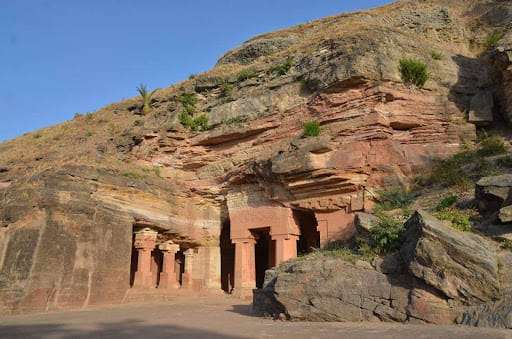
Bagh caves
- These are Buddhist caves located in Gujarat's Junagadh region. Although there are no caves here, three separate places can be located.
- Khapra Kodiya, Baba Pyare, and Uparkot are the three sites found.
- The presence of a 30-50 ft high fortress known as "Upar Kot" in front of the prayer hall is a distinctive feature of the Junagadh caves.

Junagadh caves
- "Pandav Leni" refers to a series of 24 Buddhist caves in Nasik. They were created in the first century A.D. during the Hinayana period.
- Later, though, the Mahayana sect's impact may be seen in these caves.
- His presence is expressed in the Hinayana sect through the usage of motifs and symbols such as the throne and footprints.
- Later on, Buddha idols were sculpted inside these caves, indicating Mahayana Buddhism's impact.
- The site also shows a superb water management system, as evidenced by the presence of water tanks carved out of solid rock.

Nasik Caves
- It is also known as Montperir Caves, located in Borivali, near Mumbai, and was built as a Brahmanical cave during the late Gupta dynasty.
- It was later transformed into a Christian cave, however.
- Sculptures of Natraja, Sada Shiva, and Ardhanarishwara can be seen among the site's ruins.
- Above the cave, precincts are the church and its graveyard.

Mandapeshwar Caves
- Caves of Udayagiri (not to be confused with Odisha's Udayagiri-Khandagiri Caves). It's in Madhya Pradesh's Vidisha district.
- It was built under the patronage of Chandragupta II in the early fifth century AD and is known for its numerous sculptures on the hill walls.
- Varaha, or Vishnu's Boar incarnation, is a renowned sculpture.
- One of the earliest Hindu sculptures may be found in the caverns.

Udaygiri Caves
Stupas
- The development of stupas slowed during the Gupta period.
- However, the Dhamek stupa in Sarnath, near Varanasi, is an excellent example of a stupa built during this time.
Dhamek Stupa
- The Dhamek Stupa is a huge stupa in Sarnath.
- After reaching enlightenment, the Buddha is claimed to have given his first sermon to his first five students, led by Kaundinya, revealing his Eightfold Path leading to nirvana at the Dhamek Stupa.

Dhamek Stupa
Sculptures
- Sarnath School of Sculpture, which sprang up near Sarnath, was added to the list.
- Many Buddha pictures in Sarnath have plain translucent drapery covering both shoulders and a sparsely ornamented halo around the head, whereas the Mathura Buddha images retain the folds of the drapery and the halo around the head is lavishly embellished.
- Sultanganj Buddha is a notable example (7.5ft in height).

Sultanganj Buddha
Temple Architecture
- The beginning of Indian temple architecture may be traced back to the Gupta dynasty.
- There were manuals created on how to build temples.
- The Gupta temples were divided into five categories:
- Kankali Devi temple in Tigawa and the Vishnu Varaha temples in Eran are examples of square buildings with flat roofs and shallow pillared porches.
- For the first time, the sanctum or cella (garbhagriha) of a temple with a single entrance and a porch (Mandapa) appears.

Kankali Devi Temple
- An extension of the previous form with the addition of an ambulatory (pradakshina) surrounding the shrine, often a second level;
- Examples include the Shiva temple in Bhumara, and the ladkhan at Aihole.
- Parvati temple in Nachna Kuthara is another notable example.

Shiva Temple
- The Dashavatara temple (Deogarh Jhansi) and the brick temple at Bhitargaon Kanpur are famous examples of the square temple with a low and squat tower (shikhara) above; pillared approach, a high platform at the base.
- The "Curvilinear tower," or "Shikhara," was the most remarkable achievement of this stage.
- Temple construction in the "Nagara Style" is regarded to be the third stage's triumph.

Dashavatara Temple
- The Kapoteswara temple in Cezarla (Krishna district) is a rectangular temple with an apsidal back and barrel-vaulted roof above.

Kapoteswara Temple
- Circular temples with shallow rectangular projections on the four cardinal faces; the Maniyar Math shrine in Rajgir, Bihar, is the sole monument that exemplifies the form.

Conclusion
Between 320 to 550 CE, the Gupta Empire ruled over northern, central, and southern India. The achievements in the arts, architecture, sciences, religion, and philosophy are well-known during this time period. Chandragupta I (320–335 CE) began the Gupta Empire's rapid development and quickly established himself as the empire's first autonomous ruler. It signalled the end of 500 centuries of regional power dominance and the resulting unrest, which began with the Mauryas' fall. It marked the start of a period of overall wealth and expansion that lasted for the following two and a half centuries and was known as India's Golden Age.
| Other Relevant Links | |
|---|---|
| Indian Art and Culture | Indian Architecture |
| Art of Indus Valley Civilization | Mauryan Art and Architecture |
| Visual Arts | Mudras of Buddha |
| Post Mauryan Art | Rock-cut architecture |
FAQs
Question: What were the main features of Gupta temple architecture?
Answer: Gupta temple architecture introduced stone and brick structures, the use of pillared halls, and the early forms of the shikhara (spire) that later became prominent in Indian temples.
Question: How did Gupta architecture influence Indian temple building?
Answer: Gupta architecture laid the foundation for the later Nagara style of temple architecture, which featured tower-like spires (shikhara) and a focus on structural temples rather than rock-cut caves.
Question: Which is a famous example of a Gupta-period stupa?
Answer: The Dhamek Stupa at Sarnath is a famous example from the Gupta period, known for its grandeur and religious significance.
Question: What is the significance of the Iron Pillar of Delhi?
Answer: The Iron Pillar of Delhi, erected during the Gupta period, is remarkable for its rust-resistant properties and stands as a testament to the metallurgical skills of the Gupta-era artisans.
Question: What role did rock-cut caves play in Gupta architecture?
Answer: Rock-cut caves during the Gupta period served primarily as monastic dwellings and temples. The Udayagiri Caves are significant examples showcasing early Hindu iconography.
MCQs
1. Which of the following is a well-known Gupta-era temple?A. Brihadeeswarar Temple
B. Dashavatara Temple, Deogarh
C. Sun Temple, Konark
D. Lotus Temple
Answer: (B) See the Explanation
The Dashavatara Temple at Deogarh, Uttar Pradesh, is one of the earliest examples of Gupta temple architecture, showcasing the transition from wooden structures to stone temples.
A. Its inscriptions about Ashoka
B. Its rust-resistant composition
C. Its association with Buddhism
D. Its construction using marble
Answer: (B) See the Explanation
The Iron Pillar of Delhi, erected during the Gupta period, is famous for its rust-resistant properties, which have puzzled metallurgists for centuries. The pillar has remained largely rust-free for over 1,600 years.
A. Jain Temples
B. Hindu Iconography
C. Buddhist Stupas
D. Mauryan Pillars
Answer: (B) See the Explanation
The Udayagiri Caves in Madhya Pradesh are significant for containing early examples of Hindu iconography, with carvings of deities like Vishnu and Shiva. These caves reflect the transition from Buddhist to Hindu cave architecture.
A. Agriculture and Economy
B. Art, Architecture, and Science
C. Military Conquests
D. Maritime Trade
Answer: (B) See the Explanation
The Gupta period is often referred to as the Golden Age of India due to significant advancements in art, architecture, science, and literature. Architectural achievements, particularly in temple construction, are among the key highlights of this era.
A. Shiva
B. Vishnu
C. Brahma
D. Durga
Answer: (B) See the Explanation
The Dashavatara Temple at Deogarh is dedicated to Lord Vishnu and contains intricate carvings depicting the ten incarnations (dashavatara) of Vishnu.
GS Mains Questions and Model Answers
Q1: Discuss the architectural innovations introduced during the Gupta period and their impact on later temple architecture in India.
Answer: The Gupta period marked a significant shift in Indian architecture, particularly with the introduction of stone and brick temples. One of the key innovations was the transition from rock-cut caves to free-standing structural temples, as seen in the Dashavatara Temple at Deogarh. This temple introduced elements like pillared halls, flat roofs, and the early form of the shikhara (spire), which later became a hallmark of Indian temple architecture.
The Gupta architects also focused on elaborate sculptures and carvings that adorned the temples, depicting deities, mythological scenes, and symbols of the divine. These innovations laid the foundation for the later Nagara style of temple architecture in North India, characterized by the towering shikhara and more complex temple designs. The influence of Gupta architecture can be seen in the grand temples of subsequent dynasties like the Chandellas and Rajputs.
Q2: Analyze the significance of rock-cut cave architecture during the Gupta period and its role in the spread of religious art.
Answer: During the Gupta period, rock-cut cave architecture played a significant role in both religious and cultural expression. Building on earlier Buddhist traditions, the Guptas created rock-cut caves like the Udayagiri Caves, which feature some of the earliest depictions of Hindu deities such as Vishnu and Shiva. These caves were primarily used as monastic dwellings and religious centers, helping to spread Hinduism and Buddhism across the Indian subcontinent.
The use of intricate carvings and iconography in these caves helped to visually convey religious teachings and stories, making them more accessible to the public. This fusion of art and religion helped to establish Gupta art and architecture as a vital tool for the propagation of religious ideologies.
Q3: Evaluate the impact of Gupta metallurgical advancements, as exemplified by the Iron Pillar of Delhi, on Indian craftsmanship.
Answer: The Iron Pillar of Delhi, constructed during the Gupta period, stands as a testament to the remarkable metallurgical skills of Gupta craftsmen. The pillar, which is famous for its rust-resistant properties, has remained largely corrosion-free for over 1,600 years, showcasing the advanced knowledge of metalworking and alloying techniques in ancient India.
The Gupta metallurgists used a combination of wrought iron and a protective layer of passive oxide, which has helped the pillar resist rusting in the harsh environment. The Pillar not only serves as a symbol of the Gupta empire's technical prowess but also influenced later developments in Indian metalworking, including the construction of temples and sculptures.
Previous Year Questions on Gupta Architecture
1. UPSC CSE Prelims 2017
Question: Which of the following is an example of Gupta architecture?
- A. Brihadeeswarar Temple
- B. Sun Temple, Konark
- C. Dashavatara Temple, Deogarh
- D. Lotus Temple
Answer: C
Explanation: The Dashavatara Temple at Deogarh is a notable example of Gupta architecture. It represents the transition from wooden to stone temple construction and showcases early developments in Hindu temple design with intricate carvings and the introduction of the shikhara (spire). The other options are associated with later periods.
2. UPSC CSE Mains 2019 (GS Paper 1)
Question: Discuss the role of the Gupta period in shaping Indian temple architecture and its influence on later developments in Indian architecture.
Explanation: The Gupta period is often regarded as a foundational era in the development of Indian temple architecture. During this period, structural temples built from stone and brick became prominent. Temples like the Dashavatara Temple at Deogarh exemplify early forms of shikhara (spire), pillared halls, and garbhagriha (sanctum sanctorum), which later became key features in Indian temple design.
The Guptas also popularized rock-cut cave architecture, as seen in the Udayagiri Caves, which contain some of the earliest depictions of Hindu gods. The innovations of the Gupta period laid the foundation for the Nagara style in North India and influenced later temple-building traditions across the Indian subcontinent, seen in the architecture of the Chandellas and Rajputs.
3. UPSC CSE Prelims 2015
Question: The Iron Pillar at Delhi, constructed during the Gupta period, is notable for which of the following reasons?
- A. Its association with Buddhism
- B. Its construction using marble
- C. Its rust-resistant composition
- D. Its inscriptions about Ashoka
Answer: C
Explanation: The Iron Pillar at Delhi, erected during the Gupta period, is famous for its rust-resistant properties, which have remained a subject of study for metallurgists worldwide. Despite being exposed to the elements for over 1,600 years, the pillar has shown minimal signs of corrosion, reflecting the advanced knowledge of metallurgy during the Gupta era.
Download the PREPP App and attempt FREE IAS Exam Mock Tests and get complete study material!

Full Test - 04: UPSC CSE Prelims CSAT (Paper-II)
Full Test - 03: UPSC CSE Prelims CSAT (Paper-II)
UPSC CSE Prelims 2026 GS Paper 1 Question Paper (24-May-2026)
UPSC CSE Prelims 2026 CSAT Paper 2 Question Paper (24-May-2026)

17 February 2025 | The Hindu Must Read Articles | Current Affairs

16 February 2026 | The Hindu Must Read Articles | Current Affairs

13 February 2026 | The Hindu Must Read Articles | Current Affairs









Comments