Cave Architecture - Art and Culture Notes
India's cave architecture is thought to have started in prehistoric times. Buddhist and Jain monks used these caverns as places of worship and residence. The caverns were discovered in western India at first. Indian rock-cut architecture is more diverse and abundant than any other type of rock building seen around the world (more than 1,500 rock-cut structures in India). The Mauryans were masters of cave architecture and are credited as being the forefathers of rock-cut cave architecture. This article will explain to you the concepts related to Cave Architecture which will be helpful in Indian Art and Culture preparation for the UPSC Civil service exam.
|
Table of Contents |
Buddhist Influence
- In the third to second centuries B.C, Buddhism became the dominant religion.
- Around this time, three distinct types of Buddhist architecture emerged: the colossal funeral mound or Stupa, the hall of worship or Chaitya, and the monastery or Vihara.
- Chaityas and Viharas were built along the hillside since Buddhist and Jain monks tended to stay away from cities and towns.
- Chaityas - Buddhist and Jain monks used Chaitya as sites of prayer. It contained a rectangular prayer hall with a stupa in the centre.
- The entire Chaitya was divided into three sections: a central section and two aisles. A row of pillars separated the central Chaitya from the two aisles. Chaityas' inside walls were polished, and the Chaitya's end was apsidal in shape.
- Vihara - Viharas, or monasteries, were built near Chaityas to house monks during the rainy season.
- Sculptors here depict numerous scenes from the Buddha's life. It's worth noting that, unlike Chaityas, Viharas lacked a stupa.
Ajanta Caves
- Ajanta is a group of rock-cut caves near Aurangabad, Maharashtra, amid the Sahyadri ranges on the Waghora River.
- There are 29 caverns in all, 25 of which were utilised as Viharas (residence caves) and 4 of which were used as Chaitya (prayer halls).
- Between 200 B.C. and 650 A.D the caves were constructed.
- The Buddhist monks inscribed the Ajanta caves under the patronage of the Vakataka rulers, one of them was Harishena.
- The figures in these caves were painted with frescoes and exhibit a high level of naturalism. The colours were created from local plants and minerals.
- The paintings' outlines were painted in red, and then the insides were painted. The absence of blue in the paintings is one of the most remarkable elements.
- The paintings are mostly on Buddhism, including Buddha's life and Jataka stories.
- Five of the caves were built during the Hinayana period of Buddhism, while the other 24 were built during the Mahayana period.
- The Ajanta caves are mentioned in the travel journals of Chinese Buddhist pilgrims Fa Hien and Hieun Tsang.

Ajanta Caves
Ellora Caves
- Another famous cave architecture site is Ellora Caves.
- It is almost 100 kilometres from the Ajanta caves in Maharashtra's Sahyadri hills.
- It consists of 34 caves, 17 of which are Brahmanical, 12 Buddhist, and 5 Jain.
- These caves were built by numerous guilds from Vidarbha, Karnataka, and Tamil Nadu between the 5th and 11th centuries A.D. (they are newer than the Ajanta Caves).
- As a result, in terms of topic and architectural styles, the caverns represent a natural diversity.
- It is a UNESCO World Heritage Site with cave temples dedicated to Hinduism, Buddhism, and Jainism.
- The 17 Hindu caves (caves 13, 29, 14 and 15 are famous and are known as Ravan Ki Khai and Dashavatar caves, respectively), 12 Buddhist caves (caves 1-12), and 5 Jain caves (caves 30-34, Jaina caves include Indra Sabha and Jagannath Sabha) built in close proximity demonstrate the religious harmony prevalent during this period of Indian history.
- Cave 16 in Ellora's Kailasa Temple is the world's largest single monolithic excavation.

Ellora Caves
Barabar Caves
- The Lomas Rishi and Sudama Caves, which were excavated around 250 BC in Barabar Hills in Bihar (Jehanabad district) during the Mauryan Period and are regarded India's oldest example of rock-cut architecture, impacted Western Indian rock-cut cave architecture.
- There are four caves in the Barabar Hills, which were built during the Mauryan Period, mainly under the reign of Asoka (273-232 BC) and his grandson Dasaratha.
- Originally built for the Ajivika sect, hundreds of rock-cut caves were eventually built for Buddhist, Jaina, and Brahmanical traditions.
- In this way, the Barabar caves were linked to all of the major theological philosophies of the time, including the Ajivika sect, Buddhism, Jainism, and Hinduism.
- This also exemplifies the religious tolerance policies of the two emperors (Ashoka and Dasratha), both of whom were Buddhists.

Barabar Caves
Elephanta Caves
- Elephanta cave temples (on a small island off the coast of Bombay) date from the eighth century A.D. and are similar to those at Ellora.
- The Elephanta Caves were initially intended to be a Buddhist site, but the Shaivite faith eventually took over.
- They are known for their sculpture (showing slenderness in the body, with stark light and dark effects), particularly the great Trimurti figure of Shiva (Shiva is akin to the Trimurti figure of Brahma, Vishnu, and Mahesh), as well as Ravana shaking the Kailash, Tandav dance of Shiva, Ardh-narishwara, and other notable sculptures.
- It was also designated as a UNESCO World Heritage Site in 1987.

Elephanta Caves
Bagh Caves
- A set of nine Buddhist caves formed about the 6th century A.D. on the bank of the Bagh river in Madhya Pradesh.
- It has a similar architectural style to the Ajanta caves.

Bagh Caves
Junagadh Caves
- These are Buddhist caves located in Gujarat's Junagadh region. Although there are no caves here, three separate places can be located.
- Khapra Kodiya, Baba Pyare, and Uparkot are the three sites found.
- The presence of a 30-50 ft high fortress known as "Upar Kot" in front of the prayer hall is a distinctive feature of the Junagadh caves.
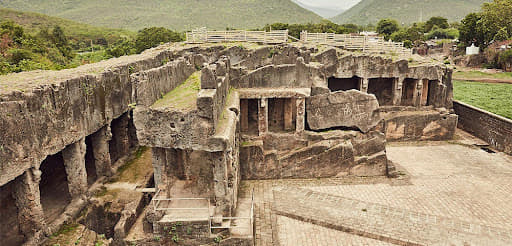
Junagadh Caves
Nasik Caves
- "Pandav Leni" refers to a series of 24 Buddhist caves in Nasik. They were created in the first century A.D. during the Hinayana period.
- Later, though, the Mahayana sect's impact may be seen in these caves.
- His presence is expressed in the hinayana sect through the usage of motifs and symbols such as the throne and footprints.
- Later on, Buddha idols were sculpted inside these caves, indicating Mahayana Buddhism's impact.
- The site also shows a superb water management system, as evidenced by the presence of water tanks carved out of solid rock.

Nasik Caves
Mandapeshwar Caves
- It is also known as Montperir Caves, located in Borivali, near Mumbai, and was built as a Brahmanical cave during the late Gupta dynasty.
- It was later transformed into a Christian cave, however. Sculptures of Natraja, Sada Shiva, and Ardhanarishwara can be seen among the site's ruins.
- Above the cave precincts are the church and its graveyard.

Mandapeshwar Caves
Udayagiri caves
- Caves of Udayagiri (not to be confused with Odisha's Udayagiri-Khandagiri Caves) It's in Madhya Pradesh's Vidisha district.
- It was built under the patronage of Chandragupta II in the early fifth century AD and is known for its numerous sculptures on the hill walls.
- Varaha, or Vishnu's Boar incarnation, is a renowned sculpture.
- One of the earliest Hindu sculptures may be found in the caverns.

Udayagiri caves
Karle Caves
- The Karle caves were built around the beginning of the Christian era, and their pattern is similar to that of the Bhaja caves, although they are larger and more spectacular.
- The Chaitya at Karle is carved 124 feet deep into the rock and is located two miles north of the Bombay-Poona highway.
- Great Chaitya is the most well-known cave (Cave no. 8). It is India's largest rock-cut chaitya.

Karle Caves
Kanheri Caves
- The Kanheri caverns are located near Bombay, and the Kanheri Chaityas follow the Karle Chaitya design.
- There are 109 caverns cut out of basalt rock in this area. The biggest caverns were Chaityas, but the majority were viharas.
- The Mahayana influence is also visible in the caves' outside walls, which depict Buddha images.

Kanheri Caves
Conclusion
Rock-cut architecture is the process of constructing a structure by carving it out of natural rock. This involves removing rock that isn't part of the building until the desired structure is achieved. Indian rock-cut architecture is more diverse and abundant than any other type of rock building seen around the world (more than 1,500 rock-cut structures in India). Furthermore, the sacred nature of Indian rock-cut building is worth mentioning. The Mauryans were masters of cave architecture and are credited as being the forefathers of rock-cut cave architecture.
| Other Relevant Links | |
|---|---|
| Indian Art and Culture | Indian Architecture |
| Art of Indus Valley Civilization | Mauryan Art and Architecture |
| Visual Arts | Mudras of Buddha |
| Post Mauryan Art | Rock-cut architecture |
FAQs
Q1: What is cave architecture?
Answer: Cave architecture refers to structures and artworks created in natural caves, often featuring rock-cut designs that reflect cultural, religious, and artistic significance. These caves are typically used for habitation, meditation, or worship.
Q2: Which are some prominent examples of cave architecture in India?
Answer: Notable examples of cave architecture in India include the Ajanta Caves, Ellora Caves, and the Karla Caves. Each of these sites showcases intricate sculptures, frescoes, and unique architectural styles representing various periods and cultures.
Q3: What are the main characteristics of cave architecture?
Answer: The main characteristics of cave architecture include rock-cut structures, elaborate carvings, detailed frescoes, and the use of natural rock formations to create sanctuaries, monasteries, and halls. These features often reflect the artistic and religious themes of the era.
Q4: How did cave architecture influence Indian art and culture?
Answer: Cave architecture significantly influenced Indian art and culture by serving as a canvas for various artistic expressions, including sculpture and painting. It also played a vital role in the dissemination of religious ideas and practices, particularly Buddhism and Hinduism.
Q5: What materials were typically used in cave architecture?
Answer: Cave architecture primarily utilized local rock types, such as basalt and sandstone. Artisans carved these materials using tools like chisels and hammers, enabling them to create intricate designs and spacious interiors.
MCQs
- What is the primary purpose of cave architecture?
a) Residential
b) Recreational
c) Religious and cultural
d) Agricultural
Answer: (C) See the Explanation
- Which of the following caves is known for its Buddhist rock-cut architecture?
a) Elephanta Caves
b) Ajanta Caves
c) Bhimbetka Caves
d) Badami Caves
Answer: (B) See the Explanation
- What is a common characteristic of cave architecture?
a) Use of bricks
b) Open-air structures
c) Rock-cut designs
d) Wooden beams
Answer: (C) See the Explanation
- Which of the following statements is true about the Ellora Caves?
a) They are exclusively Buddhist.
b) They contain a mixture of Hindu, Jain, and Buddhist temples.
c) They are located in Rajasthan.
d) They are primarily residential.
Answer: (B) See the Explanation
- What influence did cave architecture have on later Indian art forms?
a) It had no influence.
b) It limited artistic expression.
c) It provided a foundation for temple architecture.
d) It promoted only secular art.
Answer: (C) See the Explanation
GS Mains Questions and Model Answers
Q1: Discuss the significance of cave architecture in Indian culture and religion.
Answer: Cave architecture holds immense significance in Indian culture and religion as it embodies the spiritual and artistic aspirations of ancient societies. These caves served not only as places of worship and meditation but also as centers for learning and community gatherings. The intricate carvings and sculptures found in various cave complexes reflect the rich cultural heritage and the syncretism of diverse religious beliefs, particularly Buddhism and Hinduism. Additionally, these caves acted as repositories of art, preserving ancient techniques and styles that continue to influence modern Indian art. The architectural marvel of rock-cut caves exemplifies human ingenuity and adaptability in utilizing natural resources for spiritual expression, making them a vital aspect of India’s historical narrative.
Q2: Analyze the architectural features of the Ajanta Caves and their impact on Indian art.
Answer: The Ajanta Caves are renowned for their exceptional rock-cut architecture, which includes intricately carved chaityas (prayer halls) and viharas (monasteries). Characterized by elaborate sculptures and exquisite frescoes, these caves illustrate the evolution of Buddhist art during the 2nd century BCE to the 6th century CE. The architectural features, such as the use of natural light, intricate carvings depicting Jataka tales, and vibrant wall paintings, have profoundly impacted Indian art. They set a precedent for later temple architecture and mural traditions, influencing artists across centuries. The Ajanta Caves serve as a testament to the artistic brilliance of ancient artisans, showcasing the seamless blend of spirituality and artistry that defines much of Indian culture.
Q3: Evaluate the role of cave architecture in the preservation of cultural heritage in India.
Answer: Cave architecture plays a pivotal role in preserving India's cultural heritage by serving as a tangible link to the past. These rock-cut structures, which house intricate carvings and paintings, provide invaluable insights into the artistic, religious, and social practices of ancient civilizations. They stand as a testament to the skills and creativity of early artisans while embodying the spiritual beliefs of their time. Moreover, cave complexes like the Elephanta and Ajanta Caves have become significant tourist attractions, fostering a sense of national pride and cultural identity. Efforts to conserve and promote these sites contribute to raising awareness about India's rich history and encourage future generations to appreciate and preserve their cultural legacy.
Previous Year Questions on Cave Architecture
1. UPSC CSE 2022
Question: Discuss the architectural features and cultural significance of the Ajanta Caves.
Answer: In this question, candidates are expected to analyze the distinct architectural features of the Ajanta Caves, such as their rock-cut design, detailed frescoes, and sculptures. The answer should also highlight the cultural significance of these caves as centers of Buddhist art and pilgrimage, reflecting the socio-religious context of their time.
2. UPSC CSE 2021
Question: Examine the influence of cave architecture on the development of Indian art forms.
Answer: This question requires candidates to assess how cave architecture has shaped various Indian art forms over time. An analysis of how the techniques and styles developed in cave complexes influenced later temple architecture, sculpture, and painting would be essential. The response should emphasize the continuity of artistic traditions stemming from these ancient structures.
Download the PREPP App and attempt FREE IAS Exam Mock Tests and get complete study material!

Full Test - 04: UPSC CSE Prelims CSAT (Paper-II)
Full Test - 03: UPSC CSE Prelims CSAT (Paper-II)
UPSC CSE Prelims 2026 GS Paper 1 Question Paper (24-May-2026)
UPSC CSE Prelims 2026 CSAT Paper 2 Question Paper (24-May-2026)

17 February 2025 | The Hindu Must Read Articles | Current Affairs

16 February 2026 | The Hindu Must Read Articles | Current Affairs

13 February 2026 | The Hindu Must Read Articles | Current Affairs









Comments