Jain Festivals - Indian Festivals - Art and Culture Notes
Jain festivals take place on specific dates throughout the year. Jain festivals are either tied to life events of tirthankara or are held with the goal of purifying the soul. The five key events in the life of each Tirthankara are often associated with the five major Jain festivals: descent into his mother's womb, birth, renunciation, attainment of omniscience, and final emancipation. This article will explain to you the concepts related to the Jain festivals which will be helpful in Indian Art and Culture preparation for the UPSC Civil service exam.
|
Table of Contents |
Jainism
- Lord Mahavira, the founder of Jainism, popularised the faith in the 6th century B.C.
- Lord Mahavira was the final of the twenty-four great teachers.
- These twenty-four instructors were known as Tirthankaras, or those who had gained all knowledge (Moksha) and preached it to the public while still alive.
- Rishabnatha was the first Tirthankara.
- Although Jainism acknowledged the existence of gods, it ranked them lower than Jina (Mahavira).
- It did not denounce the varna system but rather aimed to minimize the varna order's and the Vedic religion's flaws.
- According to Mahavira, a person is born in higher or lower varna as a result of his or her previous birth's faults or virtues. As a result, Jainism believes in the soul's transmigration and the Karma theory.
Jain Festivals
- In the Jain community, religious festivals are very important.
- They serve as a focal point for communal celebrations as well as an opportunity to demonstrate devotion and earn merit.
- Important days in the Jain calendar are known as parvan, and religious observances such as structured fasting periods and festivals take place on these days.
- Participation in these festivals is voluntary rather than mandatory.
Mahavir Jayanti
- The festival is observed by the Jain community. It is held to commemorate Lord Mahavira's birth anniversary as the 24th Tirthankara and one of Jainism's founders.
- It occurs on the thirteenth day of Chaitra, the month of the rising moon. The festival is marked by pomp and with the saffron flag flying high above all Jain temples.
- Both the Digambaras ('sky clad' or naked) and the Svetambaras ('white clad' or clothed) Jain sects commemorate Mahavira's auspicious birth (khalnayak).
- Mahavira's idol is washed in milk and given a ceremonial bath (abhishek). After that, it is carried in a parade.
- On this day, Jain followers go to Jainism's hallowed sites to revere their religious gurus and tirthankaras.
- The festival is particularly significant in Jain temples such as Kolkata's Parshvanath Temple, Uttar Pradesh's Hastinapur, and Bihar's Pawapuri.
- Gujarat and Rajasthan, where the majority of Jain people live, are also important places to celebrate.

Mahavir Jayanti
Paryushana
- Paryushana is the name of the Jains' annual festival. The Svetambara sect celebrates it for eight days in the month of Bhadrapada (August/September).
- The celebration is held for ten days by the Digambara sect.
- The celebration commemorates the nomadic Jain monks' return to their retreats due to excessive rain and monsoon showers, which make living in forests and caves untenable.
- The ritual visit to the temples or Upashrayas, as well as listening to speeches on the Kalpa Sutra, are part of the festivities.
- The Pratikraman or meditation kriya, is required of the majority of devotees. The event concludes with the Kshamavani (forgiveness day) ceremony.
- Others are requested for forgiveness by uttering "Micchami Dukkadam." It indicates “I'm asking for forgiveness if I've injured you in words or actions, whether intentionally or unintentionally.”

Paryushana Festival
Mahamastakabhisheka
- It is a Jain festival held once every twelve years in the Karnataka town of Shravanabelagola.
- The holy bathing ceremony of Siddha Bahubali, son of Rishabhdev, is held at this festival. Devotees using specially prepared jars spray the concentrated water.
- The statue is bathed in milk, sugarcane juice, and saffron paste, then powders of sandalwood, turmeric, and vermilion are sprinkled on top. Petals, gold and silver coins, and valuable stones are used to make offerings.
- This event is based on the narrative of two step-sons, Bahubali and Bharata, who fought a duel to take over the kingdom of the other.
- Bahubali won the duel, but realised he was about to commit the sin of fratricide and prayed for pardon.
- He escaped to the jungle, shaved his head, and meditated in the bodily abandoning posture (kayotsarga) for so long (said to be twelve months) that creepers and vines wrapped themselves about him, and snakes sought refuge in the anthills that rose up beside him.
- He eventually gained supreme wisdom and was set free (moksha).

Mahamastakabhisheka
Gyana Panchami
- "Gyan Panchami," the most important of all Jain holidays, is also known as "Labh pancham" and "Jnan Panchami."
- This day is also known as Jaya Panchami’, ‘Pandava Panchami’.
- 'Saubhagya Panchami' and 'Labha Panchami' are two names for the same day.
- The event, which takes place on the fifth day following Diwali, is solely for the purpose of getting greater wisdom.
- "Gyana Panchami" is the name given to the fifth day of Kartika. It's known as "Knowledge Day." The Holy Scriptures are presented and revered on this day.
- The inherent light of the inner spirit is known as "Gyan." This light is said to assist humans in distinguishing between good and bad.
- Gyan is also referred to as the 'third eye' or ‘second sun.'
- This inherent inner light is prayed for to ward off ignorance and reveal karma knowledge, therefore wisdom replaces ignorance or folly.

Gyana Panchami
Diwali
- The festival of lights, which takes place in mid-October, is a popular event.
- Mahavira attained nirvana, or moksha, on this day. There is no need to fast. In order to foster prosperity, many Jains make offerings (puja) to Laksmi, the goddess of riches.
- The New Year begins the day after Diwali, when Mahavira's principal student Gautam Swami achieved supreme wisdom, and it also marks the start of the new business year, when merchants open a new set of financial records.

Rangoli Decoration on Diwali
Varshi Tapa or Akshay Tritiya Tapa
- Lord Adinath's one-year fast came to an end when he drank sugarcane juice poured into his cupped hands on Akshaya Tritiya.
- This festival commemorates Rishabhdev, the first Jain Tirthankara, who fasted for a total of 13 months and 13 days. His fasting came to an end on the 3rd day of the light fortnight of the Jain calendar's Vaishakh month.
- Varshi tapa is the name given to those who fast in this manner.
- Jains observe fasting and ascetic austerities, especially at pilgrimage locations such as Palitana (Gujarat).
- On this day, those who practice varshi-tapa, a year-long alternate day of fasting, complete their tapasya by doing parana.
Maun-Agiyara
- The auspicious Jain festival Maun Ekadashi (also known as Maun Agiyaras) falls on the 11th day of the Magshar month (Magshar Sud 11).
- This day is marked by complete silence and fasting.
- Meditation is practiced as well.
- This is the day on which the major events surrounding the 150 Jine Swaras are commemorated via holy recitation. This day is associated with the narrative of Suvrat Shresthi.
- According to Jainism, anyone who does all of the ceremonies outlined in the Jain Philosophy can attain Moksha as Suvrat Sheth, the ultimate happiness.
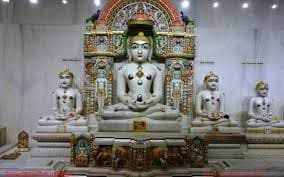
Jain Tirthankara
Navapad Oli
- The Oli is a nine-day period of semi-fasting. During this time, Jains eat only one extremely simple meal every day.
- It appears twice a year, in the months of March-April and September-October.
- Siddha Chakra is another name for Navapda. It is circular, as the name says, and Siddha is at the top.
- Navpad Oli celebrations take place every year. Each of the nine days of the festival is dedicated to one of the nine Siddha Chakra posts. Devotees do Ayambil tap on these days.
- They eat the food and drink boiled water before sunset. They honor Navpad by reading, meditating, and chanting religious melodies for nine days.
Conclusion
In Jainism, there are numerous religious festivals. Some of these are linked to the Panch Kalyanaka, five fortunate life events of Tirthankara. Jains have a number of annual celebrations. The chaumasa era of the calendar coincides with many of Jainism's main festivals. It is during the four-month monsoon season that Jain ascetics are required to stay in one area rather than travelling or roaming about Indian villages and cities, never staying in one place for more than a month, according to Jain tradition. The comasu time allows the Jain community's four orders to come together and share in joyful remembrances.
FAQs
Question: What are the main Jain festivals celebrated in India?
Answer: The main Jain festivals celebrated in India include Paryushana, Mahavir Jayanti, Diwali (as the day of liberation of Lord Mahavira), and Akshaya Tritiya. These festivals are significant for the Jain community and are observed with various rituals, prayers, and celebrations.
Question: What is Paryushana, and how is it observed by Jains?
Answer: Paryushana is one of the most important Jain festivals, typically celebrated in late August or early September. It lasts for eight to ten days and is a time for fasting, reflection, and spiritual rejuvenation. Jains engage in prayer, recite scriptures, and seek forgiveness from others, marking it as a period of penance and introspection.
Question: How is Mahavir Jayanti significant to the Jain community?
Answer: Mahavir Jayanti commemorates the birth of Lord Mahavira, the 24th Tirthankara of Jainism. It is celebrated with great fervor, including processions, prayers, and the chanting of religious hymns. Devotees often visit temples, offer special prayers, and participate in community service, emphasizing Mahavira's teachings of non-violence and truth.
Question: What rituals are performed during the Diwali festival by Jains?
Answer: Jains celebrate Diwali as the day of Lord Mahavira's liberation (moksha). Rituals include performing prayers, lighting lamps, and decorating homes with rangoli. The festival signifies the victory of light over darkness and is a time for family gatherings and sharing sweets.
Question: Why is Akshaya Tritiya important in Jain culture?
Answer: Akshaya Tritiya is considered an auspicious day in Jainism, symbolizing eternal prosperity. It is believed that any religious or charitable act performed on this day yields eternal benefits. Many Jains purchase new items, make donations, and perform rituals to seek blessings and prosperity.
MCQs
1. Which Jain festival is celebrated as the birth anniversary of Lord Mahavira?
A) Diwali
B) Paryushana
C) Mahavir Jayanti
D) Akshaya Tritiya
Answer: (C) See the Explanation
Explanation: Mahavir Jayanti is celebrated as the birth anniversary of Lord Mahavira, the founder of Jainism.
2. What does the festival of Paryushana emphasize for the Jain community?
A) Wealth accumulation
B) Spiritual reflection and forgiveness
C) Agricultural harvest
D) Cultural performances
Answer: (B) See the Explanation
Explanation: Paryushana emphasizes spiritual reflection, penance, and seeking forgiveness among Jains, marking a significant period of introspection.
3. On which day do Jains celebrate Diwali?
A) Day of Mahavira's birth
B) Day of Mahavira's liberation
C) Day of new beginnings
D) Day of harvest
Answer: (B) See the Explanation
Explanation: Jains celebrate Diwali as the day of Lord Mahavira's liberation (moksha), marking it with special prayers and festivities.
4. Which Jain festival is linked to the concept of eternal prosperity?
A) Paryushana
B) Mahavir Jayanti
C) Akshaya Tritiya
D) Diwali
Answer: (C) See the Explanation
Explanation: Akshaya Tritiya is linked to the concept of eternal prosperity, where actions performed on this day are believed to yield everlasting benefits.
5. What is a common practice among Jains during the festival of Paryushana?
A) Planting trees
B) Fasting and prayer
C) Dancing and singing
D) Market fairs
Answer: (B) See the Explanation
Explanation: During Paryushana, Jains commonly engage in fasting and prayer, reflecting on their actions and seeking forgiveness.
GS Mains Questions and Model Answers
Q1: Analyze the significance of Jain festivals in the context of Indian culture and spirituality.
Answer: Jain festivals, such as Paryushana and Mahavir Jayanti, hold great significance in Indian culture, emphasizing principles like non-violence (ahimsa), truth (satya), and compassion (karuna). These festivals foster a sense of community and spiritual reflection among Jains, encouraging them to engage in acts of kindness and self-restraint. They provide an opportunity for devotees to reconnect with their faith and cultural heritage, strengthening their identity within the diverse tapestry of Indian society. The rituals and practices associated with these festivals also contribute to the cultural richness of India, showcasing the harmonious coexistence of various religious traditions.
Q2: Discuss how Jain festivals contribute to the community and social cohesion among Jains.
Answer: Jain festivals play a vital role in promoting community and social cohesion among Jains. During celebrations like Paryushana and Diwali, families and community members come together to participate in rituals, prayers, and feasts, strengthening their bonds. These gatherings foster a sense of belonging and collective identity, encouraging the sharing of traditions and values across generations. Furthermore, the emphasis on charity and helping others during these festivals promotes social responsibility, enhancing the community's reputation for compassion and unity. Such practices cultivate solidarity and mutual support within the Jain community, which is essential for preserving their cultural heritage in a rapidly changing world.
Q3: Evaluate the impact of Jain festivals on promoting environmental awareness and sustainability.
Answer: Jain festivals emphasize principles of non-violence and respect for all living beings, which significantly impacts promoting environmental awareness and sustainability. Events like Paryushana encourage Jains to practice compassion, leading to vegetarianism and a commitment to reducing harm to the environment. Many festivals incorporate eco-friendly practices, such as using biodegradable materials for decorations and engaging in tree plantation drives. By linking their spiritual beliefs with environmental stewardship, Jain festivals inspire broader awareness about the importance of protecting nature and encourage sustainable living practices within the community. This alignment between spiritual values and environmental consciousness contributes positively to ecological sustainability in society.
Previous Year Questions on Jain Festivals
1. UPSC CSE Prelims 2021:
Question: Which festival is celebrated by Jains as the day of Lord Mahavira's liberation?
A) Diwali
B) Paryushana
C) Mahavir Jayanti
D) Akshaya Tritiya
Answer: (A)
Explanation: Jains celebrate Diwali as the day of Lord Mahavira's liberation (moksha), marking it with prayers and festivities.
2. UPSC CSE Mains 2020 (GS Paper 1):
Question: "Assess the cultural and spiritual significance of Jain festivals in contemporary Indian society."
Answer: Jain festivals hold cultural and spiritual significance in contemporary Indian society by promoting core values of Jainism such as non-violence, truth, and compassion. These festivals encourage community participation, foster social bonds, and serve as platforms for imparting teachings of Jain philosophy to younger generations. They also highlight the relevance of environmental consciousness through rituals that emphasize harmony with nature. In a rapidly changing society, these festivals act as a reminder of the importance of maintaining ethical practices and sustainable living, contributing to the diverse cultural landscape of India while reinforcing the identity of the Jain community.
Download the PREPP App and attempt FREE IAS Exam Mock Tests and get complete study material!

Full Test - 04: UPSC CSE Prelims CSAT (Paper-II)
Full Test - 03: UPSC CSE Prelims CSAT (Paper-II)
UPSC CSE Prelims 2026 CSAT Paper 2 Question Paper (24-May-2026)
UPSC CSE Prelims 2026 GS Paper 1 Question Paper (24-May-2026)

17 February 2025 | The Hindu Must Read Articles | Current Affairs

16 February 2026 | The Hindu Must Read Articles | Current Affairs

13 February 2026 | The Hindu Must Read Articles | Current Affairs









Comments