Indian Cinema - Art and Culture Notes
Indian cinema is known for producing the largest number of films in the world. India has one of Asia's largest film industries and employs thousands of people. The Indian film industry makes films in Hindi, Telugu, Tamil, Bhojpuri, and other languages. According to a 2014 survey, India produces nearly 3000 celluloid films, which are further classified as around 1000 short films and 1969 feature films. Mumbai, Chennai, Hyderabad, Kolkata, New Delhi, Amritsar, Thiruvananthapuram-Kochi, Bangalore, Bhubaneswar-Cuttack, and Guwahati are the country's major film production centers. This article will explain to you the concepts related to Indian Cinema Which will be helpful in Indian Art and Culture preparation for the UPSC Civil service exam.
Indian Cinema
- The majority of post-independence films have formed our identity as a country and as individuals living in India.
- They have aided us in portraying and comprehending Indians' economical and political existence, as well as how it has changed over time.
- The majority of scientific research reveals that films have a profound impact on the common man's psyche, and that people identify with the hero heroine and empathize with their characters as if they were real people.
- It is not only three hours of fun, but also something that people normally keep with them and like to be associated with.
- In most circumstances, there are two types of cinema: one for enjoyment and the other, known as 'alternative' or 'parallel' cinema, for depicting the reality of everyday life.
- It is not only available in major cities, but it has also spread to rural areas and smaller towns.

Various Indian Cinema posters
|
|
|
|---|---|
| South Indian Cinema | Central Board of Film Certification |
| Indian Cinematography Act of 1952 | Indian calendar |
Indian Cinema - Historical Background
- The Lumiere Brothers, known as the inventors of the Cinematograph, introduced motion pictures to India.
- In 1896, they showed six soundless short films in Bombay, which captivated the crowd.
- Coconut Fair and Our Indian Empire was the first film, shot in 1897 by an anonymous photographer.
- Colorello and Cornaglia, an Italian duo, began the next significant attempt with a tent display at the Azad Maidan in Bombay.
- In 1898, a slew of short films, including The Death of Nelson, Call on the London Fire Brigade, and Noah's Ark were shown in Bombay.
- However, these were all foreign ventures centered on the British or their Indian empire.
- Harishchandra Bhatvadekar, often known as Save Dada, was the first Indian to make a motion picture.
- In 1899, he created two short films and showed them to the public using the Edison Projecting Kinetoscope.
- There were few Indian filmmakers in the early 1900s, but F.B Thanawalla, who directed Taboot Procession and Splendid New Views of Bombay, was one of them.
- Apart from him, Hiralal Sen was well-known for his 1903 picture Indian Life and Scenes.
- The market for these films grew slowly, and because they were only on display for a short time, there was a pressing need for a theatre.
- Major Warwick, who opened the first film house in Madras (now Chennai) in 1900, met this need.
- Jamshedjee Madan, afterward a wealthy Indian businessman, founded the Elphinstone Picture House in Calcutta (now Kolkata) in 1907.
- In 1916, Universal Studios opened the first Hollywood-based agency in India, recognizing the potential benefits in the growing Indian market.
The era of Silent Films
- Silent films dominated the decade from 1910 to 1920.
- Despite the fact that they were labeled silent films, they were not completely silent and were accompanied by music and dance.
- They were accompanied by live musical instruments such as the sarangi, tabla, harmonium, and violin even when they were screened in theatres.
- N.G Chitre and R. G Torney created the first Indo-British silent film collaboration in 1912. Pundalik was the title of their film.
- The first indigenous Indian silent film, Raja Harishchandra, was produced by Dadasaheb Phalke in 1913.
- He is credited with films such as Mohini Bhasmasur and Satyavan Savitri, and is hailed as the "Father of Indian Cinema."
- In 1917, he is also credited with directing the first box office hit, Lanka Dahan.
- The creation of two film firms, Kohinoor Film Company and Dadasaheb Phalke's Hindustan Cinema Films Company, accelerated the pace of filmmaking in 1918.
- When films began to generate a substantial profit, the government levied a 'Entertainment tax' in Calcutta in 1922 and Bombay the following year.
- Many filmmakers, including Baburao Painter, Suchet Singh, and V. Shantaram, were given opportunities by the film firms.
- Because this was the beginning of Indian cinema, the filmmakers experimented with a variety of subjects. Mythology and history were the most popular subjects, as stories from history and folklore appealed to the audience's sense of shared history.
- Some writers and directors, such as V. Shantaram, made films about social issues, such as Amar Jyoti, a film about women's emancipation.
- There were very few notable female filmmakers during this time period. Fatima Begum was the first Indian woman to produce and direct her own film, Bulbul-e-Parastan, in 1926.
- The first film censorship controversy occurred in Madras in 1921, when the film Bhakta Vidhur was banned.
- Madan's Nala Damayanti was one of the most popular films produced in collaboration with Italy.
- Himanshu Ray, who directed successful films such as A Throw of Dice and Prem Sanyas, relied on Indo-German funding.

Scene from the Movie Raja Harischandra
The Golden age of Talkies
- Alam Ara, directed by Ardeshir Irani and produced by the Imperial Film Company, was the first talking film. In 1931, it was shown at Bombay's Majestic Cinema.
- W.M. Khan, India's first singer, wrote a few famous songs for this film, including De de khuda ke naam par, which was the first recorded song in Indian cinematic history.
- While talkies were able to spark a revolution that effectively ended silent film production, they were plagued by technological difficulties.
- Because there were no pre-recording facilities in the 1930s, the movies could not have dialogue writers, and even the songs had to be sung live during the filming.
- In the late 1930s, several major studios developed, including Bombay Talkies, New Theatres, and Prabhat, which were also responsible for the introduction of the Studio System.
- P.C Barua's Devdas was the first film to use the studio system, which was released in 1935.
- The production houses began to experiment with the subject of the films as well as the style of production.
- This experimentation resulted in the creation of colour films, such as Sairandhri, made by Prabhat in 1933 and considered to be the first Indian colour film, but it was processed and printed in Germany.
- Films such as Kisan Kanya, produced by Ardashir Irani in 1937, have the distinction of being the first indigenously produced colour film.
- Among the other notable films were:
| Year | Person | Movie | Description |
|---|---|---|---|
| 1935 | J.B.H Wadia and Homi Wadia | Hunterwali Toofan Mail Punjab Mail Flying Rani | These were the first stunt films made in India. They had an Australian actress named Mary Evans, who earned the nickname 'Fearless Nadia' in India. |
| 1937 | J.B.H Wadia | Naujawan | It was the first film without any songs |
| 1939 | K. Subrahmanyam | Premsagar | It was the first South Indian film |
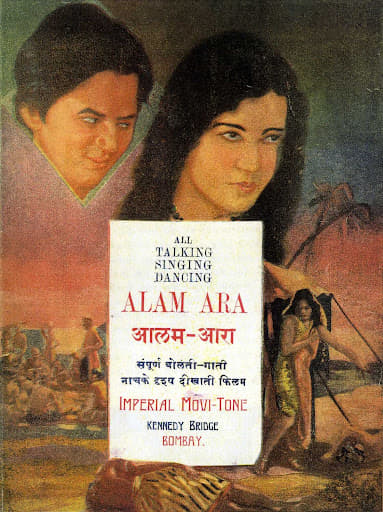
Poster of the movie Alam Ara
Indian Cinema in the 1940s
- The 1940s were a time of turbulence in Indian politics, which was mirrored in the films made during the time.
- Independence fervor was depicted in films such as Dharti ke Lal, Do Aankhen Barah Haath, and others. Chandralekha, Laila Majnu, Sikander, Chitralekha, and other films based on tragic love stories and fake historical narratives have been made.
- Despite the fact that India was experiencing post-independence problems, the film industry was booming.
- There were various films about societal themes, like Chetan Anand's Neecha Nagar, Mehboob's Aurat, and Sohrab Modi's Pukar, among others.
- This period was dominated by the very talented lyricist V. Shantaram, who wrote legendary films such as Dr. Kotnis ki Atma Katha, Pinjra, Padosi, Geet Gaya Patharon Ne, and others.
- Another notable development was the Kapoor family's establishment of RK Films in 1948. The premiere of their first film, Aag, coincided with the launch of their production company.
Indian Cinema in the 1950s - Coming of Age
- The Central Board of Film Certification was founded in the 1950s to control the content of the enormous number of films being made in both north and south India.
- During this time, 'film stars' rose to unparalleled levels of prominence and became household names.
- During this time, the 'trinity' of Hindi cinema—Dilip Kumar, Dev Anand, and Raj Kapoor—arose.
- Sohrab Modi's Jhansi Ki Rani was the first technicolor picture, released in 1953.
- This was also the time when India became a popular destination for international film festivals. In 1952, Bombay hosted the first International Film Festival of India (IFFI).
- More Indian films were able to attain international attention as a result of this. Do Bigha Zameen, directed by Bimal Roy, was the first Indian film to receive an award at the Cannes Film Festival.
- Satyajit Ray's Pather Panchali was another well-known film to win a Cannes award.
- Mother India was nominated for an Oscar Award in 1957 for Best Foreign Language Film.
- The National Film Awards were established by the Indian government in response to the international situation, and the inaugural award was handed to the feature film Shyamchi Aai.
- Mahabalipuram, directed by Jagat Murari, won the prize for a best short film.
- Sohrab Modi's film Mirza Ghalib was the first to earn the President's Gold Medal in 1954.
- Other notable works of this time include:
| Year | Movie by | Movie | Description |
|---|---|---|---|
| 1954 | S.K.Ojha | Naaz | It was the first film to shoot at a foreign location |
| 1957 | K.A. Abbas | Pardesi | It was the first Indo-Soviet collaboration |
| 1958 | Guru Dutt | Kagaz Ke Phool | It was the first Indian film in cinemascope |

Scene from the movie Pather Panchali
Indian Cinema in the 1960s - The Golden Era
- In the 1960s, the music industry became a vital aspect of the cinema industry.
- Several films have begun to use music as a unique selling point.
- Jis Desh Mein Ganga Behti hai, starring Raj Kapoor, Dev Anand's Guide, Yash Chopra's Waqt, and others were prominent.
- During this time, there were two wars, one in 1962 and the other is 1965, which were the subject of several nationalistic films.
- With the emergence of the film business, there was a need for a training school to educate the different personnel involved in the complex filmmaking process.
- The government used this motivation to build the Film and Television Institute of India in Pune in 1960.
- This institute honed the skills of writers, directors, and actors.
- Dadasaheb Phalke, the doyen of Indian cinema and theatre, died in 1969, and the Dadasaheb Phalke Award for lifetime achievement was established in his honour.

Dadasaheb Phalke Award
Indian Cinema (1970-80) - Angry Young Man Phase
- The requirement to develop and direct film around the young man who was establishing his feet in industrial Bombay dominated this period.
- The winning technique was to tell "rags to riches" stories that allowed people to live out their fantasies on film.
- Amitabh Bachchan became the face of most of these films, and this period is known as the 'Amitabh Bachchan era.'
- Zanjeer, Agnipath, Amar Akbar, and Anthony are just a few of his successful films.
- Another popular genre during this time was horror films, which the Ramsay Brothers pioneered with films like Do Gaz Zameen ke Neeche.
- Other filmmakers picked up on this, and the Censor Board coined the term "B-grade" movies to describe the genre, which mixed horror and erotica.
- There was also a flurry of religious films focusing on the lives and notable occurrences of goddesses such as Jai Santoshi Maa and others.
- Other films worth mentioning include the legendary Sholay, which was the first film to be shot in 70 mm. It shattered all previous records and remained the longest-running film in theatres until the 1990s.
- The storyline and dialogues for this legendary film were written by Kaifi Azmi and Javed Akhtar.
- Kaifi Azmi is also credited with being the first person to write a complete film with rhymed lyrics.
- Heer Ranjha was the title of this film, which was based on a Punjabi love story.
Indian Cinema (1980-2000) - Phase of Romantic Cinema
- From 1980 onwards, the face of Indian cinema evolved dramatically.
- There was a recent flurry of films that dealt with social themes. Romantic comedies and family dramas often drew large crowds.
- Anil Kapoor, Jackie Shroff, and Govinda were three of the most famous actors of the time.
- They appeared in blockbusters such as Tezaab, Ram Lakhan, Phool aur Kante, Hum, and others.
- Films like Baazigar and Darr, which catapulted Shah Rukh Khan's celebrity, ushered in the birth of the "antihero" in the late 1980s.
- People had more access to films and televisions after the introduction of Liberalisation, Globalisation, and Privatisation (LPG) in the 1990s.
- As more money flowed in through foreign corporations, the industry was revolutionized.
- Films about wealthy urban teenagers were in high demand.
- Filmmakers like Aditya Chopra capitalized on this demand with films like Dilwale Dulhania Le Jayenge, Dil to Pagal Hai, and others.
- During this time, the Khans — Shahrukh Khan, Salman Khan, and Aamir Khan – became the second trinity of Indian cinema, which now dominates Bollywood.
- Liberalization, Globalisation, and Privatisation (LPG) made it possible for superior technology to reach India.
- My Dear Kuttichathan, for example, was India's first 3D film, produced in Malayalam. Chhota Chetan was the Hindi title for this film.
- Another important technology was the Dolby sound system, which was presented to the Indian audience through Vidhu Vinod Chopra's film 1942 - A Love Story.
- Filmmakers such as Gurinder Chadha and Shekhar Kapur have collaborated internationally on films such as Bend it Like Beckham, Bride and Prejudice, and Elizabeth.
- Imtiaz Ali, Raju Hirani, Sanjay Leela Bhansali, and Karan Johar are among the most well-known filmmakers in the industry.
- Irfan Khan, Nawazuddin Siddiqui, and other actors who are not conventionally attractive but can act well have been ruling the industry.

My Dear Kuttichathan
The Parallel Cinema
- Since the late 1940s, there has always been a parallel industry producing hard-hitting films whose main objective was to make good cinema and experiment with the art, even if they were not commercially viable.
- This movement began in regional film in 1969 with the release of Mrinal Sen's Bhuvan Shome.
- This ushered in a new phase of 'new cinema,' which emphasized aesthetic excellence and a humanitarian perspective in contrast to popular mainstream cinema's fantasy-based world.
- The following factors contributed to the emergence of parallel cinema in India:
- To begin with, after World War II, the global trend changed toward neo-realism and the representation of human flaws.
- This was represented in Indian cinema with notable films like Mother India, Shree 420, and others that focused on social issues.
- There was now a multitude of organizations dedicated to the study of films, such as the National Film Archive of India, which opened in 1964, and the Film and Television Institute of India (FTII).
- Finally, as India became a hotspot for international film festivals, an increasing number of Indian directors had access to worldwide cinematic trends, which they replicated in their own work.
- Satyajit Ray, who directed the Appu Trilogy (PatherPanchali, Apur Sansar, and Aparajito), was the most well-known figure in the parallel cinema movement.
- Other notable figures include Ritwik Ghatak, whose films Nagarik, Aajantrik, and Meghe Dhaka Tara focused on the difficulties of the lower middle class.
- In the 1980s, parallel films began to emphasize the importance of women's roles.
- During this time, a number of female filmmakers rose to prominence. Sai Paranjpye (Chashme Baddoor, Sparsh), Kalpana Lajmi (Ek Pal), and Aparna Sen (36 Chowringhee Lane) are among the most renowned.
- Some received international fame, such as Meera Nair, whose film Salaam Bombay won the Golden Cannes Award in 1989.
- The majority of these films focused on the changing role of women in society.
Role of women in Indian Cinema
- With the passage of time, the image of women in cinema has evolved.
- During the silent film era, filmmakers focused on the limitations placed on a woman's existence.
- During the 1920s and 1940s, most directors such as V. Shantaram, Dhiren Ganguli, and Baburao Painter made films about women's emancipation themes such as child marriage bans, sati abolition, and so on.
- Slowly, the cinematic approach shifted to include widow remarriage, women's education, and the right to equal pay for women in the workplace.
- During the 1960s and 1980s, Hollywood's portrayal of women was exceedingly stereotyped.
- They exalted motherhood, fidelity among women, and making outrageous sacrifices for her family while depicting the heroine or the 'perfect lady.'
- In contrast to the heroine, the antiheroine, or vamp, was created by the filmmakers. She was shown to drink, have affairs with married men, and be cruel or unscrupulous in her behavior.
- Only in alternative cinema have filmmakers with a strong desire to promote women's liberation shown us an Indian woman's life. Satyajit Ray, Ritwik Ghatak, Guru Dutt, Shyam Bengal, and others are notable directors in this genre.
- The image of a modern woman who works for a living has a child and a profession to manage, and is still striving to establish her own footing is also being explored in today's cinema.
South Indian Cinema
- The term "South Indian cinema" refers to the five film industries of South India: Tamil, Telugu, Kannada, Malayalam, and Tulu (Coastal Karnataka) as a single entity.
- The Telugu and Tamil cinema industries are the two largest among them.
- While Kannada and Telugu films mostly target home audiences, Tamil and Malayalam films have a sizable international following.
- Themes from many classics of literature, mythology, and folklore have been incorporated into South Indian cinema.
- Telugu cinema produced a slew of mythological-themed films.
- In Andhra Pradesh, epic stories such as the Ramayana and the Mahabharata are immensely popular.
- N.T. Rama Rao was most known for his depictions of Krishna, Rama, Shiva, Arjuna, and Bhima in films. In his career, NTR played Krishna in 17 films. He went on to be a successful politician.
- In Kannada and Tamil cinema, mythological myths are also represented.
- The iconic actor Rajkumar played the protagonist in the Kannada mythological flicks 'Babruvahana' and 'Ramanjaneya Yuddha.'
- The Tamil film 'Tiruvilaiyadal,' directed by the acclaimed A.P. Nagarajan, was a huge success. The legendary actor Shivaji Ganeshan played Shiva in that masterpiece with tremendous finesse.
- South Indian cinema, on the other hand, is dominated by films about socioeconomic themes.

South Indian Movies
*For detailed notes on this topic, check this link South Indian Cinema
Indian Cinematograph Act of 1952
- The Indian Cinematograph Act, of 1952 was enacted by the Indian government to regulate film certification.
- The Act's main purpose was to formalize the establishment and operation of the Central Board of Film Certification (CBFC), also known as the "Censor Board of India."
- The Act calls for the Central Government to elect a Chairman of the Censor Board as well as a team of people (no less than twelve and no more than twenty-five) to assist the Chairman in his duties.
- The Board must review a film and determine whether or not it should be screened because it offends a specific geographic area, age range, religious affiliation, or political group.
- It can also instruct the film's applicant to make changes and deletions to the film before issuing a certificate.
- If these alterations are not made, the Censor Board may refuse to allow the film to be shown in public.
- Although the Central Government is responsible for film certification, state governments are responsible for enforcing censorship in their individual jurisdictions.
- In India, films are classified into four categories. They are as follows:
- U – It stands for "universal exhibition"
- A – Restricted to the adult audience only
- UA – Unrestricted public exhibition, but with a parental discretion warning for children under the age of twelve.
- S – Public exhibition for a specific group of people like doctors, engineers, etc.
- The CBFC is a well-organized organization with a Chairman and governing members nominated by the government's Ministry of Information and Broadcasting.
- According to the government regulation, they can be appointed for a period of three years or longer. Members are usually well-known and brilliant film business figures or other academics.
- In their regional office, they also have an advisory group led by regional officers.
- There are two-tier committees that can be consulted in the event of a disagreement between the filmmakers and the Censor Board.
- The Examining Committee and the Revising Committee are the two committees.
- A Censor Board certificate is required for all films. Even international films that are imported into India must be certified by the CBFC.
- All films that are dubbed from one language to another must obtain a new certificate to guarantee that the change in language is not inappropriate in any way.
- The only exception to the CBFC certificate is films made specifically for Doordarshan, which is the government of India's official broadcaster and has its own set of rules for examining such films.
- Television shows and serials are also exempt from CBFC certification.
- The Government of India established the Shyam Benegal Committee in 2016 to establish film certification standards that take into account best practices from around the world and provide sufficient and acceptable scope for artistic and creative expression.

Central Board of Film Certification
*For detailed notes on this topic, check this link Indian Cinematograph Act of 1952
Recent Controversies
- Bandit Queen, one of Shekhar Kapoor's most divisive films, was released in 1994. This film was banned by the Censor Board due to its nudity and filthy material.
- The Indian government has banned several films for offending religious feelings. The film Messenger of God, directed by Baba Ram Rahim, wreaked havoc in parts of North India in 2014.
- Similarly, Muslim organizations in Tamil Nadu have organized protests against Kamal Haasan's Vishwaroopam, claiming that it offends their religious sensitivities.
- Nonetheless, the Censor Board of India gave it the green light, and the film was released despite reports of violence.
- The film Parzania (2005) was inspired by the Gujarat riots. Despite winning a National Award, it was only shown in Gujarat and a few places in India.
- A social perspective of the outrage around the film Padmavati raises some important questions about societal perceptions and the status of women in India.
- The Ministry of Information and Broadcasting recently requested public feedback on the draft Cinematograph (Amendment) Bill, 2021, which intends to restore the Central Board of Film Certification's "revisionary powers."
- The new bill would also "improve the effectiveness of the process of certifying films for screening in light of changing circumstances and reduce the threat of piracy."
National Film Policy
- Considering India has the world's largest film production industry, it appears that a national film policy is required.
- Every year, over a thousand films are produced, with a major contribution to India's GDP.
- The film industry is caught in a paradox: its expansion is unchecked, but the content of the films produced is strictly regulated by the government through the Censor Board.
- As a result, for long-term growth, the government's participation should be limited.
- Regional film is increasingly being pushed to the margins, and a policy is needed to bring it up to the level with mainstream Hindi movies.
- The art of filmmaking and photography should be taught, and other film schools along the lines of the Film and Television Institute of India (FTII) should be established.
- There is a need for Indian cinema to be promoted globally, and a national policy can help guide it in the right direction.
- A national film policy can ensure that incentives are provided for content digitization.
- New guidelines for censorship issues are required to keep up with the changing socio-cultural scenario.
- Because Internet piracy is the industry's most serious concern, amendments to prohibit piracy are required.
- Strict punitive and monetary sanctions would be effective against the offenders.
Conclusion
The business is divided into sections based on language, with the Hindi film industry (Bollywood), Tamil film industry (Kollywood), and Telugu film industry (Tollywood) being the most popular. Malayalam, Kannada, Bengali, Marathi, and Punjabi are some of the most well-known film industries. By 2020, all other regional film industries' revenue will have surpassed that of the Hindi film industry. The Indian film industry is a multibillion-dollar industry. Its films have been seen in over 90 countries across Southern Asia, Europe, North America, Asia, the Greater Middle East, Eastern Africa, China, and elsewhere.
FAQs
Question: What is the significance of Indian cinema in global film history?
Answer: Indian cinema, particularly Bollywood, holds a significant place in global film history as one of the largest film industries in the world. Indian films are known for their diversity in genres, languages, and storytelling techniques, and have influenced international cinema through their unique narrative style and vibrant musical numbers.
Question: Who is considered the father of Indian cinema?
Answer: Dadasaheb Phalke is considered the father of Indian cinema. His 1913 silent film, "Raja Harishchandra," marked the beginning of Indian cinema, and he went on to make several landmark films during his career.
Question: What are the major film industries within Indian cinema?
Answer: Indian cinema comprises several regional film industries, with Bollywood (Hindi cinema) being the largest. Other major industries include Tollywood (Telugu cinema), Kollywood (Tamil cinema), and the film industries in Bengali, Malayalam, Kannada, and Marathi languages.
Question: How has Indian cinema contributed to social change?
Answer: Indian cinema has contributed to social change by addressing issues such as gender inequality, caste discrimination, and political corruption. Films like "Mother India" and "Gandhi" have played important roles in raising awareness and inspiring societal reforms.
Question: What is the role of music in Indian cinema?
Answer: Music is an integral part of Indian cinema, particularly in Bollywood films. Songs are often used to advance the narrative, express emotions, and entertain audiences. Many Indian films are famous for their soundtracks, which become popular independently of the films themselves.
MCQs
1. Who directed the first full-length Indian feature film, "Raja Harishchandra"?
A. Bimal Roy
B. Guru Dutt
C. Dadasaheb Phalke
D. Raj Kapoor
Answer: (C) See the Explanation
Dadasaheb Phalke directed the first full-length Indian feature film, "Raja Harishchandra," in 1913, which marked the beginning of the Indian film industry.
2. Which Indian film was the first to be nominated for an Academy Award?
A. Lagaan
B. Mother India
C. Salaam Bombay
D. Pather Panchali
Answer: (B) See the Explanation
"Mother India," directed by Mehboob Khan, was the first Indian film to be nominated for an Academy Award in the Best Foreign Language Film category in 1957.
3. Which regional film industry is referred to as "Kollywood"?
A. Tamil cinema
B. Telugu cinema
C. Kannada cinema
D. Malayalam cinema
Answer: (A) See the Explanation
"Kollywood" refers to the Tamil film industry, based in Chennai, Tamil Nadu. It is one of the largest and most influential regional film industries in India.
4. Which of the following films is considered a milestone in Indian parallel cinema?
A. Sholay
B. Pather Panchali
C. Dilwale Dulhania Le Jayenge
D. Mughal-e-Azam
Answer: (B) See the Explanation
"Pather Panchali" (1955), directed by Satyajit Ray, is considered a milestone in Indian parallel cinema, a movement focused on realistic and socially relevant films.
5. What is the highest honor in Indian cinema, awarded for lifetime contribution?
A. Filmfare Award
B. National Film Award
C. Dadasaheb Phalke Award
D. Padma Shri
Answer: (C) See the Explanation
The Dadasaheb Phalke Award is the highest honor in Indian cinema, awarded for lifetime contribution to the growth and development of Indian cinema.
GS Mains Questions and Model Answers
1. Analyze the role of Indian cinema in shaping cultural identity and fostering national integration.
Answer: Indian cinema plays a significant role in shaping cultural identity and fostering national integration. Films in multiple languages and genres represent the diversity of India, while Bollywood, as the largest film industry, unites audiences across the country. Films like "Mother India" and "Lagaan" have depicted themes of unity, resilience, and patriotism, contributing to a sense of national pride. Furthermore, regional cinemas bring local cultures and issues to the national platform, promoting understanding and cohesion among India's diverse communities.
2. Discuss the impact of Indian cinema on international perceptions of India.
Answer: Indian cinema, particularly Bollywood, has had a profound impact on international perceptions of India. Films like "Slumdog Millionaire" and "Lagaan" have introduced global audiences to Indian culture, traditions, and social issues. While Bollywood's musical extravaganzas are often what most foreigners associate with India, films from Indian parallel cinema, such as Satyajit Ray's "Apu Trilogy," have garnered international acclaim for their artistic depth. The success of Indian films at international festivals has helped bridge cultural gaps and showcase India as a country rich in history, art, and cinematic talent.
3. Examine the role of censorship in Indian cinema and its impact on creative expression.
Answer: Censorship in Indian cinema, enforced by the Central Board of Film Certification (CBFC), plays a critical role in regulating content that may offend social, religious, or political sentiments. While censorship ensures that films do not incite violence or disturb public peace, it has often been criticized for curbing creative freedom. Filmmakers face challenges in addressing controversial topics such as politics, religion, and sexuality. The balance between freedom of expression and maintaining social harmony remains a contentious issue, influencing the types of stories told in Indian cinema.
Previous Year Questions on Indian Cinema
1. UPSC CSE Prelims 2019
Question: Which Indian film was nominated for the Academy Award for Best Foreign Language Film in 1957?
A. Salaam Bombay
B. Pather Panchali
C. Mother India
D. Lagaan
Answer: C
Explanation: "Mother India" was the first Indian film to be nominated for an Academy Award in the Best Foreign Language Film category in 1957.
2. UPSC CSE Mains 2017 (GS Paper 1)
Question: "Indian cinema has evolved from a tool for entertainment to a medium of social change." Discuss with examples.
Answer: Indian cinema has significantly evolved from being a source of entertainment to becoming a powerful medium for social change. Films like "Mother India" and "Salaam Bombay" have highlighted issues such as poverty, gender inequality, and rural hardships. Contemporary films like "Pink" and "Article 15" address issues related to women's rights and caste discrimination, influencing public discourse and contributing to societal reform. Cinema has become a tool for raising awareness and inspiring action on critical social issues in India.
Download the PREPP App and attempt FREE IAS Exam Mock Tests and get complete study material!

Full Test - 04: UPSC CSE Prelims CSAT (Paper-II)
Full Test - 03: UPSC CSE Prelims CSAT (Paper-II)
UPSC CSE Prelims 2026 GS Paper 1 Question Paper (24-May-2026)
UPSC CSE Prelims 2026 CSAT Paper 2 Question Paper (24-May-2026)

17 February 2025 | The Hindu Must Read Articles | Current Affairs

16 February 2026 | The Hindu Must Read Articles | Current Affairs

13 February 2026 | The Hindu Must Read Articles | Current Affairs









Comments