Indian Forest Types - Environment Notes
India has a rich forest diversity. India's entire forest and tree cover has increased to 24.56 % of its overall geographical area. Coniferous forests, evergreen forests, wet evergreen forests, deciduous forests, broadleaved forests and mangrove forests are the most important types of forests. This article will explain to you about Indian Forest Types which will be helpful in preparing the Environment syllabus for the UPSC Civil service exam.
Forest- Definition
- There is no precise national definition of 'forest' in India at the moment.
- States are in charge of defining what constitutes a forest.
- The T.N. Godavarman Thirumulkpad vs the Union of India decision of the Supreme Court in 1996 established the states' right to define forests.
- The Supreme Court decided that the word "forest" must be interpreted in accordance with its "dictionary definition."
- This definition applies to all legally recognized forests, regardless of whether they are designated as reserved, protected, or otherwise.
Champion and Seth Classification of Forest
- Sir HG Champion categorized India's forest types for the first time in 1936, in his massive work 'Preliminary Survey of Forest Type of India and Burma'.
- In 1968, Champion and Seth released 'A Revised Survey of the Forest Kinds of India'.
- Climate, physiognomy, species composition, phenology, terrain, soil variables, altitude, aspect, and biotic factors are all used to classify forest types in India.
- From tropical to alpine, the forests have been divided into six "major groupings."
- These major groupings were further divided into 16 sub-groups based on temperature and moisture regimes.

Types of Indian Forests
-
Tropical Wet Evergreen Forests
Tropical Wet Evergreen Forests
- Tropical wet evergreen forests can be found in the southern states of Maharashtra, Karnataka, Tamil Nadu, Kerala, and the Andaman and Nicobar Islands, as well as the entire northeastern region, including West Bengal's sub-mountain division.
- The annual rainfall is more than 250 cm.
- The average annual temperature is between 25 and 27 degrees Celsius.
- The average annual humidity is around 77 percent, and the dry season is only a few months long.
- They have scant undergrowth with clearings in between.
- They don't have a lot of litter (organic matter settling on the ground).
- Mahogany, mesua, white cedar, jamun, canes, bamboo, and other valuable species can be found in these forests.
*To know more about the topic, click this link Tropical Wet Evergreen Forests
-
Tropical Semi-Evergreen Forests
Tropical Semi-Evergreen Forests
- Tropical Semi-Evergreen Forests are basically classified as a transitional type of forest between tropical wet evergreen and tropical deciduous forests. In comparison to tropical wet evergreen forests, these are drier places.
- The tropical semi-evergreen forests are distributed on the Western coast, Assam, the lower slopes of the Eastern Himalayas, Odisha, and Andaman Island.
- The average annual rainfall is 200-250 cm.
- The average yearly temperature ranges from 24 to 27 degrees Celsius.
- Teak, Jamun, cashew, hog plum, coral tree, jasmine, and crossandra are some of the indigenous and exotic tree and plant species found in this forest.
- Indian Leopard, Indian- giant Squirrel, Lemur, Deer, One-Horned Rhinos, Birds, Great Horn Bill, Bats, Sloth, Scorpions, Snails are prominent here.

Vulnerable One-Horned Rhinos
*To know more about the topic, click this link Tropical Semi-Evergreen Forests
-
Tropical Moist Deciduous Forests
Tropical Moist Deciduous Forests
- Tropical moist deciduous forests are one of the most common forests in India.
- Except in the western and northwestern parts of India, moist deciduous forests may be found practically everywhere.
- These forests can be found in places with rainfall ranging from 100 to 200 cm.
- Since topsoil is frequently washed away driven by strong rains, these forests may have poor soil.
- The Sal, as well as other species such as Adina Cardifolia (Kusum), Xylia Xylocarpa, Anogeissus Iatifolia (Dhau), and Machilus Villosa, congregate in the hetrogeneous deciduous zone.
- The Hoolok Gibbon, (also known as Yongmu) the only ape in India, is found in the tropical moist deciduous forests of Manipur.
- The tropical moist deciduous forests are one of the best forests in terms of export, import, and revenue, according to India's economic resource pooling.

Endangered Hoolok Gibbon
*To know more about the topic, click this link Tropical Moist Deciduous Forests
-
Littoral and Swamp
Littoral and Swamp
- Littoral and Swamp Forests are abundant throughout India.
- They're mostly found in Deccan Plateau reservoirs, Gujarat's saline coast, Rajasthan's saline coast, the Gulf of Kutch, Eastern Coast Deltas, Kashmir's lakes and rivers, and North East India's swamps.
- Swamp forests form where inadequate drainage and permanent soil waterlogging are caused by topography.
- Due to this obvious unique hydrologic environment, plant debris tends to accumulate on the forest floor, where it can contribute to the creation of thick peat deposits over time.
- The majority of the trees are evergreen. During low tides, they usually produce tangled webs of arching roots that are visible.
- The mangrove ecosystem is extremely productive, providing shelter and a nursery for a variety of fish species as well as other animals in the vicinity.
*To know more about the topic, click this link Littoral and Swamp
-
Tropical Dry Deciduous Forest
Tropical Dry Deciduous Forest
- The tropical moist deciduous forests are one of the best forests in terms of export, import, and revenue, according to India's economic resource pooling.
- The dry deciduous forests of India are predominantly found in North India and the Deccan Plateau's southern parts.
- They can also be found in the plains of Bihar, Uttar Pradesh, and the Peninsular plateau's northeastern regions.
- The soil of tropical dry deciduous forests are generally nutrient-poor.
- Teak (Tectona grandis), coromandel ebony (Diospyros melanoxylon), dhaora (Anogeissus latifolia), Lagerstroemia parviflora, Terminalia tomentosa, Lannea coromandelica, Hardwickia binata, and Boswellia serrata are the main canopy trees found here.
- The Bengal tiger (Panthera tigris tigris), together with gaur (Bos gaurus), packs of dhole or Asiatic wild dog (Cuon alpinus), sloth bear (Melursus ursinus), chousingha (Tetracerus quadricornis), and blackbuck (Antilope cervicapra) live in the tropical dry deciduous forests of Madhya Pradesh, none of which are endemic.

Enndangered Asiatic Wild Dog
*To know more about the topic, click this link Tropical Dry Deciduous Forest
-
Tropical Thorn Forests
Tropical Thorn Forests
- In India, tropical thorn forests can be found mostly in the northern parts along with some drier areas of the Deccan Plateau.
- The annual rainfall is less than 70cm.
- The vegetation is stunted and dominated by Acacia species that rarely reach 6 metres in height.
- Prosopis, Grewia, Salvadora, Zizyphus, Anogeissus, Gardenia, Capparis, and Carissa are among the other trees and shrubs that make up the forest community.
- Wild cats such as the common leopard, caracal, Indian desert cat, jungle cat, and rusty-spotted cat, as well as canids such as grey wolf, golden jackal, desert fox, Indian fox, and striped hyena, live in this ecoregion.
- There are various herbivorous animals in addition to these diversified carnivore species.
*To know more about the topic, click this link Tropical Thorn Forests
-
Tropical Dry Evergreen Forest
Tropical Dry Evergreen Forest
- The Tropical Dry Evergreen Forests are unique forests that can only be found in Tamil Nadu and Andhra Pradesh.
- Its distribution is limited to a short coastal strip that stretches from Vishakapattinam in Andhra Pradesh to Ramanathapuram in Tamil Nadu in the south.
- Rainfall distribution varies along a gradient from south to north and east to west throughout the coastal region.
- A larger percentage of fine pores was found in the soil of tropical dry evergreen woods.
- The clay content of the soils in this forest was clearly higher.
- Ceylon wood, Spanish Cherry, Ceylon ebony, Nux-vomica, Eugenia, veerai Tree, and Indian plum are the most common autotrophic species.
- The dhole (Cuon alpinus), sloth bear (Melursus ursinus), and Indian spotted chevrotain are among the consumers present in this ecoregion (Moschiola Indica).

Vulnearable Sloth Bear
*To know more about the topic, click this link Tropical Dry Evergreen Forest
-
Subtropical Broad-Leaved Forests
Subtropical Broad-Leaved Forests
- The subtropical broadleaf forests ecoregion stretches from central Nepal's middle hills through Darjeeling and Bhutan, as well as into Uttar Pradesh and Bihar in India.
- It comprises an east-west-directed strip of subtropical broadleaf forest in the Outer Himalayan Range at a height of 500 to 1,000 m (1,600 to 3,300 ft).
- The amount of rainfall varies from east to west, but annual rainfall might reach 2,000 mm.
- The forests are tall, with trees reaching 30 to 50 meters in height.
- Sal, or Shorea robusta, as well as Terminalia, Bauhinia, Schima, and Castanopsis species, are common in these forests.
- The Bengal tiger, Indian elephant, smooth-coated otter, clouded leopard, gaur, Sumatran serow, Irrawaddy squirrel, and particolored flying squirrel are among the ecoregion's threatened mammals.
- The endemic golden langur has a narrow range and is only found north of the Brahmaputra River in the broadleaf forest.

Endemic Golden Langur
*To know more about the topic, click this link Subtropical Broad-Leaved Forests
-
Subtropical Pine Forests
Subtropical Pine Forests
- Subtropical pine forests cover a large area between 800 and 2000 meters in height in all of northeast India's hilly states.
- The southwestern monsoon, which arrives from the Bay of Bengal and lasts from May to September, is responsible for the majority of the rainfall in the subtropical pine forests.
- The rocks are covered with a thin layer of leached, nutrient-poor soil, which serves as the plant's rooting medium.
- Shisham, Teak, Sal, Pine, Fir, Juniper, and Rhododendron are the most common trees found in Himalayan subtropical pine forests.
- Except for a few goral (a goat-like mammal) and little barking deer, the ecoregion does not support many grazing or browsing herbivores due to a lack of vegetation and browse.
- The ecoregion does not support stable populations of large carnivores since wild prey is scarce.
- The bird fauna is more diverse however it is shared with neighboring ecoregions.
*To know more about the topic, click this link Subtropical Pine Forests
-
Subtropical Dry Evergreen Forests
Subtropical Dry Evergreen Forests
- The subtropical dry evergreen forests are found in the western Himalayas, the Bhabar and the Shiwaliks up to 1000 meters above sea level.
- The average annual rainfall is only 800 millimeters.
- The majority of the precipitation falls between October and December, during the brief northeast monsoon.
- The flora and fauna of the ecoregion have adapted to the hot, dry climate.
- Manilkara hexandra, Diospyros ebernum (Ceylon ebony), Strychnos nuxvomica (strychnine tree), Drypetes sepiaria and Flacourtia indica are some of the most prevalent trees (Indian plum).
- These forests also include the globally threatened lesser florican and numerous huge, uncommon birds like the woolly-necked stork, white-bellied sea-eagle, and Indian gray hornbill, the bird diversity is greater.

Florican
*To know more about the topic, click this link Subtropical Dry Evergreen Forests
-
Montane Wet Temperate Forests
Montane Wet Temperate Forests
- Montane Wet Temperate Forests are distributed on mountains of moderate height.
- These Montane Wet Temperate Forests are distributed in the southern parts of India i.e., in Kerala and Tamil Nadu's upper mountainous areas.
- They can also be found in the east of 88°E longitude in the Eastern Himalayas, which includes the hills of Assam, West Bengal, Sikkim, Arunachal Pradesh, and Nagaland.
- The average annual rainfall ranges from 150 to 300 cm.
- The average annual temperature is between 11 and 14 degrees Celsius.
- Cullenia exarillata, Mesua ferrea, Palaquium ellipticum, Gluta travancorica, and Nageia wallichiana are typical canopy trees.
- Nilgiri tahr (Nilgiritragus hylocrius), Nilgiri pipit (Anthus nilghiriensis), Nilgiri laughingthrush (Montecincla cachinnans), broad-tailed grassbird (Schoenicola platyurus), and Nilgiri long-tailed tree mouse are all endemic to this ecoregion (Vandeleuria nilagirica).
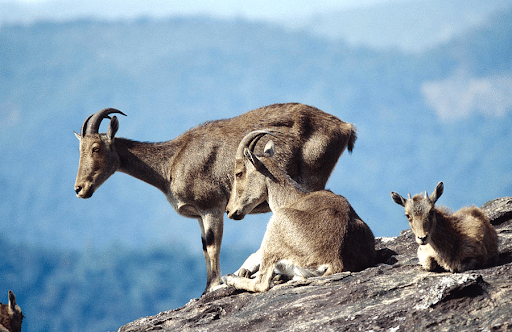
Endangered Nilgiri tahr
*To know more about the topic, click this link Montane Wet Temperate Forests
-
Himalayan Moist Temperate Forest
Himalayan Moist Temperate Forest
- The Himalayan moist temperate forests, which grow between 1500 and 3300 metres above sea level extend the entire length of the mountain range in Kashmir, Himachal Pradesh, Uttaranchal, Darjeeling, and Sikkim.
- The himalayan moist temperate forests include 150 to 250 cm of annual rainfall.
- Precipitation is mostly caused by cyclonic disturbances from the Mediterranean Sea throughout the winter.
- The rainfall ranges from 1000 to 2500 mm, with an altitudinal range of 1500 to 5500 metres.
- Sandy soils are common to the east of the Tista River.
- Broad-leaved evergreens coexist alongside dominating conifers in the wetter east.
- The most important trees include pines, cedars, silver firs, spruce, and others.
- They grow in a high, open forest with a shrubby understory of oaks, rhododendrons, laurels, and bamboos.
- The Royal Bengal Tiger, barking deer, and Himalayan Black Bear are among the prominent species.

Vulnearable Himalayan Black Bear
*To know more about the topic, click this link Himalayan Moist Temperate Forest
-
Himalayan Dry Temperate Forest
Himalayan Dry Temperate Forest
- Himalayan Dry Temperate Forest is an open evergreen forest with an undergrowth of open scrub.
- These forests are mostly found in the Himalayas' middle altitudes.
- Summers are mild and warm, with maximum temperatures rarely surpassing 32 degrees Celsius.
- Winters are lengthy and cold, with temperature fluctuations. The average yearly temperature is 5-16 degrees Celsius, with minimum temperatures below 0 degrees Celsius.
- The soil is light, rocky, and undeveloped.
- The forests have a combination of temperate zone conifers like the deodar, blue pine, fir, and spruce.
- Broad-leaved varieties may coexist with conifers in relatively small amounts, especially in wet, shady depressions.
- The snow leopard, Tibetan wolf, Tibetan argali, and black-necked crane are among the endangered wildlife of Ladakh.

Vulnerable Snow Leopard
*To know more about the topic, click this link Himalayan Dry Temperate Forest
-
Subalpine Forest
Subalpine Forest
- The subalpine forest is a transition zone between dense forest below the treeline and alpine tundra above.
- It is a conifer-dominated forest found primarily in temperate latitudes' subalpine zone, with a few extensions south of the Tropic of Cancer.
- These forests are usually found on north-facing slopes that are steep and rocky.
- Abies spectabilis, Larix griffithii, Betula utilis, Acer and Sorbus are the most common trees.
- This ecoregion is home to a diverse range of animal species.
- The brown bear, as well as rare or endangered species including the Himalayan serow and the markhor goat, are important inhabitants of this forest.
- Other important inhabitants include the white-bellied musk deer, which is hunted for its musk glands, and the endangered red panda.

Endangered Red Panda
*To know more about the topic, click this link Subalpine Forest
-
Moist Alpine Scrub
Moist Alpine Scrub
- The Moist Alpine Scrub is a type of alpine forest that occurs from 3,000 meters up to the snowline.
- They can be found in both the main Himalayan regions and the trans himalayan barren freezing desserts.
- The climate varies from subarctic to arctic. The Moist Alpine Scrub receives heavy snowfall.
- Lower alpine grasslands are abundant, with vegetation that does not rise over 1.5 meters.
- Trees are stunted and infrequent, growing in between shrubs and meadows.
- The black juniper and drooping juniper dominate the environment.
- Rhododendrons also thrive at lower elevations, close to the treeline.
- Larger mammals found in these forests include Snow leopards (Uncia uncia), Himalayan blue sheep (Pseudois nayaur), Himalayan tahr (Hemitragus jemlahicus), takin (Budorcas taxicolor), Himalayan musk deer (Moschus chrysogaster), Himalayan goral (Naemorhedus baileyi), and Himalayan serow (Nemorhaedus bailey).
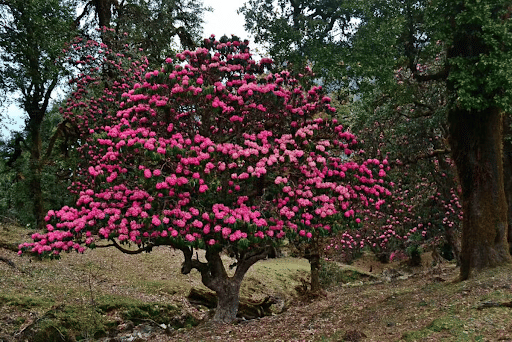
Critically Endangered Himalayan Rhododendron
*To know more about the topic, click this link Moist Alpine Scrub
-
Dry Alpine Scrub
Dry Alpine Scrub
- The Dry Alpine Scrub is a type of alpine forest that occurs over 3500 meters above sea level.
- In shaded depressions and along streams generated by snow melt waters, the scrub thrives.
- Dry arctic conditions prevail, with snowfall lasting for 5 to 6 months each year.
- The annual rainfall is usually less than 370 millimeters.
- There are no trees. Shrubs and pasture areas coexist.
- Juniperus wallichiana, Lonicera spp., and Potentilla spp. are characteristic plants of the dry alpine scrub forests.
- Giant, endangered species like snow leopards and Tibetan wolves roam the landscapes.
- These species hunt large mountain goats and sheep like goral, serow, Himalayan tahr, argali, and blue sheep, which are plentiful.

Near Threatened Argali
*To know more about the topic, click this link Dry Alpine Scrub
Importance of Forest
- Forests provide habitats to millions of animals and support numerous ecosystems.
- About 90 percent of all earth’s species dwell in forests.
- Forests serve as watershed regions because nearly all of the water in forest areas comes from forest-derived water tables as well as rivers, lakes, and streams.
- The forest cover protects streams and rivers passing through forests from the sun's radiation and drying.
- Forests act as a repository for biodiversity genes.
- This is due to the fact that forests contain around 90% of all plant and animal species on the planet, resulting in a diverse range of plant and animal life forms in distinct forest settings.
- Forests serve a vital part in purifying the air we breathe. During the day, trees and plants take carbon dioxide and release oxygen through photosynthesis.
- Because trees and plants regulate atmospheric temperatures through evapotranspiration and provide an environmental breeze, forests act as climate stabilizers.
- Plants and trees assist in the recycling of soil nutrients by shedding leaves and small branches.
- Plant and tree roots also help to break down soil into smaller particles and increase water infiltration.
- Forests also have a role in the natural cycle of water evaporation, condensation, and precipitation in the form of rain.
*To know more about the topic, click this link Importance of Forest
Threats to the Forest
- Climate change is one of the most pressing issues confronting the planet today.
- While forests can aid in the fight against climate change, they are also extremely vulnerable to changing weather patterns.
- The type of forest that can grow in a given region is determined by the climate.
- Forests must adapt to changing climate conditions. The adaptation process, on the other hand, frequently takes longer than the changing climate conditions allow.
- Deforestation has the potential to have a significant detrimental influence on forest biodiversity.
- Deforestation is projected to be responsible for the loss of 13 million hectares of forest each year, according to the UN Food and Agriculture Organization (FAO).
- Natural disturbances are working with climate change to accelerate the further degradation of forests.
- Invasive plant and insect species are gaining an advantage over native species as a result of climate change.
Conclusion
Thus the conservation measures should be taken by the center, state and well as in community level by engaging the local population. Few measures include Regulated and planned cutting of trees, control over a forest fire, checking of forest clearance for agricultural and habitation purposes, proper utilization of forest and forest products, and reforestation, and afforestation programs. The Ministry of Environment, Forests and Climate Change is in charge of implementing India's environmental and forestry programs, which include national park management, protection of India's flora and wildlife, and pollution control.
FAQs
Question: What are the main types of forests in India?
Answer: The main types include tropical wet evergreen, tropical dry deciduous, subtropical, montane, and alpine forests.
Question: Which Indian states have the largest forest cover?
Answer: Madhya Pradesh, Arunachal Pradesh, and Chhattisgarh have the largest forest areas.
Question: How do forests contribute to the environment?
Answer: Forests provide habitats, purify air, regulate climate, and support biodiversity.
Question: What is the Champion and Seth classification?
Answer: It is a system that classifies Indian forests based on climate, physiognomy, and other factors.
Question: What are the main threats to forests in India?
Answer: The main threats include deforestation, climate change, illegal logging, and invasive species.
MCQs
1. Which forest type is found in the Andaman and Nicobar Islands?A. Tropical Thorn Forest
B. Tropical Wet Evergreen Forest
C. Alpine Forest
D. Subtropical Pine Forest
Answer: (B) See the Explanation
Explanation: The Andaman and Nicobar Islands have tropical wet evergreen forests due to high rainfall and humidity.
A. Forest Rights Act
B. IUCN System
C. Champion and Seth Classification
D. FAO System
Answer: (C) See the Explanation
Explanation: The Champion and Seth system classifies forests based on climate, species, and environmental factors.
A. Tropical Wet Evergreen
B. Tropical Thorn
C. Montane Forest
D. Subtropical Broad-Leaved Forest
Answer: (B) See the Explanation
Explanation: Tropical Thorn forests are found in regions receiving less than 70 cm of rainfall.
A. High-altitude location
B. Tidal influence
C. Dense deciduous canopy
D. Presence of snow leopards
Answer: (B) See the Explanation
Explanation: Littoral and Swamp forests are located in coastal and swampy areas, influenced by tides.
A. Teak
B. Oak
C. Pine
D. Sal
Answer: (C) See the Explanation
Explanation: Subtropical pine forests are dominated by pine species in India’s hilly regions.
GS Mains Questions and Model Answers
Q1: Discuss the role of Indian forests in biodiversity conservation.
Answer: Indian forests harbor a wide range of flora and fauna, supporting around 90% of the world’s biodiversity. They act as carbon sinks, regulate water cycles, and protect soil from erosion. Forest ecosystems also provide habitats for endangered species like the Bengal tiger, red panda, and snow leopard. Conservation efforts, such as afforestation and the creation of wildlife sanctuaries, are essential for preserving this biodiversity.
Q2: Examine the impact of deforestation on Indian forests and biodiversity.
Answer: Deforestation in India has led to habitat loss, soil degradation, and the extinction of species. Key drivers include agriculture, logging, and infrastructure development. The loss of forest cover also exacerbates climate change, as forests play a vital role in sequestering carbon. Initiatives like reforestation, forest conservation laws, and community participation are needed to mitigate the impact of deforestation.
Q3: Analyze the Champion and Seth classification system and its significance for forest management in India.
Answer: The Champion and Seth classification system categorizes forests based on environmental parameters like climate and species composition. It helps in understanding forest types, managing resources, and implementing conservation strategies. This system is crucial for balancing development needs with environmental protection, as it guides policies on forest preservation, biodiversity conservation, and sustainable management.
Previous Year Questions on Indian Forests
1. UPSC CSE Prelims
Question: Which of the following forests in India is characterized by the presence of mangroves?
A. Montane Forest
B. Tropical Wet Evergreen Forest
C. Littoral and Swamp Forest
D. Tropical Thorn Forest
Answer: C
Explanation: Littoral and Swamp forests are typically characterized by the presence of mangroves along coastal areas.
2. UPSC CSE Mains
Question: Explain the significance of the Champion and Seth classification in forest management.
Explanation: The Champion and Seth classification is pivotal in forest management as it systematically classifies forests based on ecological and geographical features. This classification aids policymakers in developing targeted conservation strategies, forest resource management, and implementing measures to preserve biodiversity.
Download the PREPP App and attempt FREE IAS Exam Mock Tests and get complete study material!

Full Test - 04: UPSC CSE Prelims CSAT (Paper-II)
Full Test - 03: UPSC CSE Prelims CSAT (Paper-II)
UPSC CSE Prelims 2026 GS Paper 1 Question Paper (24-May-2026)
UPSC CSE Prelims 2026 CSAT Paper 2 Question Paper (24-May-2026)

17 February 2025 | The Hindu Must Read Articles | Current Affairs

16 February 2026 | The Hindu Must Read Articles | Current Affairs

13 February 2026 | The Hindu Must Read Articles | Current Affairs









Comments