India Sees The Lowest August Rainfall In A Century
Relevance: GS1 - Important Geophysical phenomena
(Source: The Hindu, 09/01/2023)
Click here for Daily Current Affairs
Why in the news?
- Amid the deficient rainfall activity resulting in India, the Rainfall in August has been the lowest in over a century, with India getting 36% less rainfall than it usually does in the month.
- Out of the four monsoon months, August usually sees the most amount of rainfall (25.4 cm) after July with 28 cm.
- The last time India recorded such severe deficits in August was in 2005, when the shortfall was about 25% of the normal, and in 2009, when India saw its biggest drought in half a century and August rainfall was 24% less than normal.
- The India Meteorological Department (IMD) stated that rainfall is likely to be near normal in September, with a revival of monsoon conditions.
Table of Contents
Temperature and Rainfall Recorded in August 2023
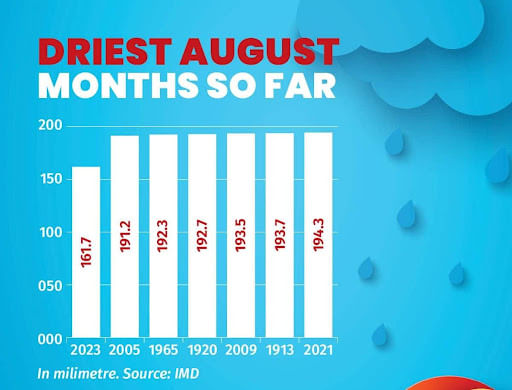
- All India rainfall was around 161.7 mm in August compared to 191.2 mm in 2005, previously the lowest.
- For Central India rainfall in August was around 164.5mm compared to the previous record for lowest rainfall of 172.8mm in 1905.
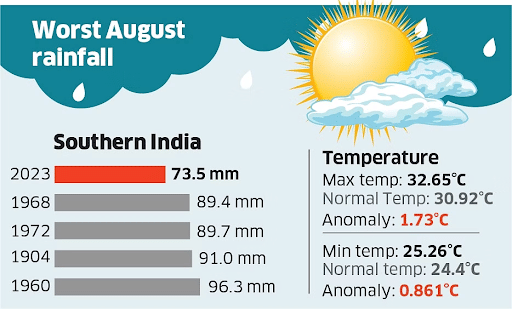
- The Peninsula recorded just 73.5mm of rain in August compared to the previous record low of 89.4mm recorded in 1968.
- August saw 36% rainfall deficiency and the monsoon rainfall to date (till August 31) is 10% deficient.
- The All-India average maximum temperature recorded in August was 32.09 °C compared to normal of 31.09°C; and the all India average mean temperature was 28.40°C compared to normal of 27.55°C.
- Both were highest for the month since 1901. The Peninsula also saw its highest average maximum, mean and minimum temperatures since 1901.
Why was August one of the worst monsoon months in history?
- Monsoon rainfall for August was the lowest in the past 122 years since 1901 at the national level and also in Central India and the southern Peninsula.
- The development of El Nino conditions in the equatorial Pacific Ocean was the most important factor behind the deficient rainfall activity in August in most of India, except in northeastern India, the Himalayan States, and parts of Tamil Nadu.
States with the most and least rains
- Deficit: Kerala has had 48% deficient rains this season, followed by Manipur and Jharkhand with 46% and 37% deficiency.
- Surplus: Ladakh has seen the highest surplus (169%), followed by Chandigarh and Himachal Pradesh with 61% and 31%.
What are the impacts?
- Rainfall in August has brought the overall national deficit to 10%, with the regional deficits being 17% in east and northeast India, 10% in central India, and 17% in southern India.
- Kharif sowing has already been affected this year with pulses leading the drop. As per the latest data, while overall kharif sowing barely inched up, by 3.6% from last year to touch 105.4 million hectares (mh) led by paddy sowing, the fall in pulses sowing has been significant with a nearly 5% in tur and urad (black gram) to 4.2 mh and 3.1 mh, respectively.
- A lack of rain has also worsened the decline in water levels of major reservoirs, which has led to an overall shortfall of 21 percent against the previous year’s levels.
- Concerns have been raised about weaker crop output and the potential for more export restrictions following the nation's curbs on rice.
Monsoon in India
*To know more about Indian Monsoon, click here |
(*Click this link to read prelims specific weekly current affairs articles)
FAQs
Question: What is Monsoon?
Answer:
A monsoon is traditionally a seasonal reversing wind accompanied by corresponding changes in precipitation but is now used to describe seasonal changes in atmospheric circulation and precipitation associated with annual latitudinal oscillation of the Intertropical Convergence Zone (ITCZ) between its limits to the north and south of the equator.
Question: What is El Nino?
Answer:
El Nino is a weather phenomenon that describes the anomalous warming of surface waters in the eastern tropical Pacific Ocean.
Question: What is Indian Ocean Dipole (IOD)?
Answer:
It is characterized by the difference in sea surface temperature between two locations (or poles, therefore a dipole) - a western pole in the Arabian Sea (western Indian Ocean) and an eastern pole in the eastern Indian Ocean south of Indonesia.
UPSC Mains Practice Question:
|
MCQ
Question: La Nina is suspected to have caused recent floods in Australia. How is La Nina different from El Nino? (UPSC 2011)
- La Nina is characterized by unusually cold ocean temperature in the equatorial Indian Ocean whereas El Nino is characterized by unusually warm ocean temperatures in the Equatorial Pacific Ocean.
- El Nino has an adverse effect on the southwest monsoon of India, but Na Nina has no effect on the monsoon climate.
Which of the statements given above is/are correct?
(a) 1 only
(b) 2 only
(c) Both 1 and 2
(d) Neither 1 nor 2
Answer: (d) See the Explanation
- Both La Nina and El Nino are linked with the Pacific Ocean.
- El Nino is caused by the rise of warm water in the Equatorial region of the Pacific Ocean.
- La Nina is characterized by unusually cold ocean temperatures in the Equatorial Pacific, compared to the El Nino which is characterized by unusually warm ocean temperatures in the Equatorial Pacific
- La Nina has an impact on the Indian monsoon. It is linked with excessive rains during the monsoon season.
Therefore, option (d) is the correct answer.
Question: The seasonal reversal of winds is the typical characteristic of: (UPSC 2014)
(a) Equatorial climate
(b) Mediterranean climate
(c) Monsoon climate
(d) All of the above climates
Answer: (c) See the Explanation
Monsoon climate is characterized by a seasonal reversal of winds. It has a distinct wet season and a dry season. The monsoon is a large-scale atmospheric circulation phenomenon that dominates the world's tropical and subtropical areas.
Therefore, option (c) is the correct answer.
Download the PREPP App and attempt FREE IAS Exam Mock Tests and get complete study material!

Full Test - 04: UPSC CSE Prelims CSAT (Paper-II)
Full Test - 03: UPSC CSE Prelims CSAT (Paper-II)
UPSC CSE Prelims 2026 GS Paper 1 Question Paper (24-May-2026)
UPSC CSE Prelims 2026 CSAT Paper 2 Question Paper (24-May-2026)

17 February 2025 | The Hindu Must Read Articles | Current Affairs

16 February 2026 | The Hindu Must Read Articles | Current Affairs

13 February 2026 | The Hindu Must Read Articles | Current Affairs









Comments