Decoding The OCCRP’s Adani Report
Relevance: GS2 - Important aspects of governance, Transparency and Accountability; GS3 - Effects Of Liberalization On The Economy, Changes In Industrial Policy and their effects on Industrial Growth
(Source: The Hindu, 09/01/2023)
Click here for Daily Current Affairs
Why in the news?
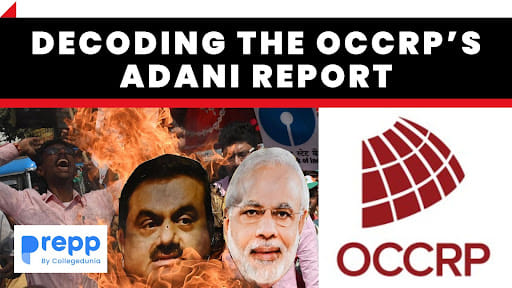
- Recently, the Organised Crime and Corruption Reporting Project (OCCRP) has made allegations of stock manipulation against the Adani Group.
- OCCRP's report comes months after the US-based Hindenburg Research accused the Adani Group of improper business dealings, citing offshore entities in tax havens.
- The Supreme Court of India, in its order dated March 2, directed the Securities and Exchange Board of India (SEBI) to investigate the Adani-Hindenburg matter.
- The investigation involves multiple aspects, including violations of Rule 19A of the Securities Contracts (Regulation) Rules 1957, non-disclosure of related party transactions, and manipulation of stock prices.
Table of Contents
About OCCRP
- The Organized Crime and Corruption Reporting Project (OCCRP) is a global network of investigative reporters.
- It was founded by Drew Sullivan and Paul Radu in 2006.
- OCCRP focuses on investigating organized crime and systemic corruption.
- It publishes its stories through local media and in English and Russian through its website.
- The entity was involved in the coverage of Pegasus spyware as well as the Panama Papers leak.
- The group aims to develop and equip a global network of investigative journalists and publish their stories.
What did the OCCRP report find?
- Mauritius-Based Funds and Key Investors: The Emerging India Focus Fund (EIFF) and EM Resurgent Fund (EMRF), both based in Mauritius, were found to have invested heavily in shares of four Adani companies between 2013 and 2018.
- Notably, Nasser Ali Shaban Ahli from the UAE and Chang Chung-Ling from Taiwan were key foreign investors in these funds.
- Bermuda-Based Fund as a Channel: These investments were channeled through the Global Opportunities Fund (GOF), a Bermuda-based investment fund.
- Magnitude of Investments: As of March 2017, Nasser Ali and Chang Chung-Ling's combined investments in Adani stocks amounted to approximately $430 million or ₹2,795 crore (at the prevailing exchange rate). In January 2017, they collectively held substantial shares in Adani Enterprises (3.4%), Adani Power (4%), and Adani Transmission (3.6%).
- The report also revealed that Vinod Adani, brother of Gautam Adani and a member of the Adani promoter group, was linked to a UAE-based firm called Excel Investment and Advisory Services Limited. This firm received over $1.4 million in "advisory" fees from management companies of EIFF, EMRF, and GOF between June 2012 and August 2014.
SEBI Investigation and Concerns
- SEBI was directed by the Supreme Court to investigate Rule 19A violations, non-disclosure of related party transactions, and stock price manipulation.
- SEBI's role in the Adani matter has come under scrutiny due to regulatory failures and potential regulatory capture.
- Amendments made to FPI and Listing Obligations and Disclosure Requirement (LODR) Regulations in 2018 have been criticized for opening regulatory loopholes, facilitating the concealment of ultimate beneficial ownership and related party transactions.
- The Expert Committee's findings have shed light on regulatory gaps that enable the hiding of "ultimate beneficial ownership" and transactions involving "related parties."
What is Rule 19A?
|
Conclusion
The OCCRP investigation, alongside previous reports and discrepancies in SEBI's disclosures, warrant a deeper inquiry into the Adani group's financial activities, emphasizing the need for transparent and thorough investigations in the interest of market integrity and regulatory accountability.
(*Click this link to read prelims specific weekly current affairs articles)
FAQs
Question: What is SEBI?
Answer:
The Securities and Exchange Board of India (SEBI) is a statutory body that was established on April 12, 1992, in accordance with the provisions of the Securities and Exchange Board of India Act, 1992. The Securities and Exchange Board of India's primary function is to protect the interests of investors in securities and to promote and regulate the securities market.
Question: What is OCCRP?
Answer:
The Organized Crime and Corruption Reporting Project is a global network of investigative journalists with staff on six continents. Founded in 2006, it specializes in organized crime and corruption.
Question: What is Adani Group?
Answer:
It is one of India's greatest conglomerates, specializing in infrastructure projects such as coal, ports, cement, green energy, and even edible oil. Its owner, Mr Gautam Adani, has long been one among the world's top four wealthiest people.
Question: What is Rule 19A?
Answer:
Rule 19A is a significant provision of the Securities Contracts (Regulation) Rules, 1957.
It mandates that Indian listed companies must maintain a minimum of 25% public shareholding.
MCQs
Question: In the parlance of financial investments, the term ‘bear’ denotes (UPSC 2010)
(a) An investor who feels that the price of a particular security is going to fall
(b) An investor who expects the price of particular shares to rise
(c) A shareholder or a bondholder who has an interest in a company, financial or otherwise
(d) Any lender whether by making a loan or buying a bond
Answer: (a) See the Explanation
A bear is an investor who believes that a particular security or market is on its way down. Bears try to profit from a drop in prices. Bears are generally pessimistic about the current state of a market. Bearish sentiment can be applied to all types of markets, including commodities, stocks, and bonds.
Therefore, option (a) is the correct answer.
Download the PREPP App and attempt FREE IAS Exam Mock Tests and get complete study material!

Full Test - 04: UPSC CSE Prelims CSAT (Paper-II)
Full Test - 03: UPSC CSE Prelims CSAT (Paper-II)
UPSC CSE Prelims 2026 GS Paper 1 Question Paper (24-May-2026)
UPSC CSE Prelims 2026 CSAT Paper 2 Question Paper (24-May-2026)

17 February 2025 | The Hindu Must Read Articles | Current Affairs

16 February 2026 | The Hindu Must Read Articles | Current Affairs

13 February 2026 | The Hindu Must Read Articles | Current Affairs









Comments