UPSC CSE Mains exam consists of Geography as one of the optional syllabi which have 2 optional papers. The two optional papers are 250 marks each, and the combined marks of optional in the IAS exam is 500. The first and foremost step of the preparation for any optional is checking its syllabus.
In this article, candidates will get to know the syllabus for UPSC CSE Mains Geography optional, UPSC CSE Geography optional study notes and much more. Check other UPSC optional syllabi for the IAS exam.
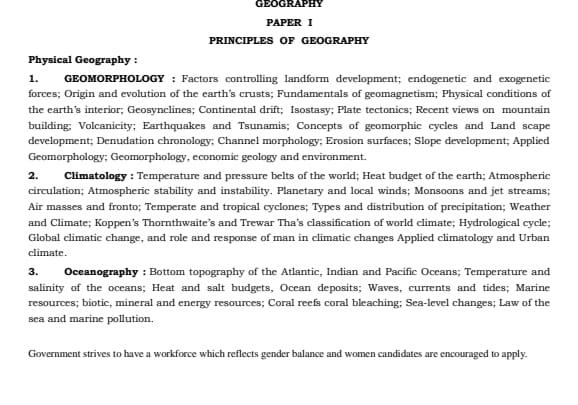
Geography Optional Paper 1 Syllabus
Following is the syllabus of UPSC CSE Geography Optional Paper 1:
![Geography Syllabus for IAS Exam]()
| UPSC CSE Mains Geography Optional Paper 1 Syllabus |
| Physical Geography |
| Geomorphology |
|
| Climatology |
|
| Oceanography |
|
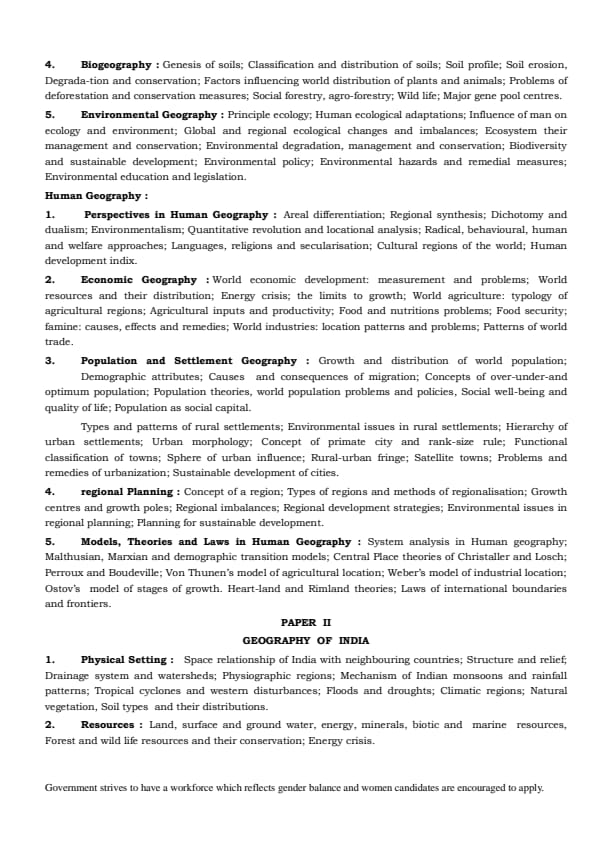
| Biogeography |
|
| Environmental Geography |
- Principle of ecology;
- Human ecological adaptations;
- Influence of man on ecology and environment;
- Global and regional ecological changes and imbalances;
- Ecosystem their management and conservation;
- Environmental degradation, management and conservation;
- Biodiversity and sustainable development;
- Environmental policy;
- Environmental hazards and remedial measures;
- Environmental education and legislation.
|
| Human Geography |
| Perspectives in Human Geography |
- Areal differentiation;
- Regional synthesis;
- Dichotomy and dualism;
- Environmentalism;
- Quantitative revolution and locational analysis;
- Radical, behavioural, human and welfare approaches;
- Languages, religions, and secularisation;
- Cultural regions of the world;
- Human development index.
|
| Economic Geography |
- World economic development: measurement and problems;
- World resources and their distribution;
- Energy crisis; the limits to growth;
- World agriculture: a typology of agricultural regions; agricultural inputs and productivity;
- Food and nutrition problems;
- Food security;
- Famine: causes, effects and remedies;
- World industries: locational patterns and problems;
- Patterns of world trade.
|
| Population and Settlement Geography |
- Growth and distribution of world population;
- Demographic attributes;
- Causes, types and consequences of migration;
- Concepts of the over-under-and optimum population;
- Population theories, world population problems and policies, Social well-being and quality of life;
- The population as social capital. Types and patterns of rural settlements;
- Environmental issues in rural settlements;
- Hierarchy of urban settlements;
- Urban morphology: Concepts of primate city and rank-size rule;
- Functional classification of towns;
- Sphere of urban influence;
- Rural-urban fringe;
- Satellite towns;
- Problems and remedies of urbanization;
- Sustainable development of cities.
|
| Regional Planning |
- Concept of a region;
- Types of regions and methods of regionalization;
- Growth centres and growth poles;
- Regional imbalances;
- Regional development strategies;
- Environmental issues in regional planning;
- Planning for sustainable development.
|
| Models, Theories and Laws in Human Geography |
- Systems analysis in Human geography;
- Malthusian, Marxian and demographic transition models;
- Central Place theories of Christaller and Losch;
- Perroux and Boudeville;
- Von Thunen's model of agricultural location;
- Weber's model of industrial location;
- Rostow's model of stages of growth. Heartland and Rimland theories;
- Laws of international boundaries and frontiers.
|
Geography Optional Paper 2 Syllabus
Following is the syllabus of UPSC CSE Geography Optional Paper 2:
![Geography Syllabus for IAS Exam]()
| UPSC CSE Mains Geography Optional Paper 2 Syllabus |
| Geography Of India |
| Physical Setting |
|
| Resources |
|
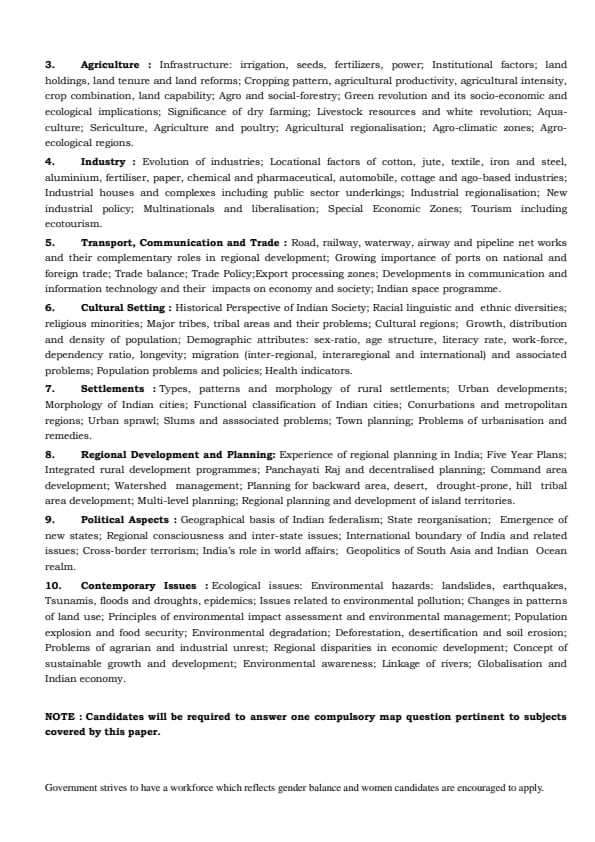
| Agriculture |
- Infrastructure: irrigation, seeds, fertilizers, power;
- Institutional factors: landholdings, land tenure, and land reforms;
- Cropping pattern, agricultural productivity, agricultural intensity, crop combination, land capability;
- Agro and social-forestry;
- Green revolution and its socio-economic and ecological implications;
- Significance of dry farming;
- Livestock resources and white revolution;
- Aquaculture;
- Sericulture, Apiculture And Poultry;
- Agricultural Regionalization;
- Agro-Climatic Zones;
- Agroecological Regions.
|
| Industry |
|
| Transport, Communication and Trade |
|
| Cultural Setting |
- Historical Perspective of Indian Society;
- Racial, linguistic and ethnic diversities;
- Religious minorities;
- Major tribes, tribal areas and their problems;
- Cultural regions;
- Growth, distribution and density of population;
- Demographic attributes: sex-ratio, age structure, literacy rate, work-force, dependency ratio, longevity;
- Migration (inter-regional, intra- regional and international) and associated problems;
- Population problems and policies;
- Health indicators.
|
| Settlements |
- Types, patterns and morphology of rural settlements;
- Urban developments;
- Morphology of Indian cities;
- Functional classification of Indian cities;
- Conurbations and metropolitan regions;
- Urban sprawl;
- Slums and associated problems;
- Town planning;
- Problems of urbanization and remedies.
|
| Regional Development and Planning |
- Experience of regional planning in India;
- Five Year Plans;
- Integrated rural development programs;
- Panchayati Raj and decentralized planning;
- Command area development;
- Watershed management;
- Planning for the backward area, desert, drought-prone, hill, tribal area development;
- Multi-level planning;
- Regional planning and development of island territories.
|
| Political Aspects |
- Geographical basis of Indian federalism;
- State reorganization;
- Emergence of new states;
- Regional consciousness and inter state issues;
- International boundary of India and related issues;
- Cross border terrorism;
- India's role in world affairs;
- Geopolitics of South Asia and Indian Ocean realm.
|
| Contemporary Issues |
- Ecological issues;
- Environmental hazards: landslides, earthquakes, Tsunamis, floods and droughts, epidemics;
- Issues relating to environmental pollution;
- Changes in patterns of land use;
- Principles of environmental impact assessment and environmental management;
- Population explosion and food security;
- Environmental degradation;
- Deforestation, desertification, and soil erosion;
- Problems of agrarian and industrial unrest;
- Regional disparities in economic development;
- Environmental awareness;
- Linkage of rivers; Globalisation and Indian economy.
|
Download UPSC Geography Optional Syllabus PDF
Many aspirants took Geography as an optional subject. The syllabus of UPSC Geography optional is vast. The aspirants must start their preparation for the UPSC Geography optional as soon as possible. They must solve previous year papers to check the level of their preparation.















Comments