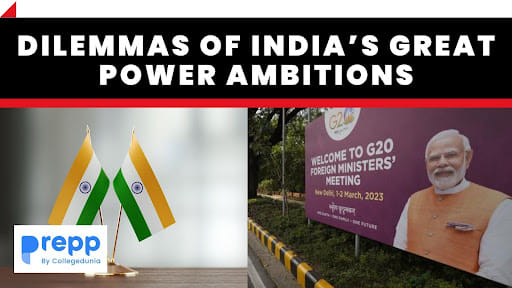
Dilemmas Of India’s Great Power Ambitions
(Source: The Hindu, 07/24/2023)
Click here for Daily Current Affairs
Why in the news?
- In this article, Happymon Jacob, teacher at the School of International Studies, Jawaharlal Nehru University, New Delhi, and founder of the Council for Strategic and Defence Research has discussed India's global power aspirations.
- Some argue that India should aspire to be a great power and assert its growing power internationally while some state that India should prioritize uplifting its people above the poverty line and improving governance before venturing into global power politics.
Table of Contents
India’s Remarkable Rise
- India in the early 90s, was a weak, destitute, and terribly troubled country with a foreign exchange reserve of $5.8 billion and a nominal GDP of $270.11 billion.
- Despite efforts to allay nuclear anxieties, the danger of an India-Pakistan conflict loomed, and violence in Kashmir was at an all-time high.
- The fall of India's trusted ally, the Soviet Union and strained ties with the United States on the other, added to the country's governing elite's burden.
- Currently, with a foreign exchange reserve of around $600 billion and a GDP projected to reach $4 trillion, India is now the world's fifth-largest economy.
- The reforms initiated after the 1991 economic crisis have not only boosted GDP growth but also led to significant poverty reduction.
- India has emerged as a pivotal swing power in international affairs, deftly navigating its relationships with major powers.
- It is also one of the largest militaries in the world with over a hundred nuclear weapons.
Role played by India in World Politics
- India's role in world politics, especially in mediating international conflicts, has gained attention.
- India’s great power politics around the Ukraine war brought renewed focus on India’s role in world politics.
- Without taking any sides, India is mediating between Ukraine and Russia in order to halt the war.
- India's rise has prompted the U.S. and other powerful nations to seek its alignment, while Russia also values its relationship with India.
- India acts as a bridge between nations suggesting its significant role as a major player in world politics.
What are the challenges?
- Despite its economic growth and military capabilities, India faces major infrastructural and governance challenges.
- Poverty reduction and improving the well-being of millions remain crucial domestic priorities.
- Limited political attention to foreign policy, often managed by career bureaucrats, can hinder proactive and risky decisions.
- Weak domestic economic conditions also restrain resource allocation for foreign policy objectives.
- Profound divisions based on regions, caste, ethnicity, and religion are deeply entrenched within society.
Way Ahead
- India's journey from a weak and impoverished nation to a significant global player demands a nuanced understanding of its challenges and potential impact.
- Balancing domestic upliftment with assertive international engagement is crucial for shaping a better world while safeguarding its citizens' well-being.
- India should exert influence and shape the global order to achieve its foreign policy goals, which will significantly impact its economic growth, security landscape, and geopolitical and geo-economic interests.
- As India continues to evolve as a global power, it must embrace its role in influencing the global order in line with its domestic growth and interests.
(*Click this link to read prelims specific weekly current affairs articles)
FAQs
Question: What was the Indian Economic Crisis of 1991?
Answer:
The 1991 Indian economic crisis was an economic crisis in India caused by a balance of payments imbalance caused by an overreliance on imports and other external causes. India's economic troubles began to intensify in 1985, as imports increased, leaving the nation with a double deficit: the Indian trade balance was in deficit at the same time as the government was running a massive budget deficit.
Question: What is G20?
Answer:
The G20 is an intergovernmental forum comprising 19 countries and the European Union. The G20 members represent around 85% of the global GDP, over 75% of the global trade, and about two-thirds of the world population. India holds the Presidency of the G20 from December 1, 2022 to November 30, 2023.
UPSC Mains Practice Question:
|
Download the PREPP App and attempt FREE IAS Exam Mock Tests and get complete study material!

Full Test - 04: UPSC CSE Prelims CSAT (Paper-II)
Full Test - 03: UPSC CSE Prelims CSAT (Paper-II)
UPSC CSE Prelims 2026 GS Paper 1 Question Paper (24-May-2026)
UPSC CSE Prelims 2026 CSAT Paper 2 Question Paper (24-May-2026)

17 February 2025 | The Hindu Must Read Articles | Current Affairs

16 February 2026 | The Hindu Must Read Articles | Current Affairs

13 February 2026 | The Hindu Must Read Articles | Current Affairs









Comments