An Internet Ban Will Not Restore Peace In Manipur
Relevance: GS 3 - Challenges to internal security through communication networks, the role of media and social networking sites in internal security challenges, GS2 - Governance
(Source: The Hindu, 07/24/23)
Click here for Daily Current Affairs
Why in the news?
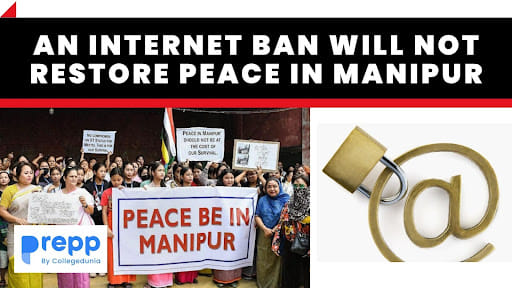
- The Ethnic violence between the Meitei and Kuki communities, which began on May 3, 2023, received little attention from the rest of India until a video of sexual violence by a mob went viral on social media recently.
- During this period, the government enforced an Internet shutdown in the region, impacting the flow of information and communication.
- This article examines the propriety of the Internet ban and its role in the nation's apathy towards the crisis in Manipur.
- There is no concrete evidence to suggest that the Internet ban prevented violence or mitigated unrest. The absence of data on the efficacy of the shutdown raises questions about its necessity.
Table of Contents
What are the arguments for and against internet shutdowns?
For
- Fake news: Internet shutdowns are used as a preventive measure to restrain disinformation on social media and communication apps.
- To prevent protesters from mobilizing and coordinating.
- It enables the prevention of reproduction and sharing of affective content, which can evoke strong emotions that can promote hatred against other communities.
- To maintain law and order and restore peace.
- Preventive Response: Cutting off the Internet is both an early and preventive response to block restive groups to organize riots against the Government.
- National Interest: The Internet cannot be independent of national sovereignty. Therefore, the necessary regulation of the Internet is a reasonable choice of sovereign countries based on national interests.
Against
- Against fundamental rights: It is against the fundamental right of freedom of speech and the right to practice any profession or to carry on any occupation, trade, or business.
- Access to Information is disrupted due to the internet shutdown. This impacts the press and media.
- Health and education: Access to health and Educational services gets impacted which may in turn increase inequalities. For example, telemedicine services like e-sanjeevani and access to education platforms like e-Patashala get impacted.
- Economic damage: Shutdowns can cause economic damage and deeply impact lives and livelihoods across India. For example, Freelancing jobs, work from home are affected. The Internet Society estimated the loss caused by internet shutdowns in India in 2022 to be $2.369 billion.
- Impact on the poor and vulnerable: Internet access is essential for accessing subsidized food grains, rural employment schemes like Mahatma Gandhi National Rural Employment Guarantee Scheme, and e-governance assistance in rural areas.
- For example, internet shutdowns make it impossible for beneficiaries to receive their rations due to linkage with Aadhaar, a biometric database system.
- Lack of empirical data: There is an absence of data or specific instances of violence being prevented due to the jamming of Internet connectivity
What is Anuradha Bhasin's Verdict on Internet shutdown?
- In 2020, Anuradha Bhasin Case the Supreme Court ruled that freedom of speech and expression and the freedom to practice any profession or carry on any trade, business or occupation over the medium of Internet are constitutionally protected under Article 19 (1) (a) and Article 19 (1) (g).
- Therefore, the restriction upon such fundamental rights should be in consonance with the mandate under Articles 19 (2) and (6) of the Constitution, inclusive of the test of proportionality.
- The doctrine of Proportionality means striking a balance between actions and goals. The Doctrine of Proportionality is often used as a basis for judicial review in matters involving administrative action.
- Suspension of the internet for an indefinite period as per Telecom Suspension Rules 2017 is not permissible.
- Suspension of the internet can only be for a reasonable duration and periodic review should be done.
- Any orders suspending the Internet are subject to judicial review.
- Government should publish all orders of prohibition to enable affected persons to challenge the same.
Conclusion
- Internet shutdowns in Manipur have proven ineffective in quelling violence and unrest. Instead, they have led to the spread of misinformation and hindered communication, making it difficult to hold the government accountable for its actions.
- Therefore, compliance with the Supreme Court guidelines in the Anuradha Bhasin case is the way forward in order to get rid of the tag of the “internet shutdown capital” of the world and fulfill Digital India’s potential.
Provisions Related to Internet Shutdown
|
(*Click this link to read prelims specific weekly current affairs articles)
FAQs
Question: What is Cyber terrorism?
Answer:
Cyberterrorism is a contemporary phenomenon, wherein terrorists use the internet to influence, communicate and fund violence on a real-time basis.
Question: What is meant by Fake news?
Answer:
Fake news is those news stories that are false,with no verifiable facts, sources, or quotes.
Question: What is the Doctrine of Proportionality?
Answer:
The doctrine of Proportionality means striking a balance between actions and goals. The Doctrine of Proportionality is often used as a basis for judicial review in matters involving administrative action.
Download the PREPP App and attempt FREE IAS Exam Mock Tests and get complete study material!

Full Test - 04: UPSC CSE Prelims CSAT (Paper-II)
Full Test - 03: UPSC CSE Prelims CSAT (Paper-II)
UPSC CSE Prelims 2026 GS Paper 1 Question Paper (24-May-2026)
UPSC CSE Prelims 2026 CSAT Paper 2 Question Paper (24-May-2026)

17 February 2025 | The Hindu Must Read Articles | Current Affairs

16 February 2026 | The Hindu Must Read Articles | Current Affairs

13 February 2026 | The Hindu Must Read Articles | Current Affairs









Comments