Can’t Ask Govt. To Recognise A Language As Official One: SC
Relevance: GS 2 - Indian Constitution; GS1 - Diversity of India
(Source: The Hindu, 07/24/23)
Click here for Daily Current Affairs
Why in the news?
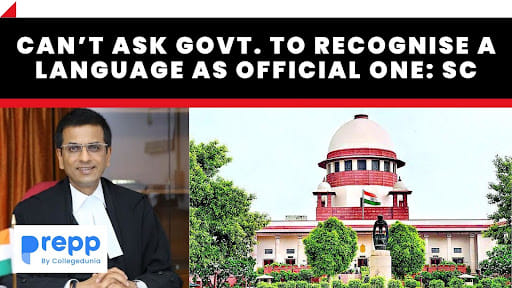
Recently, a bench led by Chief Justice of India D.Y. Chandrachud said that the Supreme Court cannot direct the Centre to include Rajasthani as an official language in the Eighth Schedule of the Constitution.
Table of Contents
What did the Supreme Court say?
- The Supreme Court referred to a 1997 reported decision of the Supreme Court in the Kanhaiya Lal Sethia case which said that to include or not to include a particular language in the VIIIth Schedule is a policy matter of the Union.
- The Court informed the petitioner that this is a policy matter and not for the courts to give a mandamus.
- 'Mandamus' is Latin for 'command.' It is a command or order given to direct any individual, company, inferior court, or government to undertake a legally obligated public obligation.
- The bench said that the courts do not exercise the power of judicial review and interfere in policy matters of the State unless the formulated policies either violate the mandate of the Constitution or any statutory provision or are otherwise motivated by malice.
What is the 8th schedule?
- It lists the official languages of the Republic of India. Part XVII of the Indian constitution deals with the official languages in Articles 343 to 351.
- The Eighth Schedule to the Constitution consists of the following 22 languages:
- Assamese, Bengali, Gujarati, Hindi, Kannada, Kashmiri, Konkani, Malayalam, Manipuri, Marathi, Nepali, Oriya, Punjabi, Sanskrit, Sindhi, Tamil, Telugu, Urdu, Bodo, Santhali, Maithili and Dogri.
- Of these languages, 14 were initially included in the Constitution. The Sindhi language was added by the 21st Amendment Act of 1967.
- Konkani, Manipuri, and Nepali were included by the 71st Amendment Act of 1992.
- Bodo, Dogri, Maithili, and Santhali were added by the 92nd Amendment Act of 2003 which came into force in 2004.
(*Click this link to read prelims specific weekly current affairs articles)
FAQs
Question: What is the Writ of Mandamus?
Answer:
A writ of mandamus is a discretionary remedy that aims to force the fulfillment of a public legal duty enumerated in a statute or at common law.
Question: When can the writ of mandamus be used?
Answer:
A mandamus is usually given when legislation requires an official or authority to execute a duty and that obligation has not been performed notwithstanding a written demand. A writ of mandamus will not be issued unless it is to overturn an unlawful order.
Question: What are the list of languages in the Eighth Schedule?
Answer:
The Eighth Schedule to the Constitution consists of the following 22
languages:-
Assamese, Bengali, Gujarati, Hindi, Kannada, Kashmiri, Konkani, Malayalam, Manipuri, Marathi, Nepali, Oriya, Punjabi, Sanskrit, Sindhi, Tamil, Telugu, Urdu, Bodo, Santhali, Maithili and Dogri.
MCQ
Question: Consider the following statements:
- 8th schedule lists the official languages of the Republic of India.
- Rajasthani and Manipuri are official languages in the Eighth Schedule of the Constitution.
Which of the above statements is/are correct?
(a) 1 only
(b) 2 only
(c) Both 1 and 2
(d) Neither 1 nor 2
Answer: (a) See the Explanation
- 8th schedule lists the official languages of the Republic of India. Hence, statement 1 is correct.
- Assamese, Bengali, Gujarati, Hindi, Kannada, Kashmiri, Konkani, Malayalam, Manipuri, Marathi, Nepali, Oriya, Punjabi, Sanskrit, Sindhi, Tamil, Telugu, Urdu, Bodo, Santhali, Maithili and Dogri. Hence, statement 2 is correct.
- Therefore, option (a) is the correct answer.
Download the PREPP App and attempt FREE IAS Exam Mock Tests and get complete study material!

Full Test - 04: UPSC CSE Prelims CSAT (Paper-II)
Full Test - 03: UPSC CSE Prelims CSAT (Paper-II)
UPSC CSE Prelims 2026 GS Paper 1 Question Paper (24-May-2026)
UPSC CSE Prelims 2026 CSAT Paper 2 Question Paper (24-May-2026)

17 February 2025 | The Hindu Must Read Articles | Current Affairs

16 February 2026 | The Hindu Must Read Articles | Current Affairs

13 February 2026 | The Hindu Must Read Articles | Current Affairs









Comments