Difference between Himalayan and Peninsular Rivers - Geography Notes
Difference Between Himalayan Rivers and Peninsular Rivers is that Himalayan rivers are perennial, whereas peninsular rivers are seasonal rivers. Indian rivers are mainly divided into the Himalayan and Peninsular groups. The Himalayan drainage system predates the Peninsular drainage system. The Himalayan rivers are perennial, which means they are filled with water throughout the year. This article will help in learning about Difference between Himalayan and Peninsular Rivers which is an integral part of Geography Syllabus preparation for the UPSC Civil service exam.
Table of Contents
Himalayan Rivers
- The Himalayan drainage system has evolved over millions of years of geological time.
- It mostly consists of the Ganga, Indus, and Brahmaputra river basins.
- Rivers in this system are perennial because they are nourished by both snowmelt and precipitation.
- These rivers flow through massive canyons created by erosional action that occurred concurrently with the Himalayan uplift.
- Every year, the Himalayan Rivers are inundated due to the rapid melting of snow. Another explanation is that they pass through high-precipitation areas throughout their journey.
- Due to glaciers melting all year, these rivers are perennial and provide water at all times of the year.

Himalayan Rivers
Peninsular Rivers
- The Peninsular drainage system predates the Himalayan drainage system.
- The vast, largely-graded shallow basins and the maturity of the rivers attest to this.
- The Western Ghats, which run parallel to the western coast, serves as a water divide between the major Peninsular rivers, which discharge their water into the Bay of Bengal, and smaller rivulets that enter the Arabian Sea.
- They are rain-fed and transport a huge volume of water, these rivers are seasonal.
- They dry up when there is a lack of rain and expand during the monsoon season. As a result, they are sometimes known as seasonal rivers.
- They run through a plateau terrain, they typically move straight and do not make meanders.
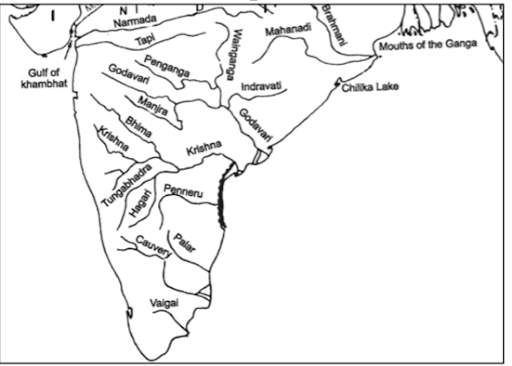
Peninsular Rivers
Difference between Himalayan and Peninsular Rivers
| Himalayan Rivers | Peninsular Rivers |
|---|---|
|
Peninsular rivers are rivers that originate in the Peninsular Plateau. Peninsular rivers are fed by rain mainly. |
|
|
|
|
|
These are illustrations of antecedent drainage. |
These are instances of Consequent drainage. |
|
|
|
These rivers, which run through the young fold mountains, are yet in their infancy. |
These rivers have matured after passing over one of the world's oldest plateaus. |
|
|
|
At their mouths, the Himalayan rivers generate large deltas. The Ganga-Brahmaputra delta is the world's biggest. |
|
|
The Himalayan rivers go a great distance from their source to the sea. |
In comparison to Himalayan rivers, these rivers have shorter and shallower courses. |
|
The Himalayan rivers offer hydroelectric power-producing potential, however, it is underutilized. |
Peninsular rivers have less potential for hydroelectric power generation, but the realisation is greater. |

Conclusion
The Himalayan and Peninsular rivers exhibit significant differences in their origin, nature, and impact on the surrounding regions. The Himalayan rivers, perennial and originating from snow and rain, shape deep valleys and vast catchment areas, offering vital resources for irrigation and hydroelectric power. In contrast, the Peninsular rivers, seasonal and rain-fed, traverse shallower valleys with smaller catchment areas, limiting their suitability for irrigation. The distinct characteristics of these river systems highlight the diverse hydrological landscape of the Indian subcontinent, crucial for understanding and managing water resources
| Other Relevant Links | |
|---|---|
| Geography Notes | Physical Geography |
| Indian Drainage Systems | India's Major Rock Groups |
| India's Divisions Based on Geological Structure and Geomorphic Processes | India's Physiographic Divisions |
| Geomorphology | Climatology |
FAQs
Question: What is the primary source of water for Himalayan rivers?
Answer: The primary sources of water for Himalayan rivers are glacial melt and rainfall, making them perennial in nature.
Question: How do Himalayan rivers differ from Peninsular rivers in terms of drainage patterns?
Answer: Himalayan rivers typically exhibit dendritic drainage patterns, while Peninsular rivers follow rectangular or trellis drainage patterns, influenced by geological structures.
Question: Why are Peninsular rivers seasonal in nature?
Answer: Peninsular rivers are largely seasonal because they rely on monsoonal rains for their flow, and they experience significantly reduced water levels during the dry season.
Question: How do Himalayan rivers contribute to landform development in the plains?
Answer: Himalayan rivers carry a large sediment load, leading to the formation of fertile floodplains and deltas. Their erosive power creates V-shaped valleys and extensive deposits in the plains.
Question: What is the key difference between the erosion patterns of Himalayan and Peninsular rivers?
Answer: Himalayan rivers are responsible for extensive erosion in the mountains due to their higher velocity and larger water volume, while Peninsular rivers experience much less erosion and primarily form broad valleys and estuaries.
MCQs
- Which of the following rivers originates from the Himalayas?
A. Godavari
B. Krishna
C. Yamuna
D. Narmada
Answer: (C) See the Explanation
The Yamuna originates from the Yamunotri glacier in the Himalayas, making it a Himalayan river. In contrast, rivers like Godavari, Krishna, and Narmada originate from the Western Ghats and the Peninsular Plateau, and they are classified as Peninsular rivers.
- Why are the Himalayan rivers perennial in nature?
A. They are fed by monsoons alone
B. They originate in deserts
C. They are fed by glaciers and rainfall
D. They originate in forests
Answer: (C) See the Explanation
The Himalayan rivers are perennial because they are fed by glacial melt and rainfall, which ensures a continuous flow throughout the year. Even during dry seasons, glacial melt keeps these rivers flowing, unlike Peninsular rivers that rely solely on rainfall.
- Which of the following is a characteristic feature of Peninsular rivers?
A. Perennial flow
B. Formation of deep V-shaped valleys
C. Seasonal flow dependent on monsoons
D. Formation of large deltas
Answer: (C) See the Explanation
Peninsular rivers are typically seasonal and depend on monsoonal rains for their flow. They tend to dry up or have reduced water levels during the dry seasons. In contrast, Himalayan rivers are perennial and form large deltas due to their sediment load.
- Which of the following drainage patterns is commonly observed in the Himalayan rivers?
A. Radial
B. Dendritic
C. Rectangular
D. Trellis
Answer: (B) See the Explanation
Himalayan rivers usually exhibit dendritic drainage patterns, where the rivers and their tributaries form a tree-like branching pattern. This pattern is common in regions with uniform rock types and gradual slopes, as seen in the Himalayas.
- Which of the following rivers forms an estuary instead of a delta?
A. Ganga
B. Godavari
C. Narmada
D. Brahmaputra
Answer: (C) See the Explanation
The Narmada River forms an estuary as it flows into the Arabian Sea, while rivers like the Ganga and Brahmaputra form large deltas at their mouths. Estuaries are formed when the river meets the sea with less sediment deposit, unlike deltas, which are formed due to heavy sedimentation.
GS Mains Questions and Model Answers
Q1: Compare and contrast the Himalayan and Peninsular river systems in terms of their origin, flow characteristics, and their contribution to landform development.
Answer: The Himalayan rivers originate from the Himalayan ranges and are typically perennial, fed by both glacial melt and rainfall, whereas the Peninsular rivers originate from the Western Ghats, Vindhya, or Satpura ranges, and are mostly seasonal as they depend primarily on monsoon rainfall.
Himalayan rivers exhibit antecedent drainage patterns, cutting through mountains and forming deep valleys, while Peninsular rivers display dendritic or trellis drainage patterns, often flowing in broad, shallow valleys. The Himalayan rivers also show large variations in water volume due to their perennial nature, while Peninsular rivers experience significant seasonal fluctuations.Q2: Explain the impact of the Himalayan rivers on the agricultural and economic landscape of India.
Q2. Examine the role of the Himalayan and Peninsular river systems in shaping the socio-economic development of the regions they flow through.
Answer: The Himalayan river system supports extensive irrigation networks and is the source of some of India’s major hydroelectric projects. Their alluvial plains are highly fertile and serve as the agricultural backbone of North India, especially in regions like the Indo-Gangetic plains.
The Peninsular rivers, although less voluminous, are crucial for the irrigation of drylands in Southern and Central India. The dams and reservoirs on these rivers contribute to power generation, flood control, and irrigation in states like Andhra Pradesh, Maharashtra, and Karnataka. However, their seasonal nature makes them less dependable than Himalayan rivers, impacting agricultural output in their basins.
Q3. Discuss the challenges and opportunities associated with the management of the Himalayan and Peninsular rivers in the context of climate change and water resource utilization.
Answer: The management of the Himalayan rivers faces challenges due to glacial retreat caused by climate change, which can lead to reduced water flow in the long term. However, opportunities exist in harnessing hydroelectric power and irrigation. Increasing risks of floods and landslides require robust disaster management strategies.
The Peninsular rivers, on the other hand, face challenges such as seasonal variability, water scarcity during droughts, and inter-state water disputes (e.g., Cauvery dispute). Opportunities lie in rainwater harvesting, interlinking of rivers, and improving irrigation efficiency to make better use of limited water resources, especially in the face of erratic rainfall patterns caused by climate change.
Previous Year Questions on Himalayan and Peninsular Rivers
1. UPSC CSE Prelims 2019
Question: Consider the following pairs:
- Krishna — Purna
- Ganga — Son
- Godavari — Penganga
Which of the pairs given above is/are correctly matched?
-
A. 1 and 2 only
-
B. 2 and 3 only
-
C. 1 and 3 only
-
D. 1, 2, and 3
Answer: B
Explanation:
- The Son is a tributary of the Ganga.
- The Penganga is a tributary of the Godavari.
- The Purna is a tributary of the Godavari, not Krishna.
2. UPSC CSE Prelims 2021
Question: Which of the following rivers forms an estuary?
A. Mahanadi
B. Godavari
C. Narmada
D. Krishna
Answer: C
Explanation: The Narmada River forms an estuary as it enters the Arabian Sea. In contrast, rivers like the Godavari, Mahanadi, and Krishna form large deltas due to the heavy sediment load they carry.
3. UPSC CSE Mains 2018 (GS Paper 1)
Question: "The Himalayan and Peninsular rivers differ in their characteristics due to their geographical and climatic conditions." Discuss the major differences between these two river systems in India.
Answer:
- Origin: Himalayan rivers originate from glaciers, while Peninsular rivers are rain-fed.
- Flow: Himalayan rivers are perennial, Peninsular rivers are seasonal.
- Drainage pattern: Himalayan rivers have dendritic patterns, while Peninsular rivers exhibit rectangular and trellis patterns.
- Landform formation: Himalayan rivers cause significant erosion and form deep valleys, while Peninsular rivers form broad valleys and estuaries.
4. UPSC CSE Prelims 2017
Question: Which of the following rivers does not form a delta?
A. Ganga
B. Mahanadi
C. Brahmaputra
D. Narmada
Answer: D
Explanation: The Narmada river forms an estuary, not a delta, as it flows into the Arabian Sea. The Ganga, Mahanadi, and Brahmaputra rivers, on the other hand, form large deltas at their mouths.
Download the PREPP App and attempt FREE IAS Exam Mock Tests and get complete study material!

Live Test : UPSC CSE Prelims CSAT (Paper-II) (Oct 20 - 23)
Full Test - 04: UPSC CSE Prelims CSAT (Paper-II)
Full Test - 03: UPSC CSE Prelims CSAT (Paper-II)
UPSC CSE Prelims 2026 GS Paper 1 Question Paper (24-May-2026)
UPSC CSE Prelims 2026 CSAT Paper 2 Question Paper (24-May-2026)

17 February 2025 | The Hindu Must Read Articles | Current Affairs

16 February 2026 | The Hindu Must Read Articles | Current Affairs

13 February 2026 | The Hindu Must Read Articles | Current Affairs









Comments