Buddhist Temple - Sravasti (Uttar Pradesh) - Art and Culture Notes
Various Buddhist temples and monasteries have been found at Sravasti, Uttar Pradesh. Sravasti was the capital of the Kosala empire in ancient India, and it was here that the Buddha spent the most of his time after attaining enlightenment. Sravasti is regarded as one of Buddhism's holiest sites. This article will explain to you about the historical background and significance related to Sravasti, Uttar Pradesh which will be helpful in Indian Art and Culture preparation for the UPSC Civil service exam.
|
Table of Contents |
Sravasti
- Sravasti, as a capital, was located at the crossroads of three key trade routes in ancient India, connecting it to other parts of the subcontinent.
- It's near the Nepalese border, along the Rapti River in northeastern Uttar Pradesh, India.
- The ancient city of Sravasti is a major Buddhist pilgrimage site, drawing a large number of devotees from India and other countries such as Thailand, Japan, China, and Sri Lanka.
- The city, sprawled along the banks of the Rapti River, was once the capital of the Kosala kingdom, ruled by king Pasenadi, a disciple of Lord Buddha.
- The Miracle Stupa, where Lord Buddha is said to have spent his time after attaining enlightenment, is the most popular attraction in this ancient city.
- Sravasti became an important centre for Buddhist learnings as a result of his sermons and teachings.

Sravasti
|
|
|
|---|---|
| Bodh Gaya | Kushinagar |
| Kapilvastu | Sarnath |
| Stupas | Rajgir |
| viharas | chaityas |
Historical Background
- From the time of the Buddha (c. 5th century BCE) to at least the 12th century CE, inscribed slabs and statues discovered at and near Sravasti imply it was an active Buddhist site and prosperous area.
- It was destroyed and covered with mounds sometime after the 13th century, marking the entrance and formation of the Delhi Sultanate chronologically.
- In the late 1800s, a team of British and Indian archaeologists rediscovered the Sravasti site. From the late 1800s to the 1990s, it has drawn waves of systematic excavations.
Sravasti - Significance
- The Buddha gave most of his discourses in Sravasti, which were later remembered by his followers and written down as Suttas decades later.
- According to Woodward, Sravasti is the setting for 871 suttas in the four Buddhist Nikayas.
- Since Lord Buddha demonstrated his extraordinary talents in producing miracles, Shravasti is also known as the Land of Twin Miracles.
- The Buddha is recognised in Buddhist history for performing miracles, two of which are shown prominently in reliefs found in stupas, artwork, and literature.
- In Shravasti, the Buddha is said to have performed the Maha Pratiharya, or "great miracle," and the Yamaka Pratiharya, or "twin marvel." The "Sravasti miracles” are what they're called.
- According to Buddhist sources, during the miracle, the Buddha simultaneously issued fire and water from the top and bottom halves of his body, first alternating and then extending them to illuminate the cosmos.
- Gautama Buddha and six rival religious instructors competed in a miracle contest.
- The Buddha spent twenty-five varshas in Sravasti, according to these texts.
- Sravasti is also listed as the capital and residence of King Prasenajit, the Buddha's royal patron.
- It was also the house of Anathapindika, the Buddha's richest early donor. In Buddhist literature, Anathapindika is credited with offering his Jetavana grove and homes.
- In Jaina sources, Sravasti is frequently referenced.
- The Mahavira, according to Jain texts, visited Shravasti several times and spent one varsha monsoon season there.
- In his attempt to learn Sanskrit and gather ancient Buddhist books, the Chinese pilgrim Fa-Hein travelled to India around 399 CE and stayed for roughly ten years. He cites Sravasti and details his journey from Sravasti to Kapilavastu.
- To the south of the Rapti river is the Shravasti archaeological site, also known as the Saheth–Maheth site.
- It is encircled by ruins of 60-foot-high strong walls dating from the third century BCE.
- The principal pilgrimage site is Jetavana monastery, with meditation and chanting primarily taking place at the Gandhakuti (Buddha's hut) and the Anandabodhi tree.
- Thailand, South Korea, Sri Lanka, Myanmar, Tibet, and China are among the countries whose Buddhist monasteries have been built at Sravasti.
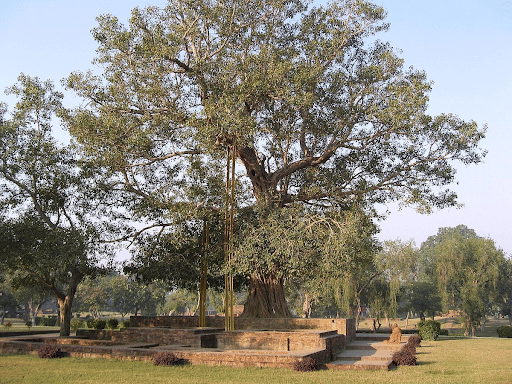
Jetavana Monastery
Conclusion
The Jetavana Monastery, built in a garden outside the city's walls and donated to the Buddha by a wealthy banker named Anathapindika, was the city's most prominent religious site. The Rajakarama and the Purvarama were two more prominent Buddhist monasteries. Shravasti was also a significant Jain centre.
FAQs
Question: Where is the Buddhist Temple at Sravasti located?
Answer: The Buddhist Temple is located in Sravasti, an ancient city in Uttar Pradesh, India, which is closely associated with Lord Buddha's life.
Question: Why is Sravasti significant in Buddhism?
Answer: Sravasti is significant in Buddhism because it was one of the places where Lord Buddha spent a considerable amount of time and performed miracles. It is also the site of important Buddhist structures, including stupas and monastic complexes.
Question: What kind of architecture can be found at the Buddhist Temple in Sravasti?
Answer: The architecture of the Buddhist temple in Sravasti features typical Buddhist art and architecture, including stupas, monastic complexes, and ancient ruins, showcasing the design style of ancient Buddhist structures.
Question: What miracles did Buddha perform in Sravasti?
Answer: In Sravasti, Lord Buddha is believed to have performed several miracles, such as multiplying his body and producing a rain of lotus flowers, which are symbolic of his divine powers and enlightenment.
Question: How does the Buddhist Temple at Sravasti reflect the spread of Buddhism?
Answer: The Buddhist Temple at Sravasti reflects the spread of Buddhism through its architectural styles, structures, and the influence of Buddhist teachings, which were propagated across India and beyond during ancient times.
MCQs
- Sravasti is an important site in Buddhism because it is associated with which historical figure?
A) Emperor Ashoka
B) Lord Buddha
C) Mahavir
D) Guru Nanak
Answer: (B) See the Explanation
Sravasti is significant in Buddhism due to its association with Lord Buddha, who spent a significant amount of time there and performed miracles.
- The Buddhist Temple in Sravasti is a reflection of which type of architecture?
A) Jain Architecture
B) Buddhist Art and Architecture
C) Mughal Architecture
D) Hindu Temple Architecture
Answer: (B) See the Explanation
The Buddhist Temple in Sravasti reflects typical Buddhist art and architecture, featuring stupas and monastic complexes.
- Which of the following miracles is Lord Buddha believed to have performed in Sravasti?
A) Stopping a war
B) Multiplying his body
C) Converting rivers into wine
D) Healing the sick
Answer: (B) See the Explanation
In Sravasti, Lord Buddha is believed to have performed the miracle of multiplying his body, which is a well-known event in Buddhist scriptures.
- In which state is the Buddhist Temple at Sravasti located?
A) Bihar
B) Uttar Pradesh
C) Rajasthan
D) Madhya Pradesh
Answer: (B) See the Explanation
The Buddhist Temple is located in Sravasti, which is situated in Uttar Pradesh, India.
- What is the historical significance of Sravasti in relation to Buddhism?
A) It is the birthplace of Buddha
B) Buddha performed many miracles here
C) It was where Buddha attained enlightenment
D) It is the site of Buddha’s parinirvana
Answer: (B) See the Explanation
Sravasti is historically significant because it is the place where Lord Buddha spent a significant amount of time and performed various miracles.
GS Mains Questions and Model Answers
Q1: Explain the importance of Sravasti in the spread of Buddhism and its role in Buddhist art and architecture.
Answer: Sravasti, an ancient city in Uttar Pradesh, holds immense significance in the history of Buddhism. It was one of the primary places where Lord Buddha spent time, delivered sermons, and performed miracles, including the famous miracle of multiplying his body. Sravasti’s prominence in the spread of Buddhism is reflected in its numerous Buddhist structures, including stupas, monasteries, and temples, which were built during the time of Buddha and thereafter. The city became a center of Buddhist learning and teachings. The art and architecture of the Buddhist Temple at Sravasti display characteristic elements of Buddhist design, such as stupas, monastic complexes, and structures that symbolize Buddha’s teachings. The temple and ruins found at Sravasti are a testament to the widespread influence of Buddhist culture and architecture, contributing to the understanding of early Buddhist art, and the city remains an important pilgrimage site for Buddhists worldwide.
Q2: Discuss the cultural and religious impact of Sravasti in ancient India.
Answer: Sravasti had a profound cultural and religious impact on ancient India, particularly in the spread of Buddhism. As a significant city during Lord Buddha’s lifetime, it became a hub for his teachings and activities. Buddha spent a substantial amount of time in Sravasti, delivering sermons and performing miracles, which attracted many followers. The city’s monastic complexes and stupas became centers of religious learning and meditation, marking it as one of the most important Buddhist sites in India. Sravasti also became a model for the architectural style of Buddhist temples and structures, which were later replicated in other parts of India and beyond. The cultural impact of Sravasti is seen in its integration of religious practices with art, as the sites there were not only places of worship but also centers for cultural exchange and the development of Buddhist philosophy. The city’s legacy continues to inspire religious and cultural practices even today.
Q3: Analyze the architectural features of the Buddhist Temple at Sravasti and their significance in understanding early Buddhist architecture.
Answer: The architectural features of the Buddhist Temple at Sravasti are representative of early Buddhist architecture and provide key insights into the design and structure of religious buildings in ancient India. The stupas and monastic complexes found in Sravasti are integral to understanding the evolution of Buddhist architectural styles. The stupa, which houses relics of Buddha, is a central feature in Buddhist temples, symbolizing enlightenment and the teachings of the Buddha. The monastic complexes served as places for monks to live, meditate, and practice Buddhism, reflecting the importance of monastic life in early Buddhist communities. The layout of these buildings, with their open courtyards and meditation spaces, emphasizes simplicity, peace, and spiritual focus. The architectural style of Sravasti influenced later Buddhist temples across India and other parts of Asia. The ruins and structures at Sravasti remain valuable for understanding the early development of Buddhist architectural traditions.
Previous Year Questions on Sravasti
1. UPSC CSE 2020
Question: Explain the cultural significance of Sravasti in the context of early Buddhism.
Answer: Sravasti holds cultural significance in early Buddhism as the place where Buddha performed miracles and spent a significant amount of time. The city became a center for Buddhist teachings, with stupas, monastic complexes, and temples becoming key features of its religious landscape, symbolizing the spread of Buddhist culture.
2. UPSC CSE 2019
Question: Discuss the role of art and architecture in promoting Buddhism during the time of Lord Buddha.
Answer: Art and architecture played a crucial role in promoting Buddhism, particularly in cities like Sravasti. The construction of stupas, monastic complexes, and Buddha statues facilitated the spread of Buddhist teachings, providing a physical space for meditation, prayer, and religious gatherings, which helped propagate the Buddha’s philosophy.
Download the PREPP App and attempt FREE IAS Exam Mock Tests and get complete study material!

Live Test : UPSC CSE Prelims CSAT (Paper-II) (Oct 20 - 23)
Full Test - 04: UPSC CSE Prelims CSAT (Paper-II)
Full Test - 03: UPSC CSE Prelims CSAT (Paper-II)
UPSC CSE Prelims 2026 GS Paper 1 Question Paper (24-May-2026)
UPSC CSE Prelims 2026 CSAT Paper 2 Question Paper (24-May-2026)

17 February 2025 | The Hindu Must Read Articles | Current Affairs

16 February 2026 | The Hindu Must Read Articles | Current Affairs

13 February 2026 | The Hindu Must Read Articles | Current Affairs









Comments