Early Temples of Ancient and Medieval India - Art and Culture Notes
The majority of architectural remnants of India are Ancient and Medieval are religious in origin. Temples in different parts of the country have distinct architectural styles due to geographical, cultural, and historical variances. The country's two major temple orders are Nagara in the north and Dravida in the south. Myths mentioned in the Puranas become part of the Hindu religion's narrative portrayal. This article will explain to you the concepts related to Early temples which will be helpful in Indian Art and Culture preparation for the UPSC Civil service exam.
|
Table of Contents |
Early Temples
- The majority of the architectural relics from Ancient and Medieval India are of a religious nature.
- Geographical, cultural, and historical differences resulted in varied architectural styles of temples in different sections of the country
- Nagara in the north and Dravida in the south are two broad orders of temples in the country.
- The Vesara temple style is sometimes discovered as a separate style, resulting from the selective merging of the Nagara and Dravida orders.
- More surfaces for sculpture were created as temples became more sophisticated, by adding more and more rhythmically protruding, symmetrical walls and niches without deviating from the shrine's basic form.
| Other Relevant Links | |
|---|---|
| Mathura, Sarnath and Gandhara Schools | Bharhut stupa |
| Buddhist Monuments of South India | Stupas |
| Chaityas | Viharas |
Historical background
- Temples in India have a few thousand years of history behind them. Their architecture has evolved with time.
- They differ in size, style & construction material, depending on geographical location and the resources available.
- In the early Vedic period there is no clear mention of temples. All worship & rituals were done before the holy fire called “Yagna'.
- In the later Vedic period, idol worship began and those were kept in elementary dwellings with simple earth mounds that were substituted later by brickwork with grass roofs.
- Later on, technology and science brought more sophistication and temples were made with more details and designs.
Temples
| Temple | Style and Features | |
|---|---|---|
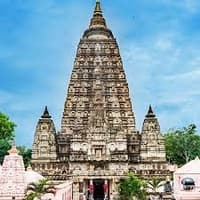
| Mahabodhi Temple, Bihar (3rd century) |
|
 |
| Sanchi temple 17, Madhyapradesh. (5th Century ) |
|
 |
| Nachna Hindu temple, Madhyapradesh. (5th Century) |
|
 |
| Bhitargaon temple, Uttarpradesh. (5th century ) |
|
 |
| Bhumara temple, Madhya Pradesh (5th century) |
|
 |
| Badami temple, Karnataka (6th century) |
|
 |
| Deogarh dashavatara temple, Uttarpradesh (6th century) |
|
 |
| Pattadakal temples, Karnataka (7th century) |
|
 |
| Kailashnath temple at Ellora (8th century) |
|
 |
| Lad Khan temple at Aihole (8th century) |
|
 |
| Chaturmukha temple, karnataka. (9th Century ) |
|
 |
| Virupaksha temple, karnataka (9th Century) |
|
 |
| Kamakhya temple, Assam ( 8th Century) |
|
 |
| Kandariya Mahadeva temple (10th Century) |
|
 |
| Lakshman temple at Khajuraho (10th Century) |
|
 |
| Shiva temple of Thanjavur, Brihadeeswara temple (10th Century) |
|
 |
| Lingaraj Temple in Bhubaneswar (11th Century) |
|
 |
| Modhera Sun temple, Gujarat. (11th Century) |
|
 |
| Chausath Yogini temple (11th Century) |
|
 |
| Siddhesvara Mahadeva Temple (12th Century) |
|
 |
| Jagannath Temple in Puri (12th Century) |
|
 |
| Sun Temple in Konark (13th Century) |
|
 |
| Lakshmi narasimha temple (13th Century) |
|
 |
Conclusion
Along with these types and styles, there are many different forms of temple architecture in India, each with its own name based on the location. And they're made of materials that are only found in that area. Kashmir's proximity to Gandhara monuments is notable, while the Himalayan region contains a variety of styles, such as Kedarnath in Garhwal and Jageshwar in Kumaon. As a result, temple architecture in different places has a variety of influences, resulting in a variety of styles with only a few distinguishing characteristics.
FAQs
Question: What are the key characteristics of early Indian temples?
Answer: Early Indian temples, from the Gupta period, showcased features like a square sanctum (garbhagriha), a mandapa (porch), and simple flat roofs. Later, a tower or shikhara was added over the sanctum, a hallmark of Nagara architecture. These temples were mostly constructed using stone and brick.
Question: How did temple architecture evolve during the Gupta period?
Answer: Gupta architecture marked the beginning of temple structures in India, with the introduction of distinct temple designs like the square sanctum and flat-roofed shrines. Notable advancements included the introduction of the shikhara and ambulatory paths around the sanctum.
Question: What is the significance of the Dashavatara Temple?
Answer: The Dashavatara Temple at Deogarh is one of the earliest known examples of temple architecture featuring a prominent shikhara. Built in the 6th century, it is noted for its intricate carvings and high platform, symbolizing early advancements in temple construction.
Question: How did the Vesara style emerge?
Answer: The Vesara style emerged as a blend of the Nagara (northern) and Dravidian (southern) styles of architecture. It is predominantly found in the Deccan region and is noted for its hybrid features such as the combination of Nagara shikharas with Dravidian domes.
Question: What is the difference between the Nagara and Dravidian temple styles?
Answer: The Nagara style, predominant in northern India, is characterized by curvilinear towers (shikharas), while the Dravidian style, from southern India, features pyramidal towers (vimanas) and elaborate gateways (gopurams). The Dravidian style often includes vast temple complexes.
MCQs
1. What was a key feature of early Gupta period temples?
A) Elaborate towers
B) Flat roofs and small shrines
C) Gopurams
D) Dome-shaped roofs
Answer: (B) See the Explanation
Explanation: Early Gupta temples were characterized by flat roofs and small shrines, often square in shape, with simple designs. Towers (shikharas) and elaborate designs became more common later.
2. Which of the following temples is an example of early Nagara architecture?
A) Brihadeeswarar Temple
B) Dashavatara Temple
C) Meenakshi Temple
D) Sun Temple at Konark
Answer: (B) See the Explanation
Explanation: The Dashavatara Temple at Deogarh is an example of early Nagara architecture, known for its square sanctum and shikhara, which is characteristic of northern Indian temple architecture.
3. In which region did the Vesara style of architecture develop?
A) Northern India
B) Southern India
C) Deccan
D) Eastern India
Answer: (C) See the Explanation
Explanation: The Vesara style developed in the Deccan region as a hybrid of Nagara and Dravidian styles, incorporating elements from both architectural traditions.
4. What is the primary feature of Dravidian temple architecture?
A) Curvilinear towers
B) Pyramidal towers (Vimanas)
C) Flat roofs
D) Dome-shaped roofs
Answer: (B) See the Explanation
Explanation: Dravidian temple architecture is marked by pyramidal towers (vimanas) over the sanctum, often accompanied by large, elaborate gateways called gopurams.
5. Which dynasty is known for the introduction of the shikhara in temple architecture?
A) Chola
B) Pallava
C) Gupta
D) Maurya
Answer: (C) See the Explanation
Explanation: The Gupta Dynasty introduced the shikhara, a prominent feature of Nagara-style temples, marking a significant evolution in temple architecture.
GS Mains Questions and Model Answers
Q1: Discuss the evolution of temple architecture in India from the Gupta period to the Chola period.
Answer: The Gupta period marked the beginning of temple construction in India, with simple, square-shaped shrines with flat roofs. The introduction of the shikhara in the Nagara style was a significant advancement. During the later periods, the Dravidian style emerged in the south, with elaborate vimanas and gopurams. The Chola period saw the further refinement of the Dravidian style, with larger temple complexes and detailed sculptures, best exemplified by the Brihadeeswarar Temple.
Q2: Explain the significance of the Dashavatara Temple at Deogarh in Indian temple architecture.
Answer: The Dashavatara Temple, built in the early 6th century, is a seminal example of Nagara architecture. It features a high platform and an intricately carved shikhara, marking a significant development in temple design. The temple's iconography and layout served as a prototype for later Hindu temple designs across northern India.
Q3: Compare the Nagara and Dravidian styles of temple architecture. What are the key differences in design and cultural significance?
Answer: The Nagara style, dominant in northern India, features curvilinear shikharas and relatively smaller, single-spired temples. Dravidian architecture, on the other hand, includes vast temple complexes, with pyramidal vimanas and grand gateways (gopurams). While Nagara temples are often built on elevated platforms, Dravidian temples focus on horizontal expansion, featuring pillared halls and large enclosures.
Previous Year Questions on Early Temples
1. UPSC CSE Prelims 2019:
Question: The Dashavatara Temple at Deogarh is associated with which style of architecture?
A) Dravidian
B) Vesara
C) Nagara
D) Buddhist
Answer: (C)
Explanation: The Dashavatara Temple is an early example of Nagara-style architecture, known for its square sanctum and towering shikhara.
2. UPSC CSE Mains 2020 (GS Paper 1):
Question: "Evaluate the impact of temple architecture on Indian society and religion, with specific reference to Nagara and Dravidian styles."
Answer: Temple architecture played a crucial role in shaping religious and social practices in India. The Nagara style, with its soaring shikharas, inspired spiritual ascension, while the Dravidian style, through its grand complexes, fostered community gatherings and religious festivals. Both styles influenced the arts, literature, and cultural traditions, leaving a lasting legacy on Indian society.
Download the PREPP App and attempt FREE IAS Exam Mock Tests and get complete study material!

Full Test - 04: UPSC CSE Prelims CSAT (Paper-II)
Full Test - 03: UPSC CSE Prelims CSAT (Paper-II)
UPSC CSE Prelims 2026 GS Paper 1 Question Paper (24-May-2026)
UPSC CSE Prelims 2026 CSAT Paper 2 Question Paper (24-May-2026)

17 February 2025 | The Hindu Must Read Articles | Current Affairs

16 February 2026 | The Hindu Must Read Articles | Current Affairs

13 February 2026 | The Hindu Must Read Articles | Current Affairs









Comments