Bad Banks - Indian Economy Notes
A bad bank is a company selling illiquid and risky assets that are owned by banks and financial institutions, or a group of banks. It is intended to assist banks in cleaning up their balance sheets by transferring poor loans, allowing them to focus on their primary business of accepting deposits and lending money.
|
Table of Contents |
In this article, let us see the meaning of a Bad bank, the need for a Bad Bank, the composition and structure of a Bad Bank in India, and its drawbacks.
What is a Bad Bank?
- A bad bank is a financial institution that was formed to purchase the bad loans and other illiquid assets of another financial institution.
- The organization with a large number of nonperforming assets will sell them to the bad bank at market value.
- The original institution may be able to clear its balance sheet by transferring such assets to the bad bank, albeit it will still be compelled to take write-downs.
- Instead of a single bank, a bad bank structure may assume the risky assets of a consortium of financial organizations.
- Grant Street National Bank is a well-known example of a bad bank. This entity was founded in 1988 to house Mellon Bank's bad assets.
- Outside of the United States, the Republic of Ireland established the National Asset Management Agency, a bad bank, in 2009 in response to the country's own financial crisis.
| Other Relevant Links | |
|---|---|
| Wilful Defaulter | Classification of NPA |
| SARFAESI Act | Insolvency and Bankruptcy Code |
| Asset Quality review | Recapitalisation of Banks |
| Development Bank | Prompt Corrective Action |
Need for Bad Bank
- The Reserve Bank of India (RBI) launched an Asset Quality Review (AQR) of banks during Governor Raghuram Rajan’s tenure, which discovered that numerous banks had suppressed or hidden poor loans in order to present a healthy balance sheet.
- He suggested the setting up of Bad Bank to absorb the rising NPAs of the banks.
- Due to several procedural problems, Asset Reconstruction Companies (ARCs) have had no effect in settling bad loans.
- While conventional banks continue lending, a "bad bank," or a bank of bad loans, would endeavor to sell these "assets" on the open market.
- It is a tried and tested method of dealing with NPAs and bad assets during the 2008 financial crisis.
- Existing ARCs have aided in the resolution of stressed assets, particularly for loans with a smaller value.
- The Insolvency and Bankruptcy Code (IBC) and other applicable resolution tools have been shown to be useful.
Bad Bank in India
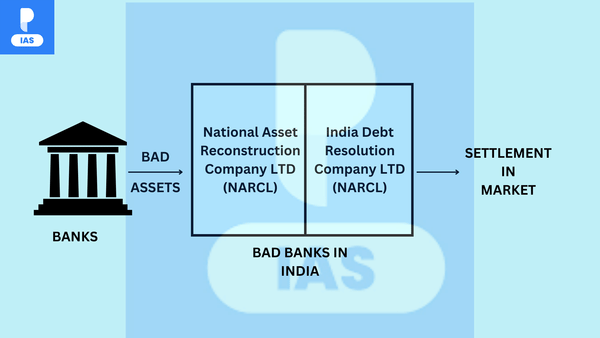
- The government of India has established two new firms to acquire stressed assets from banks and then sell them in the market in order to resolve large NPAs (Non-Performing Assets) in the Indian banking sector.
- NARCL: National Asset Reconstruction Company Limited (NARCL) was established under the Companies Act and has applied for an Asset Reconstruction Company license from the Reserve Bank of India (ARC).
- In phases, NARCL will buy stressed assets totaling roughly Rs 2 lakh crore from various commercial banks.
- NARCL will be owned by public sector banks (PSBs) to the tune of 51 percent.
- The NARCL will buy bad loans from banks first.
- It will pay 15% of the agreed price in cash and the rest 85% in "Security Receipts."
- The commercial banks will be paid back the remainder when the assets are sold with the help of IDRCL.
- The government guarantee will be activated if the bad bank is unable to sell the bad loan or must sell it at a loss.
- This guarantee is extended for a five-year period.
- IDRCL: The stressed assets will subsequently be sold in the market by another firm, India Debt Resolution Company Ltd (IDRCL).
- IDRCL will be owned to a maximum of 49 percent by PSBs and Public Financial Institutes (FIs).
- Private-sector lenders will own the remaining 51 percent of the company.
- The new bad bank structure is this framework of NARCL-IDRCL.
Significance of Bad Bank
- It will assist lenders in moving problematic assets to a bad bank and cleaning up their books.
- Banks will be able to re-start lending after the bad bank releases capital. It will be more goal-oriented, and hence better able to collect debts from borrowers.
- Because it is backed by the government, it will not be hampered by governance flaws, a slow-moving legal system, or poorly constructed regulations, among other concerns that plague ARCs.
- Overall, it will provide a significant boost to the macroeconomic environment.
- We must not overlook the fact that a bad bank will not be able to prevent future NPAs. The government must identify strategies to eliminate nonperforming assets (NPAs), which are the primary cause of banks' losses and the economy's slowdown.
Challenges for Bad Bank
- When it comes to the bad bank, the majority of these problematic assets have already been completely funded and recorded on bank books. The banks have abandoned all expectations of a significant recovery.
- The most crucial aspect of these assets will be how banks arrive at a valuation for their transfer to the bad bank. For future provision write-backs by banks, the bad bank's capacity to resolve these assets in a timely manner will be crucial.
- Another challenge that may arise is the sale of stressed assets to potential buyers while also correcting the system's fundamental dilemma.
- Finding potential purchasers for distressed assets might be difficult in the current situation when economic conditions are deteriorating and the Insolvency and Bankruptcy Code has been suspended.
- Furthermore, public sector banks will be both shareholders and customers of the bad bank, posing the risk of the bad bank becoming nothing more than a conduit for transferring bad debt from one book to another.
Criticism of Bad Bank
- Moral Hazard: Former Reserve Bank Governor Raghuram Rajan believes that establishing a bad bank could generate moral hazard issues among banks, allowing them to continue with their irresponsible lending practices and increasing the NPA problem.
- Not a trusted Antidote: It has been suggested that establishing a bad bank only moves the problem from one location to another. Without major reforms to address the NPA problem, the bad bank is likely to devolve into a storage facility for bad loans with no prospect of recovery.
- Poor Fiscal Position: Another major worry is the inability to raise capital for the bad bank. In a pandemic-affected economy, it's difficult to find purchasers for distressed assets, and the government's finances are tight.
Conclusion
The Union Cabinet has authorized a Rs 30,600 crore guarantee to back National Asset Reconstruction Company Limited's (NARCL) Security Receipts for the acquisition of stressed loan assets. The government's involvement is considered as a way to expedite the cleanup procedure. Many other countries, such as the United States, had established institutional procedures to deal with financial sector stress, such as the Troubled Asset Relief Program (TARP).
FAQs
Question. What are "Bad Banks"?
Answer: Bad Banks are financial institutions established to manage and resolve non-performing assets (NPAs) or bad loans of other banks. The primary purpose of a Bad Bank is to separate the stressed assets from the healthy ones, allowing regular banks to focus on lending and maintaining profitability. The Bad Bank takes on the bad loans, manages them, and works toward recovery or restructuring.
Question. Why do bad loans occur in banks?
Answer: Bad loans, or Non-Performing Assets (NPAs), occur when borrowers fail to repay their loans according to the agreed terms. The main reasons for the accumulation of bad loans in banks include:
- Economic downturns: A slowdown in the economy can affect borrowers’ ability to repay loans.
- Poor lending practices: Banks may issue loans without proper due diligence or risk assessment.
- Corporate mismanagement: In cases of business failures, companies may default on loans.
- Political influence: Sometimes loans are given based on political connections rather than sound financial reasoning.
Question. How do Bad Banks work?
Answer: A Bad Bank works by:
- Acquiring NPAs: It buys non-performing assets from commercial banks, which helps those banks clean up their balance sheets.
- Managing the assets: The Bad Bank works to recover or restructure the bad loans, often by selling them to investors or turning the loans around.
- Restructuring loans: Bad Banks may also engage in loan restructuring or settlement plans with borrowers to recover some of the value.
Question. How does a Bad Bank help the economy?
Answer: Bad Banks help the economy in several ways:
- Improved banking health: By offloading bad loans, regular banks can focus on profitable lending activities, which stimulates economic growth.
- Boosts lending: With fewer bad loans on their balance sheets, banks are more willing to lend to businesses and individuals.
- Economic recovery: By resolving NPAs, Bad Banks can help in the recovery of businesses and industries that are otherwise struggling, preserving jobs and economic stability.
Question. What are the challenges associated with Bad Banks?
Answer: The main challenges of Bad Banks include:
- Valuation of bad assets: Determining the true value of non-performing assets can be complex and subjective.
- Debt recovery: Recovering money from bad loans is often difficult, especially in cases of corporate defaults.
- Long-term sustainability: Bad Banks can face difficulties in managing the volume of NPAs if not backed by sufficient capital or expertise.
MCQs
- What is the primary function of a Bad Bank?
A) To generate profit through lending activities
B) To acquire and manage non-performing assets (NPAs)
C) To provide loans to government institutions
D) To issue new loans to businesses
Answer: (B) See the Explanation
A Bad Bank primarily acquires non-performing assets (NPAs) from regular banks and works on their recovery or restructuring.
- What is the key benefit of a Bad Bank in an economy?
A) It directly increases government revenue
B) It helps regular banks clean up their balance sheets and improve lending capacity
C) It reduces the interest rates in the economy
D) It increases foreign direct investment
Answer: (B) See the Explanation
By offloading NPAs, Bad Banks help regular banks improve their financial health, enabling them to resume lending and support economic growth.
- Which of the following is NOT typically a function of a Bad Bank?
A) Buy NPAs from regular banks
B) Restructure bad loans to recover value
C) Issue new loans to individuals and businesses
D) Help regular banks focus on profitable lending
Answer: (C) See the Explanation
Bad Banks focus on managing and recovering NPAs, not on issuing new loans to businesses or individuals.
- What is a major challenge faced by Bad Banks?
A) Lack of sufficient capital for lending
B) Difficulty in valuing and recovering bad loans
C) Political interference in decision-making
D) High interest rates on loans
Answer: (B) See the Explanation
One of the biggest challenges faced by Bad Banks is the difficulty in valuing NPAs and the complexity of recovering the loan amounts.
- How do Bad Banks benefit the overall banking sector?
A) By focusing solely on profitable loans
B) By cleaning up the balance sheets of regular banks, allowing them to resume lending
C) By reducing the number of branches in rural areas
D) By issuing bonds to raise funds for the government
Answer: (B) See the Explanation
Bad Banks help regular banks offload bad loans, allowing them to focus on healthy lending practices, boosting economic activity.
GS Mains Questions and Model Answer
Q1: Evaluate the role of Bad Banks in addressing the Non-Performing Asset (NPA) crisis in India.
Answer: Bad Banks play a crucial role in addressing the NPA crisis by providing a dedicated platform for managing and resolving bad loans. The Indian banking sector has been burdened by rising NPAs, which limit the capacity of banks to lend to productive sectors. By setting up Bad Banks, the government can separate toxic assets from regular banks’ balance sheets, thereby improving their financial health and their ability to provide new loans. This process not only ensures better liquidity for banks but also facilitates recovery of bad loans through restructuring or asset sales. While Bad Banks help in reducing the burden of NPAs, challenges such as effective asset valuation and debt recovery still remain. However, their role in the larger scheme of India’s financial sector reform is pivotal, and they contribute to economic stability and growth.
Q2: Discuss the challenges and benefits of establishing a Bad Bank in India to tackle NPAs.
Answer: Establishing a Bad Bank in India offers several benefits but also presents challenges.
- Benefits:
- Improved bank stability: By offloading NPAs, Bad Banks allow commercial banks to clean up their balance sheets and resume lending to productive sectors of the economy.
- Financial sector health: Bad Banks can help improve the liquidity in the financial system, promoting more robust economic growth.
- Efficient recovery: Bad Banks have specialized teams that can focus on restructuring or recovering bad loans more efficiently than regular banks.
- Challenges:
- Valuation of NPAs: Accurately assessing the value of distressed assets can be difficult, leading to potential losses.
- Debt recovery: Recovering money from bad loans is often a long and complex process and may not yield the expected returns.
- Funding and sustainability: Adequate capital and resources are needed to manage a Bad Bank’s operations effectively, especially for large-scale recoveries.
Q3: How do Bad Banks contribute to the financial inclusion agenda in India?
Answer: Bad Banks contribute to financial inclusion indirectly by improving the health of the banking sector. When regular banks have large amounts of NPAs on their books, they tend to limit lending, especially to smaller businesses and low-income individuals. By cleaning up their balance sheets, Bad Banks enable commercial banks to focus on healthy lending, which increases the availability of credit for underserved sectors of society. This can help promote financial inclusion by providing loans to businesses in rural areas, facilitating the expansion of financial services, and increasing access to credit for economically disadvantaged communities. Furthermore, as banks recover from the NPA burden, they can invest in technologies and infrastructure that enhance financial accessibility, such as mobile banking and financial literacy programs.
Previous Year Questions on Bad Bank
1. UPSC CSE 2021
Question: How can the establishment of Bad Banks contribute to resolving the Non-Performing Asset (NPA) crisis in India?
Answer: This question expects an in-depth explanation of how Bad Banks can help resolve the NPA crisis. The answer should focus on their role in separating bad loans from regular banks, providing financial stability, and enabling banks to resume lending.
2. UPSC CSE 2020
Question: Evaluate the effectiveness of Bad Banks in addressing the issue of bad loans in the Indian banking sector.
Answer: This question asks for an evaluation of the effectiveness of Bad Banks. The answer should discuss both the advantages (such as improved financial stability and better loan recovery) and challenges (such as asset valuation issues and debt recovery difficulties) involved in implementing this model in India.
Download the PREPP App and attempt FREE IAS Exam Mock Tests and get complete study material!

Full Test - 04: UPSC CSE Prelims CSAT (Paper-II)
Full Test - 03: UPSC CSE Prelims CSAT (Paper-II)
UPSC CSE Prelims 2026 GS Paper 1 Question Paper (24-May-2026)
UPSC CSE Prelims 2026 CSAT Paper 2 Question Paper (24-May-2026)

17 February 2025 | The Hindu Must Read Articles | Current Affairs

16 February 2026 | The Hindu Must Read Articles | Current Affairs

13 February 2026 | The Hindu Must Read Articles | Current Affairs









Comments