Types of Banks – Indian Economy Notes
Different types of banks and financial institutions provide differenttypes ofproducts and services to meet the needs of individuals, families, businesses, and large organisations. Even a single type of bank may provide a variety of bank accounts, such as checking, savings, and money market accounts. Banks can be classified into one of several types based on how they were established or chartered, their primary focus, and who their target customers are.
|
Table of Contents |
What is a Bank?
- Banks are the institutional bodies that accept deposits and grant credit to entities, and they play an important role in a country's economic standing.
- Banks are strictly regulated in most countries due to their importance in the economy.
- In India, the Reserve Bank of India (RBI) is the apex banking institution in charge of the country's monetary policy.
| Other Relevant Links | |
|---|---|
| Commercial Banks | Small Finance Banks |
| Payment Banks | Cooperative banks |
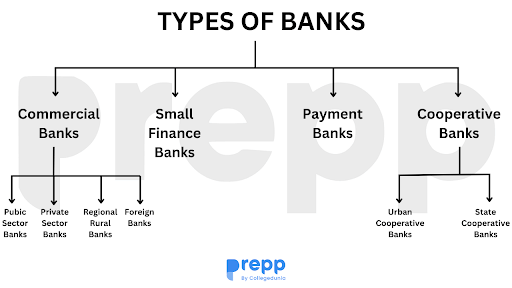
Types of Banks
-
Commercial Banks
- Any banking organisation that deals with the deposits and loans of businesses is referred to as a commercial bank.
- Commercial banks issue bank checks and drafts and accept term deposits.
- Through instalment loans and overdrafts, commercial banks also serve as moneylenders.
- Commercial banks also provide a variety of deposit accounts, including checking, savings, and time deposits.
- These institutions are run for profit and are owned by a group of people.
Commercial Banks are further divided into the following:
(i) Public Sector Banks
- These are banks in which the Government of India owns a majority stake.
- SBI, Bank of India, Canara Bank, and other public sector banks are examples.

(ii) Private Sector Banks
- The majority of a bank's share capital is held by private individuals. These banks are set up as limited-liability corporations.
- Private sector banks include ICICI Bank, Axis Bank, HDFC, and others.
| List of Private Sector Banks | |
|---|---|
| Axis Bank | IndusInd Bank |
| Bandhan Bank | Jammu and Kashmir Bank |
| City Union Bank | Karnataka Bank |
| Dhanlaxmi Bank | Kotak Mahindra Bank |
| DCB Bank | Karur Vysya Bank |
| Federal Bank | Lakshmi Vilas Bank |
| HDFC Bank | Nainital Bank |
| ICICI Bank | RBL Bank |
| IDFC Bank | South Indian Bank |
| IDBI Bank | Tamilnad Mercantile Bank |
| YES Bank | |
(iii) Regional Rural Banks
- Regional Rural Banks were established in accordance with the provisions of an Ordinance promulgated on September 26, 1975, and the RRB Act, 1976, with the goal of ensuring adequate institutional credit for agriculture and other rural sectors.
- RRBs can only operate in the areas that have been designated by Gol as covering one or more districts in the state.
- RRBs are jointly owned by Gol, the relevant State Government, and Sponsor Banks; the issued capital of an RRB is divided among the owners in the proportions of 50%, 15%, and 35%, respectively.
(iv) Foreign Banks
- These banks are registered and have their headquarters in another country, but they have branches in our country.
- Foreign banks in India include HSBC, Citibank, Standard Chartered Bank, and others.
- Small Finance Banks (SFBs)
- The Small Finance Bank (SFB) is a private financial institution that primarily undertakes basic banking activities such as deposit acceptance and lending to unserved segments such as small business units, small and marginal farmers, micro and small industries, and unorganised sector entities, but without any geographical restrictions, unlike Regional Rural Banks or Local Area Banks.
- Small Finance Banks were established in response to an announcement made in the Union Budget 2014-2015, which was presented on July 10, 2014.
- On November 27, 2014, the RBI issued guidelines for the licencing and regulation of SFBs.
- On September 16, 2015, the RBI decided to grant "in-principle" approval to ten applicants to establish small finance banks in order to advance the financial inclusion agenda.
- Au Financiers (Jaipur), Capital Local Area Bank (Jalandhar), Disha Microfin (Ahmedabad), Equitas Holdings (Chennai), ESAF Microfinance and Investments (Chennai), Janalakshmi Financial Services (Bengaluru), Janal (Bengaluru), RGVN (Northeast) Microfinance (Guwahati), Suryoday Micro Finance (Navi Mumbai), Ujjivan Financial Services (Bengaluru), and Utkarsh Micro Finance (Varanasi).
- The above-mentioned banks were chosen from a pool of 72 applicants. Customers' deposits will be accepted by small finance banks.
- In addition, unlike payments banks, small finance banks will be permitted to lend money to individuals.
- Microfinance institutions make up the majority of those who have received the 'in-principle' approval.
- As a result, the majority of small finance bank customers will be small and medium enterprises and small businesses.
- These banks will now be able to provide MSMEs and SMEs with secured and legal loans, bringing them into the financial system.
| List of Small Finance Banks | |
|---|---|
| Au Small Finance Bank Ltd. | Jana Small Finance Bank Ltd. |
| Capital Small Finance Bank Ltd. | North East Small FinanceBank Ltd. |
| ESAF Small Finance Bank Ltd. | Suryoday Small Finance Bank Ltd. |
| Equitas Small Finance Bank Ltd. | Utkarsh Small Finance Bank Ltd. |
| Fincare Small Finance Bank Ltd. | Ujjivan Small Finance Bank Ltd. |
-
Payment Banks
- A payment bank is a distinct type of bank that performs only the limited banking functions permitted by the Banking Regulation Act of 1949.
- Acceptance of deposits, payments and remittance services, internet banking, and acting as a business correspondent for other banks are examples of some oftheactivities.
- They are initially permitted to collect deposits of up to Rs 1 lakh per individual.
- They can help with money transfers as well as sell insurance and mutual funds. Furthermore, they can only issue ATM/debit cards, not credit cards.
- They are not permitted to establish subsidiaries to provide non-banking financial services. More importantly, they are not permitted to engage in any lending activities.
- On February 15, 2015, the RBI published a list of entities that had applied for a payments bank licence. There were 41 entitieswho hadapplied.
- To evaluate the licence applications, an External Advisory Committee (EAC) led by Nachiket Mor wasformed.
- The government has decided that India Post will run a payments bank using its extensive network.
- On July 6, 2015, the external advisory committee, led by Nachiket Mor, submitted its findings. The applicant entities' financial records and governance issues were scrutinised.
- Payment banks' goal is to bring unbanked people into the fold of formal banking while also accelerating financial inclusion.
- The spread of banking will also help the poor become financially literate and aid in the fight against poverty.
- The RBI's establishment of payment banks is a significantstep. People in rural areas will be reached by payment banks.
- Payments banks will ensure that more money enters the banking system.
- Various banks, including big banks like SBI, are looking to expand their rural reach, and payments banks will help them achieve this goal.
- The Reserve Bank of India granted "in-principle" permission to the following entities to establish payment banks:
- Nuvo Aditya Birla, Airtel M Commerce Services, Cholamandalam Distribution Services, Department of Posts, FINO PayTech, National Securities Depository, Reliance Industries, Dilip Shanghvi - Sun Pharmaceuticals, Paytm, Tech Mahindra, M-Pesa (Vodafone M-Pesa),
- Out of the above mentioned, three of them have surrendered their licences - The first was Chalomandalam Distribution Services, followed by Dilip Shanghvi, Sun Pharmaceuticals, and the most recent, Tech Mahindra.
- The "in-principle" licence is valid for 18 months, during which time the entities must meet the requirements.
- They are not permitted to engage in banking activities during this time.
- After determining that the conditions have been met, the RBI will consider granting full licences under Section 22 of the Banking Regulation Act of 1949.
- The Payments Bank is proposed to be registered as a public limited company under the Companies Act of 2013, and licenced under Section 22 of the Banking Regulation Act of 1949, with specific licencing conditions limiting its activities to accepting demand deposits and providing payments and remittance services.
- It will be governed by the provisions of the Banking Regulation Act of 1949, the Reserve Bank of India Act of 1934, the Foreign Exchange Management Act of 1999, the Payment and Settlement Systems Act of 2007.
- With differentiated banks entering the banking space, the biggies such as SBI, ICICI Bank, and others are feeling the heat. These banks will only operate in specific areas.
-
Co-operative Banks
- A cooperative bank is a financial entity that is owned and operated by its members, who are also its customers.
- Co-operative banks are frequently formed by people who belong to the same local or professional community or who share a common interest.
- Co-operative banks typically offer a wide range of banking and financial services to their members (loans, deposits, banking accounts, etc).
- They offer a limited range of banking services and specialise in agricultural products.
- Cooperative banks are the primary financiers of agricultural activities, small-scale industries, and self-employment.
- Cooperative banks operate on the principle of "no profit, no loss."
- Anyonya Co-operative Bank Limited (ACBL) is India's first co-operative bank, headquartered in Vadodara,Gujarat.
Co-operative Banks can further be divided into the following:
(i) Urban Cooperative Banks
- The term "Urban Co-operative Banks" refers to primary cooperative banks in urban and semi-urban areas.
- These banks primarily lent to small borrowers and businesses centred on communities, neighbourhoods, and workplace groups.
- They primarily finance entrepreneurs, small businesses, industries, and self-employment in urban areas, as well as home purchases and educational loans.
(ii) State Cooperative Banks
- A State Cooperative Bank is a federation of the central cooperative bank that serves as the state's custodian of the cooperative banking structure.
- Co-operative banks in rural areas primarily serve agricultural-based activities such as farming, livestock, dairies, and hatcheries, among others.
- They also give loans to small-scale businesses, cottage industries, and self-employment activities such as artisanship.
Conclusion
All banks do not serve the same function. There are various types of financial institutions, and each has a distinct impact on the market.Understanding the various types of banks and their functions will give you a better understanding of why they are important and how they contribute to the economy.
| Other Relevant Links | |
|---|---|
| Indian Economics Notes | Banking Sector in India |
| Evolution of Banking Sector | NABARD |
| SIDBI | National Housing Bank |
| MUDRA Bank | Non-Banking Financial Company |
FAQs
Q1: What are the different types of banks in India?
Answer: The main types include commercial banks, cooperative banks, regional rural banks, and development banks.
Q2: What is the primary function of commercial banks?
Answer: Commercial banks accept deposits and provide loans to individuals and businesses for various purposes.
Q3: How do cooperative banks differ from commercial banks?
Answer: Cooperative banks are owned and operated by their members, focusing on serving their local community, while commercial banks are profit-driven institutions.
Q4: What role do regional rural banks play in the Indian economy?
Answer: Regional rural banks aim to provide financial services to rural and semi-urban areas, enhancing agricultural and rural development.
Q5: What are development banks?
Answer: Development banks provide long-term capital for investment in various sectors to promote economic growth and development.
MCQs
- Which of the following is a type of commercial bank?
a) NABARD
b) SBI
c) IFFCO
d) NABARD
Answer: (B) See the Explanation
- What is the main focus of cooperative banks?
a) Profit maximization
b) Serving their members
c) Offering international banking
d) Investment banking
Answer: (B) See the Explanation
- What is the primary purpose of regional rural banks?
a) To provide urban banking services
b) To cater to the rural population
c) To facilitate international trade
d) To offer financial services to corporate clients
Answer: (B) See the Explanation
- Which bank primarily supports agricultural financing in India?
a) ICICI Bank
b) NABARD
c) HDFC Bank
d) Axis Bank
Answer: (B) See the Explanation
- Development banks mainly focus on which aspect of the economy?
a) Short-term loans
b) Personal banking
c) Economic development
d) Foreign exchange
Answer: (C) See the Explanation
GS Mains Questions and Model Answers
Q1: Discuss the importance of cooperative banks in the Indian banking sector.
Answer: Cooperative banks play a vital role in the Indian banking sector by providing financial services to the underserved and rural populations. They promote savings and provide credit at reasonable rates, contributing to agricultural development and rural upliftment. These banks are crucial for empowering local communities, fostering economic growth, and ensuring financial inclusion. By focusing on member welfare, cooperative banks support grassroots economic activities, which are essential for sustainable development in India.
Q2: Analyze the role of regional rural banks in promoting financial inclusion in India.
Answer: Regional rural banks (RRBs) are instrumental in promoting financial inclusion by providing banking services in rural and semi-urban areas where traditional banks may be absent. They focus on serving small farmers, agricultural laborers, and small entrepreneurs, helping to bridge the urban-rural divide in financial services. RRBs facilitate access to credit, savings, and insurance products, empowering marginalized communities. Their role in supporting self-help groups and microfinance initiatives further enhances economic stability and growth in rural regions.
Q3: Evaluate the impact of development banks on economic growth in India.
Answer: Development banks significantly impact economic growth in India by providing long-term finance for infrastructure projects, industrial development, and social initiatives. They play a crucial role in funding sectors that are vital for national development, such as agriculture, small and medium enterprises (SMEs), and housing. By offering tailored financial products, development banks stimulate investments that create jobs, enhance productivity, and promote sustainable development. Their strategic financing supports government policies aimed at balanced regional development and poverty alleviation.
Previous Year Questions on Types of Banks
1. UPSC CSE 2020
Question: "Discuss the various types of banks in India and their respective roles in the economy."
Answer: India has a diverse banking system comprising commercial banks, cooperative banks, regional rural banks, and development banks. Commercial banks, including private and public sector banks, are the backbone of the financial system, providing a wide array of services like savings accounts, loans, and investment products. Cooperative banks focus on serving specific communities, facilitating savings and credit access. Regional rural banks cater to rural populations, promoting agricultural financing and rural development. Development banks support long-term economic projects, enhancing infrastructure and industrial growth. This multi-tiered banking structure fosters financial inclusion and economic development across various sectors.
2. UPSC CSE 2019
Question: "Examine the challenges faced by cooperative banks in India."
Answer: Cooperative banks in India face several challenges, including regulatory constraints, governance issues, and competition from commercial banks. Many cooperative banks struggle with inadequate capital and lack of technological advancement, hindering their ability to compete effectively. The dual control by state governments and the Reserve Bank of India creates confusion in regulatory compliance. Moreover, the mismanagement and lack of transparency in some cooperative banks have led to a decline in public confidence. Addressing these challenges through reforms and better governance practices is essential for enhancing the efficiency and stability of cooperative banks in India.
Download the PREPP App and attempt FREE IAS Exam Mock Tests and get complete study material!
UPSC IAS : CSAT - Mini Live Test

Live Test : UPSC CSE Prelims CSAT (Paper-II) (Oct 14 - 17)
Full Test - 04: UPSC CSE Prelims CSAT (Paper-II)
Full Test - 03: UPSC CSE Prelims CSAT (Paper-II)
UPSC CSE Prelims 2026 GS Paper 1 Question Paper (24-May-2026)
UPSC CSE Prelims 2026 CSAT Paper 2 Question Paper (24-May-2026)

17 February 2025 | The Hindu Must Read Articles | Current Affairs

16 February 2026 | The Hindu Must Read Articles | Current Affairs

13 February 2026 | The Hindu Must Read Articles | Current Affairs









Comments