73rd Amendment Act - Indian Polity notes
India's 73rd Constitutional Amendment Act was enacted on 24th April 1993 to foster democratic decentralization. 73rd Amendment Act establishes a comprehensive three-tier Panchayati Raj system across rural India. Delving into decentralized governance, it empowers local communities, enabling grassroots participation in planning and development initiatives. This amendment is based on the Gandhian Principle of DPSP which recommended grass root level democracy i.e. people should decide matters on their own.
The UPSC Indian Polity and Governance Syllabus includes 73rd Amendment Act which is described in this article. Despite being the oldest form of local administration on the Indian subcontinent, Panchayati Raj Institutions were only formally recognised by the Indian Constitution as the third level of democracy by the 73rd Amendment Act.
73rd amendment act - Indian Polity Notes : Download PDF
| To Read update on this topic: |
|
Table of Contents |
73rd Constitutional Amendment
73rd Amendment Act 1992 – Background
- Though the Panchayati Raj Institutions have been in existence for a long time, it has been observed that these institutions have not been able to acquire the status and dignity of viable and responsive people's bodies.
- Some reasons were
- absence of regular elections,
- prolonged supersession,
- insufficient representation of weaker sections like Scheduled Castes, Scheduled Tribes and women,
- inadequate devolution of powers and lack of financial resources.
- Article 40 of the Constitution which enshrines one of the Directive Principles of State Policy lays down that the State shall take steps to organise village panchayats and endow them with such powers and authority as may be necessary to enable them to function as units of self-government.
- In the light of the experience in the last forty years and in view of the short-comings which have been observed, it was considered that there is an imperative need to enshrine in the Constitution certain basic and essential features of Panchayati Raj Institutions to impart certainty, continuity and strength to them.
73rd Amendment Act 1992 – Constitutional Provisions
- The central government of India passed the 73rd Amendment Act in 1992 to solve these problems and enhance local self-government.
- The law was approved by both houses and went into effect on April 24th, 1993.
- The 11th schedule was added to the constitution through this amendment which contained 29 subject matters of the Panchayats.
- Part IX was added to the Constitution which contained provisions from Articles 243 to 243 O.
- This amendment brought the state governments under constitutional obligation to adopt the new system of Panchayati Raj in accordance with the provisions of the act.
1. Gram Sabha
- Gram Sabha was the foundation of the Panchayati Raj System which consisted of the people registered in the electoral rolls of the village within the area of the Panchayat.
2. Three-tier System
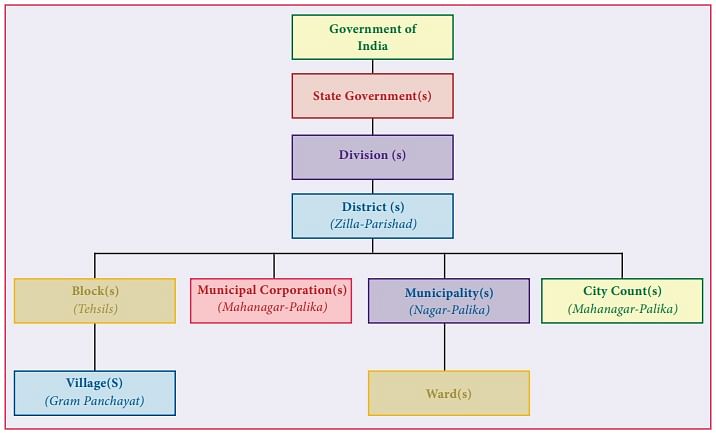
- The three-tier system of the panchayat was provided in every state i.e. Panchayat at the village, intermediate and district level which brought uniformity in the structure of Panchayati Raj institutions throughout the country.
3. Election of Members and Chairpersons
- The members of Panchayats at the village, intermediate, and district levels shall be elected directly by the people whereas the chairman of the Panchayat at the intermediate and district level shall be elected indirectly from amongst the elected members thereof.
4. Reservation of Seats
- Reservation of seats for SC and ST is provided in every panchayat in the proportion to their population. Provision for reservation of 1/3rd of the total number of seats are also provided for women.
- The state legislature has been empowered to make any provision for reservation in Panchayat at any level in favor of the backward class.
5. Duration of Panchayat
- Panchayats have been provided for a five-year term of office at every level. It can however be dissolved before the completion of its term.
- A panchayat if elected after the dissolution of the panchayat before shall continue for the remaining period for which the State Election Commission dissolved Panchayat would have continued had it not been dissolved.
6. State Election Commission
- The state election commission has been constituted and has been endowed with various roles like superintendence, direction, and control of the preparation of electoral rolls.
- The conduct of elections to the Panchayats shall also be handled by the state election commission.
7. Finance Commission
- The finance commission is constituted by the governor to review the financial position of the Panchayats.
- This commission recommends the governor decide the principles that should govern the distribution of taxes between the state and the Panchayats. It also determines the taxes, duties, tolls, and fees that may be assigned to Panchayats.
- The provisions with respect to the maintenance of accounts by the Panchayats and the auditing of such accounts are done according to the provisions decided by the state legislature.
8. Powers and Functions of Panchayats
- The powers and functions of the Panchayats are endowed by the state legislature.
- The Panchayats prepare a plan for economic development and social justice for the people of the Panchayats.
- It implements the scheme of the Central and State government for the betterment of the people at the ground level.
- Panchayats have the power to enhance employment facilities and undertake development activities in the area.
9. Finances
The state legislature may-
- authorize a panchayat to levy and collect taxes, duties, duties, and fees;
- assign to the Panchayat taxes, duties, duties, and fees levied and collected by the state government;
- provide grants-in-aid to the Panchayats from the state's consolidated fund; and
- provide for the establishment of funds to credit all money of the Panchayats.
10. Audit of Accounts
- State legislatures can make provisions regarding the maintenance and auditing of panchayat's accounts.
11. Application to Union Territories
-
The provisions of this Part apply to the territories of the Union. However, the president may specify and direct any exception of modification as required.
12. Exempted States and Areas
- The act does not apply to Nagaland, Meghalaya, and Mizoram, as well as certain other areas. These areas include:
- the scheduled areas and tribal areas in the states;
- the hill areas of Manipur with district councils; and
- the Darjeeling district of West Bengal with the Darjeeling Gorkha Hill Council.
- However, subject to the exceptions and modifications specified by the Parliament, the provisions of this Part may be extended to scheduled areas and tribal areas.
- The Parliament enacted the "Provisions of the Panchayats Extension to Scheduled Areas Act", 1996, under this provision, also known as the PESA Act or the Extension Act.
13. Continuance of Existing Laws and Panchayats
- All state laws pertaining to panchayats shall remain in effect until one year after the commencement of this act.
- In other words, states must implement the new Panchayati Raj System based on this act within a year of its enactment on April 24, 1993, the date of the act's enactment.
- However, all panchayats that existed prior to the enactment of the act will continue until the end of their terms, unless dissolved earlier by the state legislature.
- As a result, the majority of states passed Panchayati Raj Acts in 1993 and 1994, in accordance with the 73rd Constitutional Amendment Act of 1992.
14. Bar to Interference by Courts in Electoral Matters
- The act prohibits courts from interfering in panchayat elections.
- It declares that the constitutionality of any law relating to the delimitation of constituencies or the allocation of seats to such constituencies cannot be challenged in any court.
- It also states that no election to a panchayat may be challenged unless accompanied by an election petition filed with the appropriate authority and in the manner prescribed by the state legislature.
73rd Amendment Act (1992) - Compulsory and Voluntary Provisions
Compulsory Provisions
- Organization of Gram Sabha in villages
- Panchayat is an establishment at three levels, i.e. Village, Intermediate, and District level.
- Direct election to all the seats of the Panchayats.
- Indirect election to the post of Chairman at the intermediate and district level.
- Voting rights of the chairperson and other members of a panchayat elected directly or indirectly.
- The minimum age to contest a Panchayat election is decided to be 21 years.
- Reservation of seats for SC-ST(according to population) and women(1/3rd)
- The tenure of the Panchayats has been fixed for five years.
- Establishment of State Finance Commission after every five years to review the financial position of Panchayats.
- Reservation of seats for SC & ST (according to population) and women (1/3rd seats) at all three levels.
- The tenure of the Panchayats has been fixed for five years and fresh elections will be held within six months in the event of supersession of any panchayat.
- Establishment of a State Election Commission for conducting elections to the panchayats.
Voluntary Provisions
- Allocating representation to MPs and MLAs in Panchayats at different levels within their constituency
- To provide reservation of seats for backward classes in Panchayats at all levels.
- To grant power and authority to Panchayats so that they can function as institutions of self-governance.
- Granting financial power to Panchayats and authorizing them to levy, collect, and appropriate taxes, duties etc.
- Giving the Gram Sabha village-level powers and functions.
- Choosing the method for electing the village panchayat's chairperson.
- Giving representation to the chairpersons of village panchayats in intermediate panchayats or, in the absence of intermediate panchayats in a state, in district panchayats.
- Representing the chairpersons of intermediate panchayats in district panchayats.
- Members of the Parliament (both Houses) and the state legislature (both Houses) are represented in panchayats at various levels that fall within their constituencies.
- Reservation of seats (both members and chairpersons) in panchayats at any level for backward classes.
- Granting panchayats powers and authority to enable them to function as self-governing institutions (in brief, making them autonomous bodies).
- Devolution of powers and responsibilities to panchayats to prepare plans for economic development and social justice, as well as to perform some or all of the 29 functions listed in the Constitution's Eleventh Schedule.
- Granting panchayats financial powers, that is, allowing them to levy, collect, and appropriate taxes, duties, tolls, and fees.
- Taxes, duties, tolls, and fees levied and collected by the state government are assigned to a panchayat.
- Making grants-in-aid to panchayats from the state's consolidated fund.
- Providing for the establishment of funds for crediting all panchayat funds.
Eleventh Schedule
Following 29 functional items are placed within the purview of panchayats:
- Agriculture, including agricultural extension
- Land improvement, implementation of land reforms, land consolidation, and soil conservation
- Minor irrigation, water management, and watershed development
- Animal husbandry, dairying, and poultry
- Fisheries
- Social forestry and farm forestry
- Minor forest produce
- Small-scale industries, including food processing industries
- Khadi, village, and cottage industries
- Rural housing
- Drinking water
- Fuel and fodder
- Roads, culverts, bridges, ferries, waterways, and other means of communication
- Rural electrification, including distribution of electricity
- Non-conventional energy sources
- Poverty alleviation program
- Education, including primary and secondary schools
- Technical training and vocational education
- Adult and non-formal education
- Libraries
- Cultural activities
- Markets and fairs
- Health and sanitation including hospitals, primary health centers, and dispensaries
- Family welfare
- Women and child development
- Social welfare, including the welfare of the handicapped and mentally retarded
- The welfare of the weaker sections, and in particular, of the scheduled castes and the scheduled tribes
- Public distribution system
- Maintenance of community assets
|
|
|
|---|---|
| Union Executive & State Executive | State Executive |
| Gram Sabha | PESA Act |
| Punchhi Commission Report | Sarkaria Commission Report |
Issues in Implementation of the 73rd Amendment Act
- The absence of funds for PRIs is the Amendment's biggest flaw. Local governments can either rely on local taxes or intergovernmental transfers to fund their operations.
- The Panchayat's performance was also harmed by the intervention of area MPs and MLAs in their operations.
- The 73rd Amendment simply required the establishment of local self-governing bodies, leaving the discretion to delegate powers, responsibilities, and money to state legislatures; this is where PRIs failed.
- Even for subjects that are beyond the purview of PRIs, the state government must expressly authorize the power to tax. The 73rd Amendment made this a decision for state legislatures to make—one that most states have not made.
- PRIs also have structural flaws, such as a lack of secretarial support and a lack of technical competence, which limit the aggregation of bottom-up planning.
- Though women and SC/STs have got representation in PRIs through reservation mandated by the 73rd amendment but there is a presence of Sarpanch Pati and Proxy representation in case of women and SC/STs representatives respectively.
Conclusion
The national government made several efforts after independence to develop Panchayati Raj in its real sense. However, due to widespread illiteracy, a lack of political will in the state government, and a lack of funding, it took 45 years after independence for the Constitution to be amended to give Panchayats constitutional status. Panchayats have played an important role in decentralizing authority and fighting for the people at the grassroots level since then.
FAQs
Question: What was the primary objective of the 73rd Amendment Act?
Answer: The primary objective of the 73rd Amendment Act was to decentralize governance and empower local self-government institutions, particularly Panchayats, by granting them constitutional status and ensuring regular elections.
Question: What are the three tiers of Panchayati Raj institutions introduced by the 73rd Amendment?
Answer: The three tiers of Panchayati Raj institutions are the Village Panchayat (village level), Panchayat Samiti (intermediate/block level), and Zila Parishad (district level).
Question: What is the role of the Gram Sabha in Panchayati Raj?
Answer: The Gram Sabha is the foundation of the Panchayati Raj system, comprising all eligible voters in a village. It discusses and approves decisions related to local governance and development activities, acting as a direct form of democracy.
Question: How does the 73rd Amendment ensure representation for marginalized groups?
Answer: The 73rd Amendment ensures representation for marginalized groups by reserving seats for Scheduled Castes (SCs), Scheduled Tribes (STs), and women (one-third of total seats) in all Panchayati Raj institutions, ensuring their participation in local governance.
Question: What is the significance of the State Finance Commission under the 73rd Amendment?
Answer: The State Finance Commission is mandated to recommend measures for improving the financial resources of Panchayats, ensuring that they have the necessary funds to carry out their functions effectively.
MCQs
- The 73rd Amendment Act relates to which of the following?
A. Establishment of the judiciary
B. Panchayati Raj institutions
C. Fundamental duties
D. Directive principles of state policy
Answer: (B) See the Explanation
The 73rd Amendment Act of 1992 is specifically related to the establishment and empowerment of Panchayati Raj institutions (PRIs) in India. It aimed at decentralizing power to the local self-government level in rural areas. It introduced a three-tier system of governance, comprising the Village Panchayat, Panchayat Samiti, and Zila Parishad.
- Which body is responsible for conducting elections to Panchayats under the 73rd Amendment?
A. Election Commission of India
B. Ministry of Rural Development
C. State Election Commission
D. Zila Parishad
Answer: (C) See the Explanation
Under the 73rd Amendment Act, the responsibility for conducting elections to Panchayats rests with the State Election Commission. This body ensures that Panchayat elections are held regularly every five years in a free and fair manner, independent of the national Election Commission.
- What is the tenure of Panchayats as mandated by the 73rd Amendment Act?
A. Three years
B. Four years
C. Five years
D. Six years
Answer: (C) See the Explanation
According to the 73rd Amendment Act, the tenure of each Panchayat is fixed at five years. If a Panchayat is dissolved before completing its term, elections must be held within six months to reconstitute it.
- What percentage of seats is reserved for women in Panchayats as per the 73rd Amendment?
A. 25%
B. 33%
C. 50%
D. 75%
Answer: (B) See the Explanation
The 73rd Amendment Act mandates that at least one-third (33%) of the seats in all Panchayats, including the positions of chairpersons, must be reserved for women. This provision aims to ensure women’s participation in grassroots-level governance and decision-making.
- Which schedule of the Constitution lists the functions to be devolved to Panchayats under the 73rd Amendment?
A. Seventh Schedule
B. Tenth Schedule
C. Eleventh Schedule
D. Twelfth Schedule
Answer: (C) See the Explanation
The Eleventh Schedule of the Constitution was added through the 73rd Amendment Act. It lists 29 subjects that may be devolved to the Panchayats, including agriculture, education, health, sanitation, and rural development, to empower local self-governance at the grassroots level.
GS Mains Questions and Model Answers
Q1: Discuss the significance of the 73rd Constitutional Amendment in strengthening grassroots democracy in India.
Answer: The 73rd Constitutional Amendment Act of 1992 was a revolutionary step in Indian democracy, as it established a structured Panchayati Raj system and decentralized governance to the grassroots level. By granting constitutional status to Panchayati Raj Institutions (PRIs), the act empowered local bodies to take decisions on matters of local development. The inclusion of Gram Sabhas in the governance structure enhanced direct democracy, ensuring citizen participation in decision-making. The act also ensured the representation of marginalized groups, including Scheduled Castes (SCs), Scheduled Tribes (STs), and women, by reserving seats for them in Panchayats. Additionally, the act mandated the creation of State Finance Commissions to provide financial resources to Panchayats, enabling them to execute the functions listed in the Eleventh Schedule. Overall, the 73rd Amendment strengthened grassroots democracy by institutionalizing local self-government and empowering citizens to influence their local governance directly.
Q2: Analyze the role of the Gram Sabha under the 73rd Amendment in promoting participatory democracy.
Answer: The Gram Sabha is the cornerstone of participatory democracy under the 73rd Constitutional Amendment Act. It comprises all eligible voters in a village and serves as a platform where citizens can directly participate in decision-making processes. The Gram Sabha deliberates on issues such as village development plans, social audits, and the utilization of funds. This ensures transparency and accountability in governance and fosters a sense of collective responsibility among the people. The Gram Sabha plays a crucial role in approving the annual budget, identifying beneficiaries for government schemes, and overseeing the implementation of projects. By giving citizens a direct say in their governance, the Gram Sabha promotes grassroots democracy and empowers people to shape their community’s development.
Q3: Evaluate the impact of the 73rd Amendment Act on the financial autonomy of Panchayats.
Answer: The 73rd Amendment Act significantly impacted the financial autonomy of Panchayats by mandating the establishment of State Finance Commissions. These commissions recommend measures to strengthen the financial position of Panchayats, ensuring they receive adequate resources to fulfill their responsibilities. The devolution of funds from the state to local bodies has improved their capacity to implement development projects, manage infrastructure, and provide essential services at the local level. However, the financial autonomy of Panchayats is often limited due to delays in fund transfers, excessive dependence on state grants, and a lack of adequate revenue-generation mechanisms. While the 73rd Amendment laid the foundation for financial independence, further reforms are needed to enhance the fiscal capabilities of Panchayats and reduce their reliance on higher levels of government.
Previous Year Questions on 73rd Amendment Act
1. UPSC CSE Prelims 2016
Question: Which of the following provisions is included in the 73rd Constitutional Amendment Act?
A. Reservation for women in Parliament
B. Establishment of the Panchayati Raj system
C. Creation of the National Development Council
D. Directive Principles of State Policy related to education
Answer: B
Explanation: The 73rd Constitutional Amendment Act established the Panchayati Raj system as a decentralized form of governance at the village, intermediate, and district levels. It aimed to empower local self-government by providing a constitutional mandate to these institutions.
2. UPSC CSE Mains 2017 (GS Paper 2)
Question: "The 73rd Constitutional Amendment Act laid the foundation for decentralization and grassroots democracy in India." Discuss the key provisions and the challenges in implementing the Panchayati Raj system.
Answer:
- Key Provisions: The act established a three-tier Panchayati Raj system, mandated regular elections, provided for reservations for SCs, STs, and women, and created State Finance Commissions to ensure financial resources.
- Challenges: Despite these provisions, Panchayats face challenges such as limited financial autonomy, bureaucratic interference, delays in elections, and inadequate devolution of powers from state governments.
Download the PREPP App and attempt FREE IAS Exam Mock Tests and get complete study material!

Full Test - 04: UPSC CSE Prelims CSAT (Paper-II)
Full Test - 03: UPSC CSE Prelims CSAT (Paper-II)
UPSC CSE Prelims 2026 GS Paper 1 Question Paper (24-May-2026)
UPSC CSE Prelims 2026 CSAT Paper 2 Question Paper (24-May-2026)

17 February 2025 | The Hindu Must Read Articles | Current Affairs

16 February 2026 | The Hindu Must Read Articles | Current Affairs

13 February 2026 | The Hindu Must Read Articles | Current Affairs









Comments