
Fielder's Action Explained: Reducing Ball's Acceleration
When a fielder catches a fast-moving cricket ball, they gradually pull their hands backward. This action might seem counterintuitive, but it's based on fundamental principles of physics, specifically related to impulse and momentum.
Understanding Momentum and Impulse
Momentum is a measure of an object's motion and is calculated as the product of its mass (\(m\)) and velocity (\(v\)). The formula is:
\( p = m \times v \)
A fast-moving cricket ball has a significant amount of momentum.
Impulse is the change in momentum of an object. It is also equal to the average force (\(F_{avg}\)) applied multiplied by the time interval (\(\Delta t\)) over which the force is applied. The impulse-momentum theorem states:
\( J = \Delta p = F_{avg} \times \Delta t \)
Where \(\Delta p\) is the change in momentum.
The Fielder's Technique
To catch the ball, the fielder needs to bring its momentum from its initial value (\(p_{initial}\)) to zero (\(p_{final} = 0\)). This means the change in momentum (\(\Delta p\)) is fixed:
\( \Delta p = p_{final} - p_{initial} = 0 - p_{initial} = -p_{initial} \)
The negative sign indicates the change is in the opposite direction of the initial motion.
According to the impulse-momentum theorem (\(F_{avg} \times \Delta t = \Delta p\)), the fielder must apply an impulse to change the ball's momentum. They can do this in two ways:
- By applying a large force over a short time.
- By applying a smaller force over a longer time.
A fielder pulls their hands backward to increase the time interval (\(\Delta t\)) during which they are in contact with the ball. By increasing \(\Delta t\), they decrease the average force (\(F_{avg}\)) required to bring the ball to rest, since \(\Delta p\) is constant.
\( F_{avg} = \frac{\Delta p}{\Delta t} \)
This reduced average force also means a reduced average acceleration (\(a\)) of the ball, as described by Newton's second law (F = ma):
\( a_{avg} = \frac{F_{avg}}{m} \)
Reducing the acceleration minimizes the impact force on the fielder's hands, preventing injury and allowing for a secure catch.
Analysis of Options
- 1. To reduce the acceleration of the ball: This is correct. By increasing the time of contact (\(\Delta t\)), the fielder reduces the average force and consequently the acceleration acting on the ball (and their hands).
- 2. To increase the acceleration of the ball: This is incorrect. The goal is to stop the ball, which requires decreasing its acceleration (deceleration), not increasing it.
- 3. To increase the velocity of the ball: This is incorrect. Catching a ball involves reducing its velocity to zero, not increasing it.
- 4. None of above: This is incorrect because option 1 accurately explains the physics involved.
Therefore, the primary reason a fielder pulls their hands backward is to reduce the acceleration (and the associated force) acting on them by increasing the time over which the ball's momentum is changed.
Similar Questions
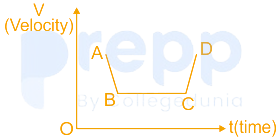
In the given velocity (V) versus time (t) graph, accelerated and decelerated motions are respectively represented by line segments
Consider the following velocity and time graph:
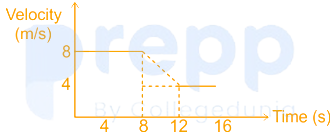
Which one of the following is the value of average acceleration from 8 s to 12 s?
- What is the upward force acting on a skydiver of mass \(60\text{ kg}\) who is falling at a uniform speed of \(2\text{ m/s}\)?
The force-time (\(F-t\)) graph of a 10 kg object initially at rest is shown below.
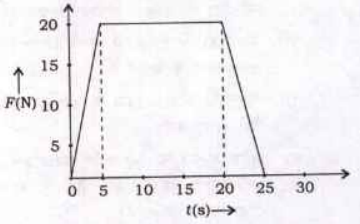
What is the final speed of the object?
- The position vector of a particle is given by \(\vec{r} = \sqrt{3} t^2 \hat{i} + \sqrt{2} t \hat{j} + \sqrt{5} \hat{k}\). Which one of the following statements is correct?
- Which one of the following statements for second law of motion is NOT correct?
A rigid body of mass 2 kg is dropped from a stationary balloon kept at a height of 50 m from the ground. The speed of the body when it just touches the ground and the total energy
when it is dropped from the balloon are respectively
(acceleration due to gravity = 9·8 m/s -2 )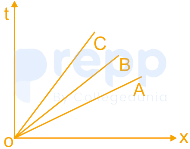
The figure shown above gives the time (t) versus position (x) graphs of three objects A, B and C. Which one of the following is the correct relation between their speeds V A, V Band V C, respectively at any instant (t > 0)?
A ball is released from rest and rolls down an inclined plane, as shown in the following figure, requiring 4 s to cover a distance of 100 cm along the plane:

Which one of the following is the correct value of angle θ that the plane makes with the horizontal? (g = 1000 cm/s 2)
The force acting on a particle of mass m moving along the X-axis is given by F(x) = AX 2- Bx. Which one of the following is the potential energy of the particle?
Important Questions from Newton's Laws of Motion
In the given velocity (V) versus time (t) graph, accelerated and decelerated motions are respectively represented by line segments
A balloon is filled with air. The mass of the air in the balloon is 10 gram. A small hole is made to the balloon and released. The balloon moves up with an average speed of 5 cm/s and shrinks completely in 5 seconds. Find the average force acting on the balloon.
A uniform rope is suspended from the roof of a building. The rope breaks if the tension in the rope is greater than 700 N.
A man of mass 50 kg climbs up the rope. Find the maximum acceleration with which he can climb up the rope (g = 10 m/s2)A ball is thrown up with a certain velocity, it attains 50 m and come back to the thrower then the
A string of certain length used to whirl a stone in a vertical circle with certain velocity. The tension developed in the string will be



