
A balloon is filled with air. The mass of the air in the balloon is 10 gram. A small hole is made to the balloon and released. The balloon moves up with an average speed of 5 cm/s and shrinks completely in 5 seconds. Find the average force acting on the balloon.
10 dynes
Understanding the Physics of the Moving Balloon
This problem involves the concept of thrust force, which propels the balloon upwards as it expels air. This is an application of Newton's third law and the principle of momentum conservation, similar to how a rocket works. The air is pushed out in one direction, and the balloon is pushed in the opposite direction.
We are asked to find the average force acting on the balloon.
Analyzing the Given Data
The information provided is:
- Total mass of air expelled (\(m\)): 10 grams
- Time taken for the balloon to shrink completely (\(\Delta t\)): 5 seconds
- Average speed of the balloon during this time (\(v_{avg}\)): 5 cm/s
Calculating the Average Force Using Impulse and Momentum
According to the impulse-momentum theorem, the impulse acting on an object equals the change in its momentum. Impulse is also defined as the average force multiplied by the time interval over which the force acts.
Impulse \( = F_{avg} \times \Delta t \)
Impulse \( = \Delta p \) (Change in momentum)
Therefore, \( F_{avg} \times \Delta t = \Delta p \).
The average force acting on the balloon is the thrust. This thrust is the reaction force to the momentum change of the expelled air. In a simplified approach using the given data, we can consider the total momentum change related to the expulsion process that results in the balloon's motion.
Let's calculate a value representing the total momentum associated with the expelled mass using the total mass and the average speed attained by the balloon:
Total momentum associated with expelled mass \( \approx m \times v_{avg} \)
\( \Delta p \approx 10 \text{ g} \times 5 \text{ cm/s} = 50 \text{ g cm/s} \)
Now, we can calculate the average force:
\( F_{avg} = \frac{\Delta p}{\Delta t} \)
\( F_{avg} = \frac{50 \text{ g cm/s}}{5 \text{ s}} \)
\( F_{avg} = 10 \text{ g cm/s}^2 \)
The unit g cm/s\(^2\) is defined as a dyne (CGS unit of force).
So, the average force acting on the balloon is 10 dynes.
| Quantity | Value | Units |
|---|---|---|
| Mass of air (\(m\)) | 10 | g |
| Time interval (\(\Delta t\)) | 5 | s |
| Average speed (\(v_{avg}\)) | 5 | cm/s |
| Approximate change in momentum (\(\Delta p\)) | \(10 \times 5 = 50\) | g cm/s |
| Average force (\(F_{avg}\)) | \(50 / 5 = 10\) | g cm/s\(^2\) (dynes) |
Revision Table: Force and Momentum Concepts
| Concept | Description/Formula |
|---|---|
| Momentum (\(p\)) | A measure of mass in motion; \(p = m \times v\) |
| Impulse (\(J\)) | Change in momentum; \(J = \Delta p\). Also, \(J = F_{avg} \times \Delta t\). |
| Newton's Second Law | Force is equal to the rate of change of momentum (\(F = \frac{dp}{dt}\)) |
| Thrust Force | Force generated by expelling mass (e.g., in rockets, jet engines, or a balloon releasing air). It's a reaction force. |
| Dyne | The CGS unit of force. 1 dyne = 1 g cm/s\(^2\). |
Additional Information on Thrust Force
Thrust is a force that causes a body to move forward. In the case of a balloon expelling air, the thrust is generated by the momentum carried away by the exiting air. According to Newton's third law, the force exerted by the balloon on the air (to push it out) is equal in magnitude and opposite in direction to the force exerted by the air on the balloon (the thrust).
The exact calculation of thrust often involves the exhaust velocity of the expelled mass relative to the moving body and the rate of mass expulsion. The formula is typically \(F_{thrust} = v_{e} \frac{dm}{dt}\), where \(v_e\) is the relative exhaust velocity and \(\frac{dm}{dt}\) is the mass flow rate.
In this problem, the average speed of the balloon (5 cm/s) is given, not the exhaust velocity of the air relative to the balloon. The approach taken above, using the total mass of air and the balloon's average speed over the time interval, provides a simplified way to calculate the average force based on the total momentum change implied by the problem statement and the options provided. This method essentially links the total momentum change of the system (balloon + expelled air, relative to initial state) to the impulse from the thrust force.
Important Questions from Newton's Laws of Motion
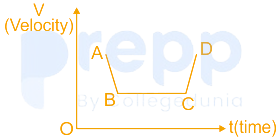
In the given velocity (V) versus time (t) graph, accelerated and decelerated motions are respectively represented by line segments
A uniform rope is suspended from the roof of a building. The rope breaks if the tension in the rope is greater than 700 N.
A man of mass 50 kg climbs up the rope. Find the maximum acceleration with which he can climb up the rope (g = 10 m/s2)A ball is thrown up with a certain velocity, it attains 50 m and come back to the thrower then the
A string of certain length used to whirl a stone in a vertical circle with certain velocity. The tension developed in the string will be
Which of the following is caused by the third law of motion?
I. Repulsive force on the gun
II. In case of sailor jumping forward, the boat moving backwards


