
A ball is thrown up with a certain velocity, it attains 50 m and come back to the thrower then the
Total displacement is zero
Understanding Distance and Displacement for Ball Motion
The question describes a scenario where a ball is thrown vertically upwards with a certain velocity, reaches a maximum height, and then returns to the thrower. We need to determine the total distance covered and the total displacement.
Defining Distance and Displacement
Let's first clarify the key terms:
- Distance: This is the total length of the path traveled by an object. It is a scalar quantity, meaning it only has magnitude and no direction.
- Displacement: This is the change in position of an object. It is the shortest straight-line distance between the initial and final points, and it is a vector quantity, meaning it has both magnitude and direction.
Calculating Total Distance
The ball is thrown upwards and reaches a maximum height of 50 meters from the thrower. It then falls back down to the thrower. The path taken is:
- Upwards from the thrower to the maximum height (50 m).
- Downwards from the maximum height back to the thrower (50 m).
The total distance covered is the sum of the distance traveled upwards and the distance traveled downwards.
Total Distance = Distance (up) + Distance (down)
Total Distance = 50 m + 50 m = 100 m
So, the total distance covered by the ball is 100 meters.
Calculating Total Displacement
Displacement is the change in position. We need to compare the initial position with the final position.
- Initial position: The ball starts at the thrower's hand.
- Final position: The ball returns to the thrower's hand.
Since the ball starts and ends at the same location, its initial position is the same as its final position.
Displacement is calculated as:
Displacement = Final Position - Initial Position
In this case, since the initial and final positions are identical, the change in position is zero.
Total Displacement = 0 meters
Therefore, the total displacement of the ball is zero.
Conclusion on Ball Motion
For the described motion where the ball goes up 50 m and comes back to the thrower, the total distance is 100 m, and the total displacement is 0 m.
Reviewing the options:
- Total distance covered by it is 50 m (Incorrect - distance is 100 m)
- Total displacement covered by it is 100 m (Incorrect - displacement is 0 m)
- Total displacement is zero (Correct)
- Total distance covered by it is 120 m (Incorrect - distance is 100 m)
Based on our calculations, the correct statement is that the total displacement is zero.
Important Questions from Newton's Laws of Motion
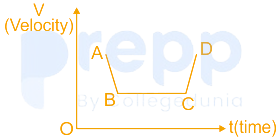
In the given velocity (V) versus time (t) graph, accelerated and decelerated motions are respectively represented by line segments
A balloon is filled with air. The mass of the air in the balloon is 10 gram. A small hole is made to the balloon and released. The balloon moves up with an average speed of 5 cm/s and shrinks completely in 5 seconds. Find the average force acting on the balloon.
A uniform rope is suspended from the roof of a building. The rope breaks if the tension in the rope is greater than 700 N.
A man of mass 50 kg climbs up the rope. Find the maximum acceleration with which he can climb up the rope (g = 10 m/s2)A string of certain length used to whirl a stone in a vertical circle with certain velocity. The tension developed in the string will be
Which of the following is caused by the third law of motion?
I. Repulsive force on the gun
II. In case of sailor jumping forward, the boat moving backwards


