
A uniform rope is suspended from the roof of a building. The rope breaks if the tension in the rope is greater than 700 N.
4 m/s2
Understanding the Forces on the Man Climbing the Rope
When a man climbs a rope, there are two main forces acting on him:
- Weight ($mg$): The force of gravity pulling him downwards.
- Tension ($T$): The force exerted by the rope pulling him upwards. This is the force he exerts on the rope, and by Newton's third law, the rope exerts an equal and opposite force (tension) on him.
For the man to climb upwards with acceleration, the upward force (tension) must be greater than the downward force (weight). According to Newton's Second Law of Motion, the net force acting on an object is equal to its mass multiplied by its acceleration ($\Sigma F = ma$).
Applying Newton's Second Law
Let's define the upward direction as positive. The forces acting on the man are:
- Tension ($T$) in the positive (upward) direction.
- Weight ($mg$) in the negative (downward) direction.
The net force ($\Sigma F$) acting on the man is the difference between the upward tension and the downward weight:
$\Sigma F = T - mg$
Using Newton's Second Law ($\Sigma F = ma$), we have:
$T - mg = ma$
where:
- $T$ is the tension in the rope
- $m$ is the mass of the man
- $g$ is the acceleration due to gravity
- $a$ is the acceleration of the man
Calculating Maximum Acceleration
The problem states that the rope breaks if the tension in the rope is greater than 700 N. This means the maximum possible tension the rope can withstand is $T_{max} = 700$ N.
The man's mass is given as $m = 50$ kg, and the acceleration due to gravity is $g = 10$ m/s<sup>2</sup>.
To find the maximum acceleration ($a_{max}$) with which the man can climb, we use the maximum tension the rope can support in our equation:
$T_{max} - mg = m a_{max}$
Now, we can substitute the given values into this equation to solve for $a_{max}$:
$700\ {\rm{N}} - (50\ {\rm{kg}} \times 10\ {\rm{m/s^2}}) = 50\ {\rm{kg}} \times a_{max}$
$700\ {\rm{N}} - 500\ {\rm{N}} = 50\ {\rm{kg}} \times a_{max}$
$200\ {\rm{N}} = 50\ {\rm{kg}} \times a_{max}$
To find $a_{max}$, we rearrange the equation:
$a_{max} = \frac{200\ {\rm{N}}}{50\ {\rm{kg}}}$
$a_{max} = 4\ {\rm{m/s^2}}$
Therefore, the maximum acceleration with which the man can climb up the rope without breaking it is 4 m/s<sup>2</sup>.
Summary of Calculation
| Maximum Tension ($T_{max}$) | 700 N |
| Man's Mass ($m$) | 50 kg |
| Acceleration due to gravity ($g$) | 10 m/s<sup>2</sup> |
| Weight ($mg$) | \(50\ {\rm{kg}} \times 10\ {\rm{m/s^2}} = 500\ {\rm{N}}\) |
| Equation for max acceleration ($a_{max}$) | \(T_{max} - mg = m a_{max}\) |
| Calculation | \(700\ {\rm{N}} - 500\ {\rm{N}} = 50\ {\rm{kg}} \times a_{max}\) <br> \(200\ {\rm{N}} = 50\ {\rm{kg}} \times a_{max}\) |
| Maximum Acceleration ($a_{max}$) | \(\frac{200\ {\rm{N}}}{50\ {\rm{kg}}} = 4\ {\rm{m/s^2}}\) |
Revision Table: Key Physics Concepts
| Concept | Description | Formula/Relation |
| Newton's Second Law | The net force on an object is equal to its mass times its acceleration. | \(\Sigma F = ma\) |
| Weight | The force of gravity acting on an object's mass. | \(W = mg\) |
| Tension | The force transmitted through a rope, string, or cable when pulled taut by forces acting from opposite ends. | (Context Dependent) |
Additional Information: Forces and Motion
Understanding forces and motion, particularly Newton's Laws, is fundamental in physics. In this problem, we used Newton's Second Law to relate the forces acting on the man to his acceleration. Here are some additional points:
- If the man were climbing downwards, the net force equation would change depending on whether he is accelerating downwards or moving at a constant velocity.
- If the man were hanging stationary, the tension in the rope would simply be equal to his weight ($T = mg$), and his acceleration would be zero.
- If the man were accelerating downwards, the net force would be downwards, and the tension would be less than his weight ($mg - T = ma$ or $T - mg = -ma$).
Problems involving ropes often require analyzing the tension force and applying Newton's laws to determine acceleration or other unknown forces.
Important Questions from Newton's Laws of Motion
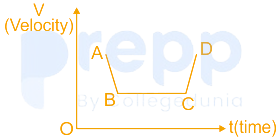
In the given velocity (V) versus time (t) graph, accelerated and decelerated motions are respectively represented by line segments
A balloon is filled with air. The mass of the air in the balloon is 10 gram. A small hole is made to the balloon and released. The balloon moves up with an average speed of 5 cm/s and shrinks completely in 5 seconds. Find the average force acting on the balloon.
A ball is thrown up with a certain velocity, it attains 50 m and come back to the thrower then the
A string of certain length used to whirl a stone in a vertical circle with certain velocity. The tension developed in the string will be
Which of the following is caused by the third law of motion?
I. Repulsive force on the gun
II. In case of sailor jumping forward, the boat moving backwards


