
A string of certain length used to whirl a stone in a vertical circle with certain velocity. The tension developed in the string will be
highest at the bottom of the circle
Understanding Tension in a String Whirling a Stone
When a stone is whirled in a vertical circle using a string, the tension in the string is not constant. It changes depending on the position of the stone in the circle. This variation in the tension in string is due to the combined effect of gravity and the requirement for centripetal force.
Forces Acting on the Stone
At any point in the vertical circle, two main forces act on the stone:
- Gravitational Force (weight): This force acts vertically downwards and has a magnitude of $mg$, where $m$ is the mass of the stone and $g$ is the acceleration due to gravity.
- Tension Force: This force is exerted by the string and acts along the string towards the center of the circle. The magnitude of this tension in string varies.
Centripetal Force Requirement
For the stone to move in a circular path, there must be a net force acting towards the center of the circle. This net force provides the necessary centripetal force ($F_c = \frac{mv^2}{r}$), where $m$ is the mass, $v$ is the speed of the stone at that point, and $r$ is the radius of the circle (length of the string).
Analyzing Tension at Top and Bottom
Let's consider the forces at the top and bottom of the vertical circle:
- At the Top: Both the tension ($T_{top}$) and the gravitational force ($mg$) act downwards, towards the center of the circle. The net force towards the center is $T_{top} + mg$. This must equal the centripetal force: $$T_{top} + mg = \frac{mv_{top}^2}{r}$$ Therefore, the tension in string at the top is: $$T_{top} = \frac{mv_{top}^2}{r} - mg$$
- At the Bottom: The tension ($T_{bottom}$) acts upwards (towards the center), while the gravitational force ($mg$) acts downwards (away from the center). The net force towards the center is $T_{bottom} - mg$. This must equal the centripetal force: $$T_{bottom} - mg = \frac{mv_{bottom}^2}{r}$$ Therefore, the tension in string at the bottom is: $$T_{bottom} = \frac{mv_{bottom}^2}{r} + mg$$
Velocity Variation in Vertical Circular Motion
Due to gravity, the speed of the stone is not constant. The stone slows down as it moves upwards and speeds up as it moves downwards. The speed is maximum at the bottom of the circle ($v_{bottom}$) and minimum at the top ($v_{top}$). Thus, $v_{bottom} > v_{top}$.
Comparing Tension Values
Comparing the expressions for tension at the top and bottom:
- $T_{top} = \frac{mv_{top}^2}{r} - mg$
- $T_{bottom} = \frac{mv_{bottom}^2}{r} + mg$
Since $v_{bottom} > v_{top}$, the term $\frac{mv_{bottom}^2}{r}$ is greater than $\frac{mv_{top}^2}{r}$. Furthermore, $mg$ is subtracted from $\frac{mv_{top}^2}{r}$ to get $T_{top}$, while $mg$ is added to $\frac{mv_{bottom}^2}{r}$ to get $T_{bottom}$.
This clearly shows that the tension in string is highest at the bottom of the circle and least at the top of the circle.
Conclusion
Based on the analysis of forces and velocity in vertical circular motion, the tension in string developed when whirling a stone in a vertical circle is highest at the bottom of the circle.
Important Questions from Newton's Laws of Motion
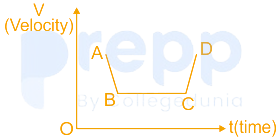
In the given velocity (V) versus time (t) graph, accelerated and decelerated motions are respectively represented by line segments
A balloon is filled with air. The mass of the air in the balloon is 10 gram. A small hole is made to the balloon and released. The balloon moves up with an average speed of 5 cm/s and shrinks completely in 5 seconds. Find the average force acting on the balloon.
A uniform rope is suspended from the roof of a building. The rope breaks if the tension in the rope is greater than 700 N.
A man of mass 50 kg climbs up the rope. Find the maximum acceleration with which he can climb up the rope (g = 10 m/s2)A ball is thrown up with a certain velocity, it attains 50 m and come back to the thrower then the
Which of the following is caused by the third law of motion?
I. Repulsive force on the gun
II. In case of sailor jumping forward, the boat moving backwards


