
Which of the following is caused by the third law of motion? I. Repulsive force on the gun II. In case of sailor jumping forward, the boat moving backwards
Both I and II
Newton's Third Law: Action and Reaction
Newton's Third Law of Motion is a fundamental principle in physics that describes how forces interact between objects. It states that for every action, there is an equal and opposite reaction. This means that if an object A exerts a force on object B, then object B simultaneously exerts a force of equal magnitude and opposite direction on object A. It's crucial to remember that these action-reaction forces always act on two different bodies.
Gun Recoil and Repulsive Force
Let's analyze the first statement concerning the repulsive force on the gun:
- When a bullet is fired from a gun, the expanding gases inside the gun barrel exert a strong forward force on the bullet, accelerating it out of the gun. This forward push on the bullet is the action.
- According to Newton's Third Law of Motion, the bullet simultaneously exerts an equal and opposite force backward on the gun. This backward force is the reaction.
- This backward reaction force causes the gun to move in the opposite direction of the bullet's motion, which is commonly known as gun recoil or the repulsive force on the gun.
- Therefore, the repulsive force experienced by the gun is a direct and clear example of Newton's Third Law of Motion.
Mathematically, if $\vec{F}_{\text{gun on bullet}}$ is the force exerted by the gun on the bullet and $\vec{F}_{\text{bullet on gun}}$ is the force exerted by the bullet on the gun, then according to the third law:
$$\vec{F}_{\text{gun on bullet}} = -\vec{F}_{\text{bullet on gun}}$$Sailor Jumping and Boat Movement
Next, let's examine the second statement about a sailor jumping forward from a boat:
- When a sailor jumps forward from a boat onto the shore, they push the boat backward with their feet. This backward push on the boat is the action.
- In response to this action, the boat exerts an equal and opposite force forward on the sailor. This forward force helps propel the sailor towards the shore and is the reaction acting on the sailor.
- Simultaneously, because the sailor exerted a backward force (action) on the boat, the boat itself moves backward. This backward movement of the boat is a direct consequence of the action force exerted by the sailor on it, and it's a perfect demonstration of the action-reaction pair in motion.
- Thus, the boat moving backward when a sailor jumps forward is another classic example illustrating Newton's Third Law of Motion.
In this scenario:
- Action: Sailor pushes the boat backward ($\vec{F}_{\text{sailor on boat}}$).
- Reaction: Boat pushes the sailor forward ($\vec{F}_{\text{boat on sailor}}$).
As per Newton's Third Law, these forces are equal in magnitude and opposite in direction:
$$\vec{F}_{\text{sailor on boat}} = -\vec{F}_{\text{boat on sailor}}$$Conclusion on Newton's Third Law Applications
Both scenarios described, namely the repulsive force (recoil) on a gun when fired and the backward movement of a boat when a sailor jumps forward, are excellent real-world demonstrations of Newton's Third Law of Motion. They both involve an action force producing an equal and opposite reaction force, acting on different bodies.
| Scenario | Action Force | Reaction Force |
|---|---|---|
| Firing a gun | Gun pushes bullet forward | Bullet pushes gun backward (causes recoil of gun) |
| Sailor jumping from a boat | Sailor pushes boat backward | Boat pushes sailor forward (enables jump), Boat moves backward (due to action on it) |
Final Answer
Based on the detailed analysis, both statement I (Repulsive force on the gun) and statement II (In case of sailor jumping forward, the boat moving backwards) are phenomena directly caused by Newton's Third Law of Motion. Therefore, the correct option is "Both I and II".
Important Questions from Newton's Laws of Motion
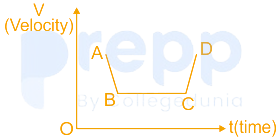
In the given velocity (V) versus time (t) graph, accelerated and decelerated motions are respectively represented by line segments
A balloon is filled with air. The mass of the air in the balloon is 10 gram. A small hole is made to the balloon and released. The balloon moves up with an average speed of 5 cm/s and shrinks completely in 5 seconds. Find the average force acting on the balloon.
A uniform rope is suspended from the roof of a building. The rope breaks if the tension in the rope is greater than 700 N.
A man of mass 50 kg climbs up the rope. Find the maximum acceleration with which he can climb up the rope (g = 10 m/s2)A ball is thrown up with a certain velocity, it attains 50 m and come back to the thrower then the
A string of certain length used to whirl a stone in a vertical circle with certain velocity. The tension developed in the string will be


