
A rigid body of mass 2 kg is dropped from a stationary balloon kept at a height of 50 m from the ground. The speed of the body when it just touches the ground and the total energy when it is dropped from the balloon are respectively
√980 m.s -1 and 980 J
Understanding the Physics of a Dropped Rigid Body
This problem involves analyzing the motion and energy of a rigid body falling under the influence of gravity. We need to determine its speed just as it reaches the ground and its total mechanical energy when it is dropped from a specific height. The key principles involved are kinematics under constant acceleration (due to gravity) and the conservation of mechanical energy.
Given Information:
- Mass of the rigid body, \(m = 2 \, \text{kg}\)
- Initial height from the ground, \(h = 50 \, \text{m}\)
- Initial velocity, \(u = 0 \, \text{m/s}\) (since it's dropped from rest)
- Acceleration due to gravity, \(g = 9·8 \, \text{m/s}^2\)
Calculating the Speed When the Body Just Touches the Ground
We can find the final velocity (\(v\)) just before hitting the ground using kinematic equations or the principle of conservation of mechanical energy.
Method 1: Using Kinematic Equation
The relevant kinematic equation relating initial velocity (\(u\)), final velocity (\(v\)), acceleration (\(a\)), and displacement (\(s\)) is:
\(v^2 = u^2 + 2as\)
In this case:
- \(u = 0 \, \text{m/s}\)
- \(a = g = 9·8 \, \text{m/s}^2\) (positive as direction is downwards)
- \(s = h = 50 \, \text{m}\)
Substituting the values:
\(v^2 = (0)^2 + 2 \times (9·8 \, \text{m/s}^2) \times (50 \, \text{m})\)
\(v^2 = 0 + 2 \times 490 \, \text{m}^2/\text{s}^2\)
\(v^2 = 980 \, \text{m}^2/\text{s}^2\)
Taking the square root to find \(v\):
\(v = \sqrt{980} \, \text{m/s}\)
Method 2: Using Conservation of Mechanical Energy
Mechanical energy is conserved if only conservative forces (like gravity) are doing work. The total mechanical energy (\(E\)) is the sum of kinetic energy (KE) and potential energy (PE).
\(E = KE + PE\)
Initial mechanical energy (\(E_{initial}\)) when dropped from height \(h\):
\(KE_{initial} = \frac{1}{2}mu^2 = \frac{1}{2}(2 \, \text{kg})(0 \, \text{m/s})^2 = 0 \, \text{J}\)
\(PE_{initial} = mgh = (2 \, \text{kg})(9·8 \, \text{m/s}^2)(50 \, \text{m}) = 980 \, \text{J}\)
\(E_{initial} = KE_{initial} + PE_{initial} = 0 \, \text{J} + 980 \, \text{J} = 980 \, \text{J}\)
Final mechanical energy (\(E_{final}\)) just before hitting the ground (height \(h = 0\)):
\(KE_{final} = \frac{1}{2}mv^2 = \frac{1}{2}(2 \, \text{kg})v^2 = v^2 \, \text{J}\)
\(PE_{final} = mgh = (2 \, \text{kg})(9·8 \, \text{m/s}^2)(0 \, \text{m}) = 0 \, \text{J}\)
\(E_{final} = KE_{final} + PE_{final} = v^2 \, \text{J} + 0 \, \text{J} = v^2 \, \text{J}\)
By conservation of mechanical energy, \(E_{initial} = E_{final}\):
\(980 \, \text{J} = v^2 \, \text{J}\)
\(v^2 = 980 \, \text{m}^2/\text{s}^2\)
\(v = \sqrt{980} \, \text{m/s}\)
Both methods give the same speed at the ground: \(\sqrt{980} \, \text{m/s}\).
Calculating the Total Energy When Dropped
As calculated in Method 2 for the speed, the total energy when the body is dropped from the balloon is the sum of its kinetic and potential energy at that height.
Initial kinetic energy (\(KE_{initial}\)) is 0 as the body starts from rest.
\(KE_{initial} = 0 \, \text{J}\)
Initial potential energy (\(PE_{initial}\)) at height \(h=50 \, \text{m}\) is:
\(PE_{initial} = mgh = (2 \, \text{kg})(9·8 \, \text{m/s}^2)(50 \, \text{m}) = 980 \, \text{J}\)
Total energy when dropped (\(E_{initial}\)) is:
\(E_{initial} = KE_{initial} + PE_{initial} = 0 \, \text{J} + 980 \, \text{J} = 980 \, \text{J}\)
The total energy when dropped is 980 J.
Summary of Results
- Speed when it just touches the ground: \(\sqrt{980} \, \text{m/s}\)
- Total energy when it is dropped: 980 J
Therefore, the speed and total energy are respectively \(\sqrt{980} \, \text{m/s}\) and 980 J.
Revision Table: Key Concepts
| Concept | Definition/Formula | Application in Problem |
|---|---|---|
| Kinetic Energy (KE) | Energy of motion: \(KE = \frac{1}{2}mv^2\) | Calculated at initial (0 J) and final (\(v^2\) J) points. |
| Potential Energy (PE) | Energy due to position (gravitational): \(PE = mgh\) | Calculated at initial (980 J) and final (0 J) points. |
| Total Mechanical Energy (E) | Sum of KE and PE: \(E = KE + PE\) | Remains constant throughout the fall (Conservation of Energy). |
| Conservation of Energy | In the absence of non-conservative forces (like air resistance), total mechanical energy is constant: \(E_{initial} = E_{final}\). | Used to find final speed and verify total energy. |
| Kinematic Equations | Equations describing motion under constant acceleration (e.g., \(v^2 = u^2 + 2as\)) | Used as an alternative method to find final speed. |
Additional Information: Energy Transformation During Free Fall
As the rigid body falls from the balloon, its energy transforms. Initially, at the maximum height, its speed is zero, so its energy is purely potential energy. As it falls, the height decreases, reducing potential energy, while its speed increases, increasing kinetic energy. This transformation continues until just before hitting the ground, where the height is zero, and the potential energy is zero. At this point, all the initial potential energy has been converted into kinetic energy (assuming no energy loss due to air resistance).
The total mechanical energy (\(KE + PE\)) remains constant throughout the fall, demonstrating the principle of conservation of energy in a closed system under conservative forces.
In this problem, the initial total energy was 980 J (all potential), and the final total energy just before impact is also 980 J (all kinetic).
Similar Questions
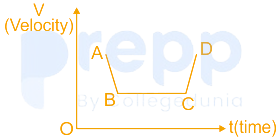
In the given velocity (V) versus time (t) graph, accelerated and decelerated motions are respectively represented by line segments
Consider the following velocity and time graph:
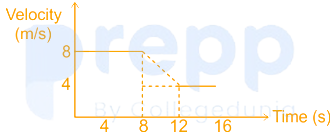
Which one of the following is the value of average acceleration from 8 s to 12 s?
- What is the upward force acting on a skydiver of mass \(60\text{ kg}\) who is falling at a uniform speed of \(2\text{ m/s}\)?
The force-time (\(F-t\)) graph of a 10 kg object initially at rest is shown below.
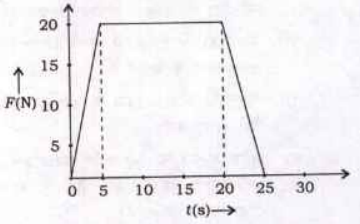
What is the final speed of the object?
- The position vector of a particle is given by \(\vec{r} = \sqrt{3} t^2 \hat{i} + \sqrt{2} t \hat{j} + \sqrt{5} \hat{k}\). Which one of the following statements is correct?
- Which one of the following statements for second law of motion is NOT correct?
- Why a fielder in the ground gradually pulls his hands backward while catching a fast moving cricket ball?
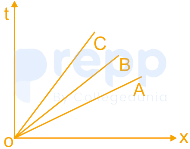
The figure shown above gives the time (t) versus position (x) graphs of three objects A, B and C. Which one of the following is the correct relation between their speeds V A, V Band V C, respectively at any instant (t > 0)?
A ball is released from rest and rolls down an inclined plane, as shown in the following figure, requiring 4 s to cover a distance of 100 cm along the plane:

Which one of the following is the correct value of angle θ that the plane makes with the horizontal? (g = 1000 cm/s 2)
The force acting on a particle of mass m moving along the X-axis is given by F(x) = AX 2- Bx. Which one of the following is the potential energy of the particle?
Important Questions from Newton's Laws of Motion
In the given velocity (V) versus time (t) graph, accelerated and decelerated motions are respectively represented by line segments
A balloon is filled with air. The mass of the air in the balloon is 10 gram. A small hole is made to the balloon and released. The balloon moves up with an average speed of 5 cm/s and shrinks completely in 5 seconds. Find the average force acting on the balloon.
A uniform rope is suspended from the roof of a building. The rope breaks if the tension in the rope is greater than 700 N.
A man of mass 50 kg climbs up the rope. Find the maximum acceleration with which he can climb up the rope (g = 10 m/s2)A ball is thrown up with a certain velocity, it attains 50 m and come back to the thrower then the
A string of certain length used to whirl a stone in a vertical circle with certain velocity. The tension developed in the string will be



