
The force acting on a particle of mass m moving along the X-axis is given by F(x) = AX 2- Bx. Which one of the following is the potential energy of the particle?
Calculating Potential Energy from Force F(x) = AX² - Bx
The problem asks us to find the potential energy of a particle given the force acting on it along the X-axis. The force is given as a function of position x, specifically F(x) = AX² - Bx.
In physics, for a conservative force acting along one dimension (like the X-axis), the relationship between the force F(x) and the potential energy U(x) is given by:
$$F(x) = -\frac{dU}{dx}$$
To find the potential energy U(x) from the force F(x), we need to integrate the force with respect to x, and include a negative sign:
$$dU = -F(x) \, dx$$
$$U(x) = \int -F(x) \, dx$$
Substitute the given expression for F(x):
$$U(x) = \int -(AX^2 - Bx) \, dx$$
$$U(x) = \int (-AX^2 + Bx) \, dx$$
Now, we integrate term by term:
$$U(x) = \int -AX^2 \, dx + \int Bx \, dx$$
We can pull the constants A and B out of the integrals:
$$U(x) = -A \int X^2 \, dx + B \int x \, dx$$
Using the power rule for integration (\(\int x^n \, dx = \frac{x^{n+1}}{n+1} + C\), where C is the integration constant):
$$U(x) = -A \left(\frac{X^{2+1}}{2+1}\right) + B \left(\frac{x^{1+1}}{1+1}\right) + C$$
$$U(x) = -A \frac{X^3}{3} + B \frac{x^2}{2} + C$$
This is the general expression for the potential energy, including the integration constant C. The value of C depends on where the zero point of potential energy is defined. Often, the potential energy is defined to be zero at some reference point, such as x=0 or x=\(\infty\). Looking at the provided options, none include an arbitrary constant C. This suggests that the potential energy is likely defined such that U(0) = 0. If U(0) = 0, then substituting x=0 into our expression:
$$U(0) = -A \frac{(0)^3}{3} + B \frac{(0)^2}{2} + C = 0 + 0 + C = C$$
So, if U(0) = 0, then C = 0. In this case, the potential energy function becomes:
$$U(x) = -\frac{Ax^3}{3} + \frac{Bx^2}{2}$$
Now let's compare this form with the given options. The second option is given as \(-\frac{{{x^2}}}{6}\left( {2Ax - 3B} \right)\). Let's expand this expression to see if it matches our result:
$$-\frac{x^2}{6}(2Ax - 3B) = -\frac{x^2}{6}(2Ax) - \frac{x^2}{6}(-3B)$$
$$= -\frac{2Ax^3}{6} + \frac{3Bx^2}{6}$$
$$= -\frac{Ax^3}{3} + \frac{Bx^2}{2}$$
This expanded form exactly matches the potential energy function we derived assuming U(0)=0. Therefore, the potential energy of the particle is given by the second option.
| Concept | Formula | Description |
|---|---|---|
| Force from Potential Energy | \(F(x) = -\frac{dU}{dx}\) | Force is the negative derivative of potential energy with respect to position. |
| Potential Energy from Force | \(U(x) = \int -F(x) \, dx\) | Potential energy is the negative integral of force with respect to position. |
Revision Table: Force and Potential Energy
| Key Concept | Description |
|---|---|
| Conservative Force | A force is conservative if the work done by it on a particle moving between two points depends only on the initial and final points and is independent of the path taken. Gravity and the force from a spring are examples. |
| Potential Energy | Energy stored in a system due to the relative positions of its components. It is associated with conservative forces. The change in potential energy is the negative of the work done by the conservative force. |
| Relationship | For one-dimensional motion under a conservative force F(x), the potential energy U(x) is related by \(F(x) = -\frac{dU}{dx}\). Conversely, \(U(x) = \int -F(x) \, dx\). |
Additional Information on Potential Energy Concepts
Potential energy is a very useful concept when dealing with conservative forces. It simplifies calculations involving work and energy, especially when forces vary with position.
- The change in potential energy (\(\Delta U\)) of a system is defined as the negative of the work done by the conservative force within the system when the configuration changes. \(\Delta U = -W_c\).
- The concept of potential energy is only meaningful for conservative forces. Friction, for instance, is a non-conservative force, and there is no associated potential energy function for it.
- The total mechanical energy (\(E = K + U\)), which is the sum of kinetic energy (K) and potential energy (U), is conserved if only conservative forces are doing work on the system.
- The specific value of potential energy at a point depends on the choice of the reference point where the potential energy is defined to be zero. However, the change in potential energy (\(\Delta U\)) between two points is independent of this choice.
- In this problem, since the options provide a specific functional form without an additive constant, it is implied that the reference point for potential energy is chosen such that \(U(x)=0\) at \(x=0\).
Similar Questions
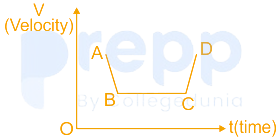
In the given velocity (V) versus time (t) graph, accelerated and decelerated motions are respectively represented by line segments
Consider the following velocity and time graph:
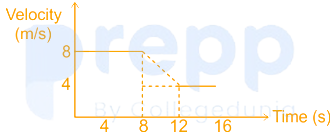
Which one of the following is the value of average acceleration from 8 s to 12 s?
- What is the upward force acting on a skydiver of mass \(60\text{ kg}\) who is falling at a uniform speed of \(2\text{ m/s}\)?
The force-time (\(F-t\)) graph of a 10 kg object initially at rest is shown below.
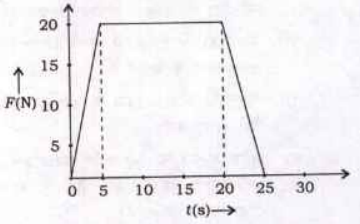
What is the final speed of the object?
- The position vector of a particle is given by \(\vec{r} = \sqrt{3} t^2 \hat{i} + \sqrt{2} t \hat{j} + \sqrt{5} \hat{k}\). Which one of the following statements is correct?
- Which one of the following statements for second law of motion is NOT correct?
- Why a fielder in the ground gradually pulls his hands backward while catching a fast moving cricket ball?
A rigid body of mass 2 kg is dropped from a stationary balloon kept at a height of 50 m from the ground. The speed of the body when it just touches the ground and the total energy
when it is dropped from the balloon are respectively
(acceleration due to gravity = 9·8 m/s -2 )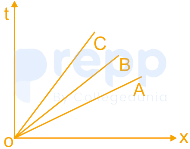
The figure shown above gives the time (t) versus position (x) graphs of three objects A, B and C. Which one of the following is the correct relation between their speeds V A, V Band V C, respectively at any instant (t > 0)?
A ball is released from rest and rolls down an inclined plane, as shown in the following figure, requiring 4 s to cover a distance of 100 cm along the plane:

Which one of the following is the correct value of angle θ that the plane makes with the horizontal? (g = 1000 cm/s 2)
Important Questions from Newton's Laws of Motion
In the given velocity (V) versus time (t) graph, accelerated and decelerated motions are respectively represented by line segments
A balloon is filled with air. The mass of the air in the balloon is 10 gram. A small hole is made to the balloon and released. The balloon moves up with an average speed of 5 cm/s and shrinks completely in 5 seconds. Find the average force acting on the balloon.
A uniform rope is suspended from the roof of a building. The rope breaks if the tension in the rope is greater than 700 N.
A man of mass 50 kg climbs up the rope. Find the maximum acceleration with which he can climb up the rope (g = 10 m/s2)A ball is thrown up with a certain velocity, it attains 50 m and come back to the thrower then the
A string of certain length used to whirl a stone in a vertical circle with certain velocity. The tension developed in the string will be



