
A ball is released from rest and rolls down an inclined plane, as shown in the following figure, requiring 4 s to cover a distance of 100 cm along the plane: Which one of the following is the correct value of angle θ that the plane makes with the horizontal? (g = 1000 cm/s 2)
θ = sin -1 (1/80)
CONCEPT:
- Equation of Kinematics : These are the various relations between u, v, a, t, and s for the particle moving with uniform acceleration where the notations are used as:
- Equations of motion can be written as
V = U + at
\(s =ut+\frac{1}{2}{at^{2}}\)
V 2 = U 2+ 2as
where, U = Initial velocity, V = Final velocity, g = Acceleration due to gravity, t = time, and h = height/Distance covered
u = Initial velocity of the particle at time t = 0 sec
v = Final velocity at time t sec
a = Acceleration of the particle
s = Distance traveled in time t sec
CALCULATION :
- Here ball is on an inclined plane of inclination θ. So we have two components of acceleration due to gravity.
- One component will be along the inclined plane which will accelerate the object (a = g sinθ) and the other will be perpendicular to the plane (g cosθ) which is of no use here in this case.
- As the ball is released from rest,
Initial velocity,u = 0 m/s, distance, S = 100 cm, time, t = 4 sec
Acceleration, a = g sinθ = 1000 sinθ cm/s 2
- Use the equation
\(⇒ S = ut + \frac{1}{2}a{t^2}\)
⇒ 100 = 0 + (1/2).1000 sinθ .4 2
⇒ 80 sinθ = 1
⇒ θ = sin -1 (1/80)Similar Questions
Consider the following velocity and time graph:
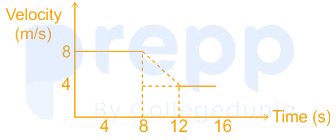
Which one of the following is the value of average acceleration from 8 s to 12 s?
A rigid body of mass 2 kg is dropped from a stationary balloon kept at a height of 50 m from the ground. The speed of the body when it just touches the ground and the total energy
when it is dropped from the balloon are respectively
(acceleration due to gravity = 9·8 m/s -2 )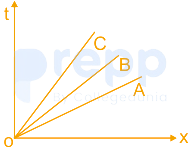
The figure shown above gives the time (t) versus position (x) graphs of three objects A, B and C. Which one of the following is the correct relation between their speeds V A, V Band V C, respectively at any instant (t > 0)?
The force acting on a particle of mass m moving along the X-axis is given by F(x) = AX 2- Bx. Which one of the following is the potential energy of the particle?
How long does light take to reach the earth from the Sun?
How is the kinetic energy of a moving object effected If the net work done on it is positive?
The correct sequence of energy transfer that occurs when an apple falls to the ground is
Which one of the following has maximum inertia?
If an object moves with constant velocity then which one of the following statements is NOT correct?
An object is moving with uniform acceleration a. Its initial velocity is u and after time t its velocity is v. The equation of its motion is v = u + at. The velocity (along y-axis) time (along the x-axis) graph shall be a straight line
Important Questions from Newton's Laws of Motion
If the resultant force acting on a particle is perpendicular to its velocity then-
1. The speed of the particle changes.
2. The speed of the particle does not change.
3. Kinetic energy of the particle does not change.
Choose the correct code.
Consider the following velocity and time graph:
Which one of the following is the value of average acceleration from 8 s to 12 s?
When the speed of car is doubled, then what will be the braking force of the car to stop it in the same distance.
A wire of length L has mass μ per unit length. It is used to pull up a body of mass M upwards with acceleration α. What is the tension at the mid-point of the wire?
(g = acceleration due to gravity)
A rigid body of mass 2 kg is dropped from a stationary balloon kept at a height of 50 m from the ground. The speed of the body when it just touches the ground and the total energy
when it is dropped from the balloon are respectively
(acceleration due to gravity = 9·8 m/s -2 )



