
Which one of the following is the first and the oldest Government-owned coal mining company in India?
Singareni Collieries Company Limited
Identifying India's Oldest Government Coal Company
The question asks us to identify the first and oldest government-owned coal mining company in India. To answer this, we need to look at the history and establishment dates of the companies provided in the options and their ownership status.
Analyzing the Options for Oldest Coal Company
Let's examine each option:
- Neyveli Lignite Corporation (NLC): NLC India Limited, formerly known as Neyveli Lignite Corporation, was incorporated in 1956. While it is a significant government-owned company, it was established much later than some other mining operations.
- Singareni Collieries Company Limited (SCCL): The history of Singareni Collieries dates back to 1889 when coal was discovered. The Hyderabad (Deccan) Company Limited acquired mining rights in 1920. The Hyderabad State Government took over the company in 1945, making it government-owned. After the reorganization of states, it became a joint venture of the Government of Andhra Pradesh and the Government of India in 1960. Currently, it is jointly owned by the Telangana State Government and the Government of India. Its origin and government takeover timeline make it a strong contender for the oldest government-owned coal company.
- Coal India Limited (CIL): Coal India Limited is a public sector undertaking under the Ministry of Coal, Government of India. It was formed in 1975. CIL was created by nationalizing many private collieries. While it is the largest coal producer currently, it is not the oldest company in operation.
- Mahanadi Coalfields Limited (MCL): Mahanadi Coalfields Limited is a subsidiary of Coal India Limited (CIL). It was carved out of South Eastern Coalfields Limited in 1992. Clearly, it is a much more recent company.
Determining the First and Oldest
Comparing the establishment and government takeover dates:
- SCCL: Operations started around 1889, became government-owned in 1945.
- NLC: Incorporated in 1956.
- CIL: Formed in 1975.
- MCL: Formed in 1992.
Based on this timeline, Singareni Collieries Company Limited (SCCL) has the longest history of operation among the options and became government-owned significantly earlier than the formation of Coal India Limited and its subsidiaries or NLC.
Therefore, Singareni Collieries Company Limited is indeed the first and the oldest Government-owned coal mining company in India among the given options.
Revision Table: Key Coal Mining Companies in India
| Company | Established/Formed | Key Information |
|---|---|---|
| Singareni Collieries Company Limited (SCCL) | Discovery 1889, Govt takeover 1945 | Oldest coal mining company, joint ownership (Telangana Govt & Govt of India) |
| Neyveli Lignite Corporation (NLC India Ltd) | 1956 | Major lignite mining and power generation company |
| Coal India Limited (CIL) | 1975 | India's largest coal producer, public sector undertaking |
| Mahanadi Coalfields Limited (MCL) | 1992 | Subsidiary of Coal India Limited, operates in Odisha |
Additional Information on Indian Coal Industry
The coal industry in India has a long history, dating back to the late 18th century. Initially, mining was done by private companies. Post-independence, the government started taking steps to nationalize the industry to ensure planned development and equitable distribution of coal resources. The nationalization process primarily occurred in the early 1970s, leading to the formation of Coal India Limited in 1975, which consolidated most of the coking and non-coking coal mines. However, Singareni Collieries Company Limited had already come under government control much earlier, securing its position as the oldest government-owned entity in this sector.
Similar Questions
What is Inter-cropping?
As per Census 2011, the concentration of Scheduled Caste population (going by percentage of Scheduled Caste population to total population of the State) is the highest in the State of _________.
What do you mean by 'Demographic Dividend'?
Consider the following statements with respect to the adolescent population (age group of 10 to 19 years) of India, according to the 2011 Census :
1. Adolescent population comprises half the population of the country.
2. The group is regarded as youthful population with high potential.
3. In this group there are greater number of females than males.
Which of the statements given above is/are correct?
According to the Census 2011, in India, what is the percentage of people (approximately) considered to be migrants (internal), i.e., now settled in a place different from their previous residence?
On which among the following is National Waterway No. 2 situated?
Which of the the following statements regarding coconut production in Lakshadweep is/are correct?
1. Productivity per hectare is highest in India.
2. Oil content in nuts is highest in the world.
Select the correct answer using the code given below.
What is culturable wasteland?
According to Census 2011, which one of the following is the correct sequence of stages in decreasing order of their total size of the population?
Consider the following map of India:
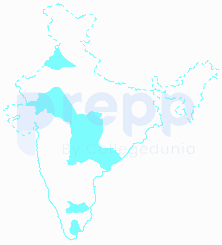
The areas marked in the map given above account for the production of which one of the following cash crops?
Important Questions from Indian Economic and Human Geography
In India, oil wells are found in:
Which of the following is a non-Conventional source of energy?
Select the top Four States with highest population according to census 2011
In which of the following district Manganese is found ?
Monu went on a trip, when he return back he told his classmates that he travelled the longest National Highway of India. You have to tell on which of the following tour he was ?



