
What is Inter-cropping?
It is growing of two or more crops in definite row patterns.
Understanding Inter-cropping in Agriculture
Inter-cropping is a method of farming where two or more crops are grown simultaneously on the same field during the same growing season. This practice is widely adopted for various benefits, including improved soil health, better utilization of resources, and reduced pest and disease incidence.
What is Inter-cropping?
The key characteristic that defines inter-cropping is the arrangement of the different crops being grown together. Unlike simply mixing seeds randomly, inter-cropping involves planting the crops in a specific, predetermined pattern.
- The crops are typically planted in alternating rows or blocks.
- This allows for easier management practices like sowing, weeding, harvesting, and irrigation compared to a random mix.
- The row pattern helps in optimizing the use of sunlight, water, and nutrients by the different crops based on their growth habits and requirements.
Analyzing the Options for Inter-cropping Definition
Let's look at the provided options and see how they relate to the concept of inter-cropping:
-
Option 1: It is the time period between two cropping seasons.
This describes a fallow period or the interval between harvesting one crop and planting the next. It is not the definition of inter-cropping.
-
Option 2: It is growing of two or more crops in random mixture.
This describes 'mixed cropping'. In mixed cropping, the seeds of different crops are mixed together and sown, resulting in a random distribution of plants in the field. This is different from the planned row arrangement in inter-cropping.
-
Option 3: It is growing of two or more crops in definite row patterns.
This precisely matches the definition of inter-cropping. The presence of 'definite row patterns' is the distinguishing feature of this cropping system.
-
Option 4: It is growing of different crops on a piece of land in a pre-planned succession.
This describes 'crop rotation'. Crop rotation involves growing different crops on the same field in a specific sequence over different growing seasons or years, not simultaneously in the same season.
Why is Inter-cropping Beneficial?
Practicing inter-cropping offers several advantages to farmers:
- Pest and Disease Control: Planting different crops together can confuse pests or attract natural predators, reducing the incidence of pests and diseases specific to one crop.
- Improved Soil Fertility: Including legume crops in the inter-cropping system can help fix atmospheric nitrogen in the soil, improving soil fertility.
- Better Resource Utilization: Crops with different root depths or nutrient requirements can utilize resources from different layers of the soil more efficiently.
- Increased Yield: Sometimes, the combined yield from inter-cropping can be higher than the yield of growing single crops separately.
- Risk Reduction: If one crop fails due to pests, diseases, or unfavorable weather, the farmer can still get a yield from the other crop(s), reducing the overall risk.
- Weed Suppression: Densely grown inter-crops can help suppress weed growth.
Common examples of inter-cropping include growing maize and pulses, groundnut and sunflower, or mustard and wheat in alternating rows.
| Feature | Inter-cropping | Mixed Cropping |
|---|---|---|
| Definition | Growing 2+ crops in definite row patterns | Growing 2+ crops in random mixture |
| Sowing Method | Separate sowing for each crop row | Mixing seeds before sowing |
| Management | Easier and crop-specific (e.g., fertilization, harvesting) | Difficult to manage crops separately |
| Harvesting | Can be done separately for different crops | Difficult to harvest crops separately |
| Fertilization | Crop-specific fertilization possible | Uniform fertilization for all crops |
Based on the definitions and comparison, the description "growing of two or more crops in definite row patterns" accurately defines inter-cropping.
Revision Table: Key Cropping Practices
| Practice | Description |
|---|---|
| Single Cropping | Growing only one crop on a field per year/season. |
| Multiple Cropping | Growing two or more crops on the same field in one year. Includes sequential cropping and inter-cropping. |
| Inter-cropping | Growing two or more crops simultaneously in definite row patterns. |
| Mixed Cropping | Growing two or more crops simultaneously in a random mixture. |
| Crop Rotation | Growing different crops on the same field in a planned sequence over different seasons/years. |
Additional Information on Cropping Systems
Understanding different cropping systems is crucial for sustainable agriculture. Each system has its own advantages and is chosen based on factors like climate, soil type, resource availability, and economic goals.
- Inter-cropping is a form of multiple cropping.
- The choice of crops for inter-cropping is important; they should ideally have different growth durations, nutrient requirements, and pest/disease susceptibility to maximize benefits and minimize competition.
- Proper planning of row ratios and spacing is essential for successful inter-cropping.
- Inter-cropping can contribute to biodiversity on the farm.
Similar Questions
As per Census 2011, the concentration of Scheduled Caste population (going by percentage of Scheduled Caste population to total population of the State) is the highest in the State of _________.
What do you mean by 'Demographic Dividend'?
Consider the following statements with respect to the adolescent population (age group of 10 to 19 years) of India, according to the 2011 Census :
1. Adolescent population comprises half the population of the country.
2. The group is regarded as youthful population with high potential.
3. In this group there are greater number of females than males.
Which of the statements given above is/are correct?
According to the Census 2011, in India, what is the percentage of people (approximately) considered to be migrants (internal), i.e., now settled in a place different from their previous residence?
On which among the following is National Waterway No. 2 situated?
Which of the the following statements regarding coconut production in Lakshadweep is/are correct?
1. Productivity per hectare is highest in India.
2. Oil content in nuts is highest in the world.
Select the correct answer using the code given below.
What is culturable wasteland?
According to Census 2011, which one of the following is the correct sequence of stages in decreasing order of their total size of the population?
Consider the following map of India:
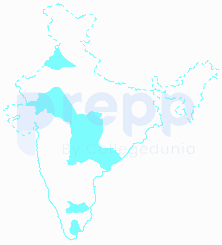
The areas marked in the map given above account for the production of which one of the following cash crops?
Headquarters of which one among the following Railway Zones in India is situated at the highest elevation from the mean sea level?
Important Questions from Indian Economic and Human Geography
Which of the following Indian states has the greatest number of sugar mills?
India possesses an expansive and continuously growing road network, vital for its economic and social development. When considering the cumulative length of national highways, state highways, and other categories of roads, India's road system is surpassed in total length by only one other country globally. What is India's rank in the world in terms of its total road network length?
According to the 2011 Census of India, which state has lowest population density?
In India, oil wells are found in:
Which of the following is a non-Conventional source of energy?



