
As per Census 2011, the concentration of Scheduled Caste population (going by percentage of Scheduled Caste population to total population of the State) is the highest in the State of _________.
Punjab
Understanding Scheduled Caste Population Data from Census 2011
The question asks about the concentration of Scheduled Caste (SC) population in various Indian states as per the Census 2011. Concentration here refers to the percentage of the Scheduled Caste population relative to the total population of the state.
Census 2011 Findings on SC Population Percentage
According to the Census 2011 data, among all the states in India, Punjab had the highest percentage of the Scheduled Caste population. This means that when you look at every 100 people in Punjab, the largest proportion of them belonged to the Scheduled Caste category compared to any other state.
Let's look at the approximate percentages for some states based on Census 2011:
- Punjab: Approximately 31.9%
- Himachal Pradesh: Approximately 24.7%
- West Bengal: Approximately 23.5%
- Uttar Pradesh: Approximately 20.7%
- Haryana: Approximately 20.2%
Comparing these figures, it is clear that Punjab had the highest concentration of Scheduled Caste population by percentage in 2011.
Analyzing the Given Options
Let's consider the options provided in the question:
- Uttar Pradesh: Uttar Pradesh has a very large Scheduled Caste population in terms of absolute numbers, but its percentage relative to the total state population is not the highest among all states.
- Himachal Pradesh: Himachal Pradesh has a significant percentage of Scheduled Caste population, but it is lower than that of Punjab.
- Punjab: Based on Census 2011 data, Punjab recorded the highest percentage of Scheduled Caste population among Indian states.
- West Bengal: West Bengal also has a substantial Scheduled Caste population, both in number and percentage, but its percentage is lower than that of Punjab.
Therefore, based on the percentage of Scheduled Caste population to the total population as per Census 2011, Punjab ranks highest.
| State | Approximate SC Population Percentage (Census 2011) |
|---|---|
| Punjab | \(31.9\%\) |
| Himachal Pradesh | \(24.7\%\) |
| West Bengal | \(23.5\%\) |
| Uttar Pradesh | \(20.7\%\) |
Conclusion
The Census 2011 data clearly indicates that the State with the highest concentration (percentage) of Scheduled Caste population is Punjab.
Revision Table: Census 2011 SC Population Concentration
| Key Concept | Finding from Census 2011 |
|---|---|
| Highest SC Population Percentage | Punjab |
| Definition of Concentration | Percentage of SC population to total population |
| Punjab's Percentage | Approx. \(31.9\%\) |
Additional Information: Scheduled Castes and Census Data
Scheduled Castes (SCs) are groups of people listed in the Constitution of India under Article 341. The lists are based on the historical discrimination and marginalization faced by these communities. The Indian Census collects detailed data on the population, including demographic characteristics like religion, language, and caste/tribe (specifically for SCs and Scheduled Tribes - STs).
Key points about Census data:
- The Census is conducted every 10 years and is a primary source of information about India's population.
- Data on SC and ST populations is crucial for understanding their socio-economic status, distribution, and for planning welfare schemes and policies, including reservations.
- Percentage concentration is calculated by dividing the total SC population in a state by the total population of that state and multiplying by 100.
- While a state might have a large absolute number of SC people, its percentage concentration might be lower than another state with a smaller total population but a higher proportion of SC people.
Understanding population demographics through Census data is essential for informed policymaking and social development.
Similar Questions
What is Inter-cropping?
What do you mean by 'Demographic Dividend'?
Consider the following statements with respect to the adolescent population (age group of 10 to 19 years) of India, according to the 2011 Census :
1. Adolescent population comprises half the population of the country.
2. The group is regarded as youthful population with high potential.
3. In this group there are greater number of females than males.
Which of the statements given above is/are correct?
According to the Census 2011, in India, what is the percentage of people (approximately) considered to be migrants (internal), i.e., now settled in a place different from their previous residence?
On which among the following is National Waterway No. 2 situated?
Which of the the following statements regarding coconut production in Lakshadweep is/are correct?
1. Productivity per hectare is highest in India.
2. Oil content in nuts is highest in the world.
Select the correct answer using the code given below.
What is culturable wasteland?
According to Census 2011, which one of the following is the correct sequence of stages in decreasing order of their total size of the population?
Consider the following map of India:
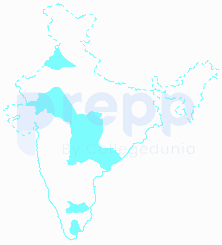
The areas marked in the map given above account for the production of which one of the following cash crops?
Headquarters of which one among the following Railway Zones in India is situated at the highest elevation from the mean sea level?
Important Questions from Indian Economic and Human Geography
In India, oil wells are found in:
Which of the following is a non-Conventional source of energy?
Select the top Four States with highest population according to census 2011
In which of the following district Manganese is found ?
Monu went on a trip, when he return back he told his classmates that he travelled the longest National Highway of India. You have to tell on which of the following tour he was ?



