
Which one of the following is an exhaustible but renewable natural resource?
Water in usable condition
Understanding Natural Resources: Exhaustible but Renewable
Natural resources are materials or substances occurring in nature which can be exploited for economic gain. They are broadly classified based on their renewability. Some are renewable, meaning they replenish naturally over time, while others are non-renewable, meaning they exist in fixed amounts and are depleted by consumption.
This question asks for a specific type of natural resource: one that is exhaustible but renewable. This means the resource can be used up or depleted (exhaustible) but has the capacity to regenerate or be replenished naturally over a relevant timescale (renewable).
Analyzing the Options
Let's look at each option provided:
- Solar energy: Solar energy comes from the sun. It is continuously available and its rate of consumption does not affect its future availability. This makes it an inexhaustible and renewable resource.
- Water in usable condition: Water is a renewable resource because it is continuously circulated through the water cycle (evaporation, condensation, precipitation, runoff). However, fresh, clean, and easily accessible water (usable condition) can be depleted locally or regionally by overuse, pollution, or drought faster than natural processes can replenish it in that specific usable state. So, while the total amount of water cycles, the supply of water in a usable state can become exhausted in a particular area, making it locally exhaustible, even though it's globally and fundamentally renewable via the water cycle.
- Soil: Soil is technically a renewable resource, as it forms from the weathering of rocks and decomposition of organic matter. However, soil formation is an extremely slow process, taking hundreds or thousands of years to build even a few centimeters. If soil is degraded or eroded faster than it forms, it can be considered exhaustible within human timescales. But compared to the rapid renewal of water, soil renewal is very slow.
- Landscape in its natural condition: A landscape is a geographical area. Maintaining it in its natural condition depends on ecological processes and lack of human interference. While ecosystems within a landscape can regenerate (renewable aspect), returning a significantly altered landscape to its original 'natural condition' can be difficult or take very long periods. It's a broader concept than a specific resource like water or energy.
Identifying the Exhaustible but Renewable Resource
Based on the analysis:
- Solar energy is inexhaustible and renewable.
- Water in usable condition is renewable (water cycle) but can be locally or regionally exhausted in its usable state.
- Soil is renewable but very slowly, making it practically exhaustible if mismanaged.
- Landscape is a complex concept; its 'natural condition' is not a resource that renews in the same way as water or energy.
The term "exhaustible but renewable" perfectly describes resources that regenerate, but whose usable supply can be temporarily or locally depleted by consumption or degradation that outpaces replenishment. Water, specifically in usable form (like fresh water in an aquifer or river), fits this description because while the global water cycle renews water, local sources of clean, usable water can be depleted through overuse or pollution, making them locally "exhaustible" even though the resource overall is "renewable".
Conclusion
Comparing the options, Water in usable condition is the resource that best fits the description of being renewable through natural processes (the water cycle) but also exhaustible in terms of its local availability, quality, or quantity for human use if consumption exceeds the local replenishment rate or if it becomes too polluted.
| Resource | Renewable? | Exhaustible (in usable form)? | Classification |
|---|---|---|---|
| Solar energy | Yes | No (Inexhaustible) | Inexhaustible & Renewable |
| Water in usable condition | Yes (Water Cycle) | Yes (Locally/Regionally) | Exhaustible but Renewable |
| Soil | Yes (Very Slowly) | Practically Yes (If Mismanaged) | Renewable (Slow) / Practically Exhaustible |
| Landscape (Natural Condition) | Complex | Yes (Can be altered) | Not a standard resource classification |
Revision Table: Natural Resources Classification
| Type | Description | Examples |
|---|---|---|
| Renewable Resources | Resources that replenish naturally over human timescales. | Solar energy, wind energy, biomass, fresh water (in general), air, forests (if sustainably managed). |
| Non-renewable Resources | Resources that exist in fixed amounts and are depleted by consumption over geological timescales. | Fossil fuels (coal, oil, natural gas), minerals (iron ore, copper), nuclear fuels (uranium). |
| Exhaustible but Renewable | A subset of renewable resources that can be depleted faster than they replenish in a specific location or usable state, but still regenerate. | Fresh water (in local sources), forests (if over-harvested). |
Additional Information: Water as a Resource
Water is fundamental to life and ecosystems. While the Earth has a vast amount of water, over 97% is saltwater in oceans. Most of the remaining freshwater is locked up in glaciers and ice caps. The readily available freshwater in rivers, lakes, and shallow groundwater makes up only a tiny fraction of the total water.
The usability of water is affected by:
- Quantity: Over-extraction for agriculture, industry, and domestic use can lower water tables or dry up surface water bodies.
- Quality: Pollution from various sources can render water unusable without expensive treatment.
- Location and Timing: Water availability varies greatly by region and season due to climate patterns and geographical features.
Therefore, managing water resources sustainably is crucial to ensure that usable water supplies are not exhausted for current and future generations, even though the overall water cycle continues.
Similar Questions
What is Inter-cropping?
As per Census 2011, the concentration of Scheduled Caste population (going by percentage of Scheduled Caste population to total population of the State) is the highest in the State of _________.
What do you mean by 'Demographic Dividend'?
Consider the following statements with respect to the adolescent population (age group of 10 to 19 years) of India, according to the 2011 Census :
1. Adolescent population comprises half the population of the country.
2. The group is regarded as youthful population with high potential.
3. In this group there are greater number of females than males.
Which of the statements given above is/are correct?
According to the Census 2011, in India, what is the percentage of people (approximately) considered to be migrants (internal), i.e., now settled in a place different from their previous residence?
On which among the following is National Waterway No. 2 situated?
Which of the the following statements regarding coconut production in Lakshadweep is/are correct?
1. Productivity per hectare is highest in India.
2. Oil content in nuts is highest in the world.
Select the correct answer using the code given below.
What is culturable wasteland?
According to Census 2011, which one of the following is the correct sequence of stages in decreasing order of their total size of the population?
Consider the following map of India:
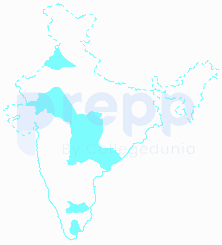
The areas marked in the map given above account for the production of which one of the following cash crops?
Important Questions from Indian Economic and Human Geography
In India, oil wells are found in:
Which of the following is a non-Conventional source of energy?
Select the top Four States with highest population according to census 2011
In which of the following district Manganese is found ?
Monu went on a trip, when he return back he told his classmates that he travelled the longest National Highway of India. You have to tell on which of the following tour he was ?



