
What is the ASA congruence rule of triangles, where A and S represents angle and side of triangle respectively?
Two triangles are said to be congruent if 2 angles and the included side of one triangle are equal to 2 angles and the included side of the other triangle.
Understanding Triangle Congruence and the ASA Rule
In geometry, congruence means that two figures have the same shape and size. For triangles, this means that all corresponding sides and all corresponding angles are equal. We don't always need to check all six parts (three sides and three angles) to determine if two triangles are congruent. There are specific rules, known as congruence criteria or congruence rules, that allow us to prove congruence based on fewer measurements. The question asks about the ASA congruence rule for triangles.
What is the ASA Congruence Rule?
The ASA congruence rule is one of the fundamental criteria for proving triangle congruence. ASA stands for Angle-Side-Angle. This rule specifies the minimum conditions under which two triangles can be declared congruent.
According to the ASA congruence rule, two triangles are congruent if:
- Two angles of one triangle are equal to two corresponding angles of the other triangle.
- The side included between these two angles of one triangle is equal to the corresponding included side of the other triangle.
The term 'included side' is very important here. If we are talking about angles $\angle A$ and $\angle B$ of a triangle, the included side is the side that connects the vertices A and B, which is side AB. Similarly, for angles $\angle B$ and $\angle C$, the included side is BC, and for angles $\angle C$ and $\angle A$, the included side is CA.
So, if we have two triangles, say $\triangle ABC$ and $\triangle PQR$, the ASA rule states that $\triangle ABC \cong \triangle PQR$ if:
- $\angle B = \angle Q$ (An angle)
- $BC = QR$ (The included side)
- $\angle C = \angle R$ (Another angle)
Or, alternatively:
- $\angle A = \angle P$
- $AB = PQ$
- $\angle B = \angle Q$
And similarly for the third pair of angles and included side.
Analyzing the Options
Let's look at the given options and compare them to the definition of the ASA congruence rule:
-
Two triangles are said to be congruent if all three sides of both the triangles are equal.
This describes the SSS (Side-Side-Side) congruence rule, not the ASA rule.
-
Two triangles are said to be congruent if 2 angles and the included side of one triangle are equal to 2 angles and the included side of the other triangle.
This statement perfectly matches the definition of the ASA (Angle-Side-Angle) congruence rule, which requires two corresponding angles and the side specifically located between them to be equal in both triangles.
-
Two triangles are said to be congruent if 2 sides and the included angle of one triangle are equal to 2 sides and the included angle of the other triangle.
This describes the SAS (Side-Angle-Side) congruence rule, not the ASA rule. The 'A' here is the angle included between the two specified sides.
-
Two triangles are said to be congruent if any pair of 2 angles and any 1 pair of sides of both the triangles are equal.
This statement is too general and is not always true. For example, having two angles and a non-included side equal is the AAS (Angle-Angle-Side) congruence rule, which is valid, but this option says "any 1 pair of sides," which could imply the non-included side (AAS) or potentially an included side (ASA). However, the wording "any pair of 2 angles and any 1 pair of sides" doesn't precisely define the required positional relationship (like 'included') needed for a specific rule like ASA or SAS. It's vague and covers cases beyond just ASA. While AAS is a valid rule, this option's description doesn't specifically define ASA.
Comparison of Triangle Congruence Rules
It's helpful to compare the different congruence rules to better understand the ASA rule.
| Rule | Description | Key Feature |
|---|---|---|
| SSS | Three sides are equal. | Only sides are considered. |
| SAS | Two sides and the included angle are equal. | Angle must be between the two sides. |
| ASA | Two angles and the included side are equal. | Side must be between the two angles. |
| AAS (or SAA) | Two angles and a non-included side are equal. | Side is not between the two angles. (Note: AAS can be derived from ASA using the angle sum property of a triangle). |
| RHS | For right triangles: Right angle, Hypotenuse, and one Side are equal. | Specific to right triangles. |
Based on the analysis, the statement that correctly defines the ASA congruence rule is the one that mentions two angles and the included side being equal.
Conclusion on ASA Congruence Rule
The ASA congruence rule is a powerful tool in geometry for proving that two triangles are identical in size and shape. It requires checking specific corresponding parts: two angles and the side positioned precisely between those two angles in both triangles. If these three corresponding parts are equal, the triangles are congruent by ASA.
Revision Table: Triangle Congruence Criteria
| Congruence Rule | Condition for Congruence |
|---|---|
| SSS | Side-Side-Side: All three corresponding sides are equal. |
| SAS | Side-Angle-Side: Two corresponding sides and the angle included between them are equal. |
| ASA | Angle-Side-Angle: Two corresponding angles and the side included between them are equal. |
| AAS | Angle-Angle-Side: Two corresponding angles and a non-included side are equal. |
| RHS | Right angle-Hypotenuse-Side: In two right triangles, the hypotenuse and one side are equal. |
Additional Information on Triangle Congruence
Understanding congruence is fundamental in geometry for proving theorems and solving problems related to shapes. When two triangles are proven congruent using a rule like ASA, it implies that all their corresponding parts (sides and angles) are equal. This is often referred to as CPCTC, which stands for "Corresponding Parts of Congruent Triangles are Congruent." For example, if $\triangle ABC \cong \triangle PQR$ by ASA, then not only are the parts used in the ASA criteria equal ($\angle B = \angle Q$, $BC = QR$, $\angle C = \angle R$), but the other corresponding parts are also equal: $AB = PQ$, $AC = PR$, and $\angle A = \angle P$. The ASA congruence rule is a direct consequence of the Angle-Side-Angle theorem, which can be proven using other axioms or postulates in geometry.
Similar Questions
If sides of a triangle are 12 cm, 15 cm and 21 cm, then what is the inradius (in cm) of the triangle?
In ΔPQR, PQ = PR and S is a point on QR such that ∠PSQ = 96° + ∠QPS and ∠QPR = 132°. What is the measure of ∠PSR?
ΔABC ~ ΔDEF and the perimeters of ΔABC and ΔDEF are 40 cm and 12 cm, respectively. If DE = 6 cm, then AB is:
If in acute-angled triangle ABC, AL, BM, and CN are the three altitudes of triangle ABC, then which of the following statements will be true?
If ∆ABC ~ ∆EDF such that AB = 6 cm, DF = 16 cm and DE = 8 cm, then the length of BC is:
If the ratio of corresponding sides of two similar triangles\(\sqrt{5} : \sqrt{7}\) is then what is the ratio of the area of the two triangles?
- ΔABC ~ Δ DEF and the perimeters of these triangles are 32 cm and 12 cm, respectively. If DE = 6 cm, then what will be the length of AB?
If the areas of two similar triangles are in the ratio 196 ∶ 625,what would be the ratio of the corresponding sides?
If the areas of two similar triangles are in the ratio 196 : 625, what would be the ratio of the corresponding sides?
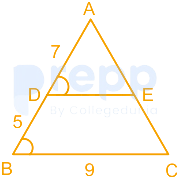
In ΔABC, D and E are the points on sides AB and AC, respectively such that ∠ADE = ∠B. If AD = 7 cm, BD = 5cm and BC = 9 cm, then DE (in cm) is equal to:
Important Questions from Triangles, Congruence and Similarity
G is the centroid of the equilateral triangle ABC. If AB = 8√ 3 cm, then the length of AG is equal to:
If sides of a triangle are 12 cm, 15 cm and 21 cm, then what is the inradius (in cm) of the triangle?
What is the area of quadrilateral ABCD?
It is given that ΔABC ~ ΔXYZ and Area ΔABC : Area ΔXYZ = 81 : 25. If AB = 18 cm, BC = 10 cm, CA = 15 cm, then what is the side XZ (in cm)?
Sides of two similar triangles are in the ratio 4 ∶ 9. Area of these triangles are in the ratio:



