
ΔABC ~ ΔDEF and the perimeters of ΔABC and ΔDEF are 40 cm and 12 cm, respectively. If DE = 6 cm, then AB is:
20 cm
Understanding Similar Triangles and Perimeters
The question deals with two similar triangles, ΔABC and ΔDEF. We are given their perimeters and the length of one side in ΔDEF (DE = 6 cm). We need to find the length of the corresponding side in ΔABC (AB).
Similar triangles have corresponding angles that are equal and corresponding sides that are in proportion. A key property related to similar triangles is that the ratio of their perimeters is equal to the ratio of their corresponding sides.
Mathematically, if ΔABC ~ ΔDEF, then:
- $\angle\text{A} = \angle\text{D}$, $\angle\text{B} = \angle\text{E}$, $\angle\text{C} = \angle\text{F}$
- $\frac{\text{AB}}{\text{DE}} = \frac{\text{BC}}{\text{EF}} = \frac{\text{AC}}{\text{DF}}$
- $\frac{\text{Perimeter}(\Delta\text{ABC})}{\text{Perimeter}(\Delta\text{DEF})} = \frac{\text{AB}}{\text{DE}} = \frac{\text{BC}}{\text{EF}} = \frac{\text{AC}}{\text{DF}}$
Applying the Perimeter Ratio Property
We are given:
- Perimeter of ΔABC = 40 cm
- Perimeter of ΔDEF = 12 cm
- DE = 6 cm
We want to find AB. Since AB is the side corresponding to DE (as the triangles are named ΔABC ~ ΔDEF, so A corresponds to D, B to E, C to F), we can use the ratio of perimeters and the ratio of these corresponding sides:
$\frac{\text{Perimeter}(\Delta\text{ABC})}{\text{Perimeter}(\Delta\text{DEF})} = \frac{\text{AB}}{\text{DE}}$
Calculating the Side Length AB
Now, let's substitute the given values into the equation:
$\frac{40\text{ cm}}{12\text{ cm}} = \frac{\text{AB}}{6\text{ cm}}$
To find AB, we can rearrange the equation:
$\text{AB} = \left(\frac{40}{12}\right) \times 6\text{ cm}$
Simplify the fraction $\frac{40}{12}$: both 40 and 12 are divisible by 4.
$\frac{40}{12} = \frac{40 \div 4}{12 \div 4} = \frac{10}{3}$
So the equation becomes:
$\text{AB} = \left(\frac{10}{3}\right) \times 6\text{ cm}$
Now, multiply:
$\text{AB} = \frac{10 \times 6}{3}\text{ cm}$
$\text{AB} = \frac{60}{3}\text{ cm}$
$\text{AB} = 20\text{ cm}$
Thus, the length of side AB is 20 cm.
Verification
Let's check if the ratio of sides matches the ratio of perimeters:
Ratio of perimeters = $\frac{40}{12} = \frac{10}{3}$
Ratio of corresponding sides $\frac{\text{AB}}{\text{DE}} = \frac{20}{6} = \frac{10}{3}$
The ratios match, confirming our calculation for AB is correct based on the properties of similar triangles.
| Triangle | Perimeter | Side |
|---|---|---|
| ΔABC | 40 cm | AB = ? |
| ΔDEF | 12 cm | DE = 6 cm |
Similar Triangle Properties Summary
- Corresponding angles are equal.
- Corresponding sides are proportional.
- Ratio of areas is the square of the ratio of corresponding sides.
- Ratio of perimeters is equal to the ratio of corresponding sides.
Revision Table: Similar Triangles Perimeter
Key concepts for solving similar triangle problems involving perimeters:
| Concept | Description | Formula (for ΔABC ~ ΔDEF) |
|---|---|---|
| Similarity | Triangles with equal corresponding angles and proportional corresponding sides. | ΔABC ~ ΔDEF |
| Corresponding Sides | Sides opposite equal angles. Ratio is constant. | $\frac{\text{AB}}{\text{DE}} = \frac{\text{BC}}{\text{EF}} = \frac{\text{AC}}{\text{DF}}$ |
| Perimeter Ratio | Ratio of perimeters equals the ratio of corresponding sides. | $\frac{\text{Perimeter}(\Delta\text{ABC})}{\text{Perimeter}(\Delta\text{DEF})} = \frac{\text{AB}}{\text{DE}}$ |
Additional Information: Scale Factor in Similar Triangles
The constant ratio between corresponding sides of similar triangles is called the scale factor. In this problem, the ratio of perimeters is $\frac{40}{12} = \frac{10}{3}$. This means the scale factor from ΔDEF to ΔABC is $\frac{10}{3}$, and from ΔABC to ΔDEF is $\frac{3}{10}$.
If you know the scale factor, you can find the length of any corresponding side. For example, if the scale factor from ΔDEF to ΔABC is $k$, then any side length in ΔABC is $k$ times the corresponding side length in ΔDEF.
Here, $k = \frac{10}{3}$. So, $\text{AB} = k \times \text{DE} = \frac{10}{3} \times 6 = 20$ cm. This matches our result.
Similar Questions
If sides of a triangle are 12 cm, 15 cm and 21 cm, then what is the inradius (in cm) of the triangle?
In ΔPQR, PQ = PR and S is a point on QR such that ∠PSQ = 96° + ∠QPS and ∠QPR = 132°. What is the measure of ∠PSR?
If in acute-angled triangle ABC, AL, BM, and CN are the three altitudes of triangle ABC, then which of the following statements will be true?
If ∆ABC ~ ∆EDF such that AB = 6 cm, DF = 16 cm and DE = 8 cm, then the length of BC is:
If the ratio of corresponding sides of two similar triangles\(\sqrt{5} : \sqrt{7}\) is then what is the ratio of the area of the two triangles?
What is the ASA congruence rule of triangles, where A and S represents angle and side of triangle respectively?
- ΔABC ~ Δ DEF and the perimeters of these triangles are 32 cm and 12 cm, respectively. If DE = 6 cm, then what will be the length of AB?
If the areas of two similar triangles are in the ratio 196 ∶ 625,what would be the ratio of the corresponding sides?
If the areas of two similar triangles are in the ratio 196 : 625, what would be the ratio of the corresponding sides?
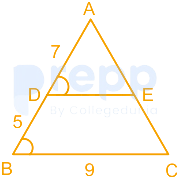
In ΔABC, D and E are the points on sides AB and AC, respectively such that ∠ADE = ∠B. If AD = 7 cm, BD = 5cm and BC = 9 cm, then DE (in cm) is equal to:
Important Questions from Triangles, Congruence and Similarity
G is the centroid of the equilateral triangle ABC. If AB = 8√ 3 cm, then the length of AG is equal to:
If sides of a triangle are 12 cm, 15 cm and 21 cm, then what is the inradius (in cm) of the triangle?
What is the area of quadrilateral ABCD?
It is given that ΔABC ~ ΔXYZ and Area ΔABC : Area ΔXYZ = 81 : 25. If AB = 18 cm, BC = 10 cm, CA = 15 cm, then what is the side XZ (in cm)?
Sides of two similar triangles are in the ratio 4 ∶ 9. Area of these triangles are in the ratio:



