
If in acute-angled triangle ABC, AL, BM, and CN are the three altitudes of triangle ABC, then which of the following statements will be true?
AL + BM + CN < AB + BC + CA
Understanding the Problem: Altitudes in an Acute Triangle
The question asks us to compare the sum of the lengths of the altitudes of an acute-angled triangle ABC with the sum of the lengths of its sides. We are given that AL, BM, and CN are the altitudes from vertices A, B, and C respectively.
Let the lengths of the sides opposite to vertices A, B, and C be denoted by $a, b, c$ respectively. So, BC = $a$, AC = $b$, and AB = $c$. The lengths of the altitudes AL, BM, and CN are commonly denoted by $h_a, h_b, h_c$. We need to find the correct relationship between $(h_a + h_b + h_c)$ and $(a + b + c)$.
Analysing Altitudes in an Acute-Angled Triangle
An acute-angled triangle is a triangle where all three interior angles are less than 90 degrees. A key property of acute-angled triangles is that the foot of each altitude lies inside the opposite side (strictly between the two vertices of that side).
Consider the altitude AL from vertex A to the side BC. Since L lies between B and C, the altitude AL forms two right-angled triangles: $\triangle ABL$ (right-angled at L) and $\triangle ACL$ (right-angled at L).
- In the right-angled triangle $\triangle ABL$, AL is one leg and AB is the hypotenuse. In any right-angled triangle, the hypotenuse is the longest side. Therefore, the length of the leg AL must be less than the length of the hypotenuse AB.
This gives us the inequality: $AL < AB$, or $h_a < c$.
- Similarly, in the right-angled triangle $\triangle ACL$, AL is one leg and AC is the hypotenuse. Thus, the length of the leg AL must be less than the length of the hypotenuse AC.
This gives us the inequality: $AL < AC$, or $h_a < b$.
Applying the Principle to All Altitudes
We can apply the same reasoning to the other two altitudes:
- For the altitude BM from vertex B to side AC, M lies between A and C. BM forms right triangles $\triangle BMA$ (right-angled at M) and $\triangle BMC$ (right-angled at M).
- In $\triangle BMA$, BM is a leg and AB is the hypotenuse. So, $BM < AB$, or $h_b < c$.
- In $\triangle BMC$, BM is a leg and BC is the hypotenuse. So, $BM < BC$, or $h_b < a$.
- For the altitude CN from vertex C to side AB, N lies between A and B. CN forms right triangles $\triangle CNA$ (right-angled at N) and $\triangle CNB$ (right-angled at N).
- In $\triangle CNA$, CN is a leg and AC is the hypotenuse. So, $CN < AC$, or $h_c < b$.
- In $\triangle CNB$, CN is a leg and BC is the hypotenuse. So, $CN < BC$, or $h_c < a$.
Comparing Sum of Altitudes and Sum of Sides
Now we have several inequalities involving the altitude lengths and side lengths:
- $h_a < b$
- $h_b < c$
- $h_c < a$
Let's add these three inequalities together:
$$h_a + h_b + h_c < b + c + a$$Rearranging the terms on the right side, we get:
$$h_a + h_b + h_c < a + b + c$$Substituting the notation from the question:
$$AL + BM + CN < AB + BC + CA$$This inequality shows that the sum of the lengths of the altitudes of an acute-angled triangle is less than the sum of the lengths of its sides.
Evaluating the Options
Let's compare our derived inequality with the given options:
- $AL + BM + CN = AB + BC + CA$
- $AL + BM + CN < AB + BC + CA$
- $AL + BM + CN > AB + BC + CA$
- $AL + BM = AB + BC$
Our result, $AL + BM + CN < AB + BC + CA$, matches option 2.
Conclusion
Based on the geometric properties of altitudes in an acute-angled triangle, the sum of the lengths of the altitudes is always less than the sum of the lengths of the sides.
| Geometric Element | Notation | Description |
|---|---|---|
| Sides | AB, BC, CA or $c, a, b$ | The three boundary segments of the triangle. |
| Altitudes | AL, BM, CN or $h_a, h_b, h_c$ | Perpendicular segments from a vertex to the opposite side. |
| Acute Triangle Property | Foot of altitude is internal | The point where the altitude meets the side lies between the endpoints of that side. |
Revision Table: Triangle Altitudes and Sides Inequality
| Triangle Type | Relationship between $\Sigma h$ and $\Sigma s$ |
|---|---|
| Acute-angled Triangle | $\Sigma h < \Sigma s$ (Sum of altitudes < Sum of sides) |
| Right-angled Triangle | $\Sigma h < \Sigma s$ (Equality $h_a=c$ or $h_b=a$ etc. is not part of $\Sigma h < \Sigma s$ proof; e.g., for a 3-4-5 triangle, $3+4+2.4 = 9.4 < 3+4+5=12$) |
| Obtuse-angled Triangle | $\Sigma h < \Sigma s$ (Foot of altitude can be external, but inequality still holds) |
Additional Information: Properties of Altitudes
Altitudes are important lines in a triangle. Here are a few more facts about them:
- The three altitudes of a triangle are concurrent, meaning they intersect at a single point.
- The point of intersection of the altitudes is called the orthocenter.
- In an acute-angled triangle, the orthocenter lies inside the triangle.
- In a right-angled triangle, the orthocenter is at the vertex with the right angle.
- In an obtuse-angled triangle, the orthocenter lies outside the triangle.
- The lengths of the altitudes are inversely proportional to the lengths of the corresponding sides. That is, $a h_a = b h_b = c h_c = 2 \times Area$. This means the longest altitude is perpendicular to the shortest side, and the shortest altitude is perpendicular to the longest side.
Similar Questions
If sides of a triangle are 12 cm, 15 cm and 21 cm, then what is the inradius (in cm) of the triangle?
In ΔPQR, PQ = PR and S is a point on QR such that ∠PSQ = 96° + ∠QPS and ∠QPR = 132°. What is the measure of ∠PSR?
ΔABC ~ ΔDEF and the perimeters of ΔABC and ΔDEF are 40 cm and 12 cm, respectively. If DE = 6 cm, then AB is:
If ∆ABC ~ ∆EDF such that AB = 6 cm, DF = 16 cm and DE = 8 cm, then the length of BC is:
If the ratio of corresponding sides of two similar triangles\(\sqrt{5} : \sqrt{7}\) is then what is the ratio of the area of the two triangles?
What is the ASA congruence rule of triangles, where A and S represents angle and side of triangle respectively?
- ΔABC ~ Δ DEF and the perimeters of these triangles are 32 cm and 12 cm, respectively. If DE = 6 cm, then what will be the length of AB?
If the areas of two similar triangles are in the ratio 196 ∶ 625,what would be the ratio of the corresponding sides?
If the areas of two similar triangles are in the ratio 196 : 625, what would be the ratio of the corresponding sides?
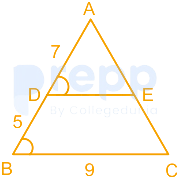
In ΔABC, D and E are the points on sides AB and AC, respectively such that ∠ADE = ∠B. If AD = 7 cm, BD = 5cm and BC = 9 cm, then DE (in cm) is equal to:
Important Questions from Triangles, Congruence and Similarity
G is the centroid of the equilateral triangle ABC. If AB = 8√ 3 cm, then the length of AG is equal to:
If sides of a triangle are 12 cm, 15 cm and 21 cm, then what is the inradius (in cm) of the triangle?
What is the area of quadrilateral ABCD?
It is given that ΔABC ~ ΔXYZ and Area ΔABC : Area ΔXYZ = 81 : 25. If AB = 18 cm, BC = 10 cm, CA = 15 cm, then what is the side XZ (in cm)?
Sides of two similar triangles are in the ratio 4 ∶ 9. Area of these triangles are in the ratio:



