
ΔABC ~ Δ DEF and the perimeters of these triangles are 32 cm and 12 cm, respectively. If DE = 6 cm, then what will be the length of AB?
16 cm
Relating Perimeters and Sides of Similar Triangles
The question asks us to find the length of a side (AB) in one triangle (ΔABC) given information about a similar triangle (ΔDEF). We know both triangles are similar (indicated by the '~' symbol), we have their perimeters, and the length of one side of ΔDEF.
The Property of Similar Triangles' Perimeters
A key concept in geometry is that for any two similar triangles, the ratio of their perimeters is exactly the same as the ratio of any pair of corresponding sides.
If we have two similar triangles, say ΔABC ~ ΔDEF, this property can be written as:
$$ \frac{\text{Perimeter of } \Delta ABC}{\text{Perimeter of } \Delta DEF} = \frac{\text{Side AB}}{\text{Corresponding Side DE}} = \frac{\text{Side BC}}{\text{Corresponding Side EF}} = \frac{\text{Side AC}}{\text{Corresponding Side DF}} $$
Using the Given Information
Let's list the values provided in the question:
- The triangles are similar: ΔABC ~ ΔDEF
- Perimeter of ΔABC = 32 cm
- Perimeter of ΔDEF = 12 cm
- Length of side DE = 6 cm
We need to find the length of side AB. AB is the side corresponding to DE because of the order the vertices are listed in the similarity statement (ΔABC ~ ΔDEF).
Setting Up the Equation
Using the property mentioned earlier, we can set up a ratio involving the perimeters and the corresponding sides AB and DE:
$$ \frac{\text{Perimeter}(\Delta ABC)}{\text{Perimeter}(\Delta DEF)} = \frac{AB}{DE} $$
Now, we substitute the given values into this equation:
$$ \frac{32 \text{ cm}}{12 \text{ cm}} = \frac{AB}{6 \text{ cm}} $$
Solving for the Length of AB
To find the length of AB, we need to isolate AB in the equation. We can do this by multiplying both sides of the equation by 6 cm:
$$ AB = \frac{32 \text{ cm}}{12 \text{ cm}} \times 6 \text{ cm} $$
Now, we can perform the calculation. Notice that 6 cm is half of 12 cm:
$$ AB = 32 \times \left( \frac{6}{12} \right) \text{ cm} $$
Simplify the fraction $$ \frac{6}{12} $$:
$$ \frac{6}{12} = \frac{1}{2} $$
Substitute this back into the equation for AB:
$$ AB = 32 \times \frac{1}{2} \text{ cm} $$
$$ AB = 16 \text{ cm} $$
Conclusion
By applying the property that the ratio of perimeters of similar triangles equals the ratio of their corresponding sides, we calculated that the length of side AB is 16 cm.
Similar Questions
If sides of a triangle are 12 cm, 15 cm and 21 cm, then what is the inradius (in cm) of the triangle?
In ΔPQR, PQ = PR and S is a point on QR such that ∠PSQ = 96° + ∠QPS and ∠QPR = 132°. What is the measure of ∠PSR?
ΔABC ~ ΔDEF and the perimeters of ΔABC and ΔDEF are 40 cm and 12 cm, respectively. If DE = 6 cm, then AB is:
If in acute-angled triangle ABC, AL, BM, and CN are the three altitudes of triangle ABC, then which of the following statements will be true?
If ∆ABC ~ ∆EDF such that AB = 6 cm, DF = 16 cm and DE = 8 cm, then the length of BC is:
If the ratio of corresponding sides of two similar triangles\(\sqrt{5} : \sqrt{7}\) is then what is the ratio of the area of the two triangles?
What is the ASA congruence rule of triangles, where A and S represents angle and side of triangle respectively?
If the areas of two similar triangles are in the ratio 196 ∶ 625,what would be the ratio of the corresponding sides?
If the areas of two similar triangles are in the ratio 196 : 625, what would be the ratio of the corresponding sides?
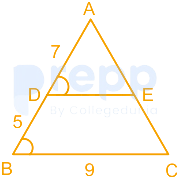
In ΔABC, D and E are the points on sides AB and AC, respectively such that ∠ADE = ∠B. If AD = 7 cm, BD = 5cm and BC = 9 cm, then DE (in cm) is equal to:
Important Questions from Triangles, Congruence and Similarity
G is the centroid of the equilateral triangle ABC. If AB = 8√ 3 cm, then the length of AG is equal to:
If sides of a triangle are 12 cm, 15 cm and 21 cm, then what is the inradius (in cm) of the triangle?
What is the area of quadrilateral ABCD?
It is given that ΔABC ~ ΔXYZ and Area ΔABC : Area ΔXYZ = 81 : 25. If AB = 18 cm, BC = 10 cm, CA = 15 cm, then what is the side XZ (in cm)?
Sides of two similar triangles are in the ratio 4 ∶ 9. Area of these triangles are in the ratio:



