
The mechanical model of communication is characterised by: A. Multiple-way flow B. One-way flow C. From one-to-many D. Anonymity E. Active audience. Choose the most appropriate answer from the options given below:
B, C and D only
Concept: The mechanical (transmission) model of communication treats communication as a linear, machine-like transfer of a message from a single source to a large audience. Classic examples are the Shannon–Weaver model and early mass-media thinking. Its hallmark features are: a one-way flow of information, transmission from one source to many receivers, and the anonymity of a scattered, unknown, passive audience.
Evaluating the given features:
• A. Multiple-way flow — WRONG for the mechanical model; multi-directional exchange belongs to interactive/transactional models.
• B. One-way flow — CORRECT; the message moves in a single direction, source → receiver.
• C. From one-to-many — CORRECT; a single sender addresses a large mass.
• D. Anonymity — CORRECT; the audience is large, dispersed and unknown to the sender.
• E. Active audience — WRONG; the mechanical model assumes a passive audience that merely receives; an active audience is a feature of later reception/transactional models.
Hence the correct combination is B, C and D.
Why the other option-sets are wrong: Any set including 'Multiple-way flow' or 'Active audience' contradicts the linear, passive-audience nature of the mechanical model, so combinations built around those features are incorrect.
Takeaway: The mechanical model = one-way, one-to-many, anonymous passive audience → B, C and D only.
Correct answer: B, C and D only
Similar Questions
Given below are two statements:
Statement I : The linear model of communication is used for generating intentional results.
Statement II : The linear model of communication was the basis of propaganda during the World War II.
In the light of the above statements, choose the correct answer from the options given below:
Swapping of encoder-decoder roles in communication happens due to
In the communication process, signs derive meanings through:
Match the following.
Set – I (Communication elements) Set – II (Description of process part) (a) Sender (i) Brain (b) Receiver (iv) Sensory organs (c) Message (ii) Electro-magnetic impulses (d) Medium (iii) The central nervous system
Choose the correct answer from the options given below:Choose the correct sequence of communication from the options given below:
In a classroom situation, a teacher organizes group discussion to help arrive at a solution of a problem. In terms of a model of communication used, it will be called
Which of the following sequence correctly depicts the linear communication model between teacher and students.
Signs are considered as secondary products of :
Find the odd one from below:
Feedback makes the classroom communication process:
(a) Linear
(b) Circular
(c) Complete
(d) Interactive
(e) Disorganized
Important Questions from Process of Communication
- Arrnage the steps of message development in sequential order:
A. Encoding message
B. Transmission message
C. Formulation of meaning
D. Submitting message
E. Development of message
Choose the correct answer from the options given below: - Arrange the elements of Westley and MacLean Model in sequential order:
A. Feedback
B. Senders Sensory experience
C. Environment
D. Message to the reciever
E. Gate keeper who controls the flow of information
Choose the correct answer from the options given below: The faces of a cube are numbered 1 to 6. Four different positions of the cube are shown below :
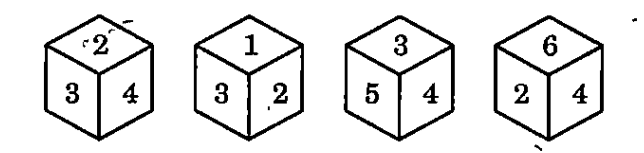
The number on the face opposite to 2 is:- Communication can be seen as processes of information transmission governed by three levels of semiotic rules:
- Which one of the following models use only three elements to explain the process of communication ?



