
Find the odd one from below:
Listening
To find the odd one out from the given options, let's analyze each term based on their roles in the communication process:
- Listening: This is the act of receiving audio information. It involves the passive perception of sounds and words, with the aim of decoding them into meaningful input for further processing.
- Perceiving: This involves all senses and refers to the ability to be aware of something through the senses. In communication, it is a broader term encompassing how we interpret various sensory inputs, not limited to auditory information.
- Inferring: This is a cognitive process where conclusions are drawn from evidence and reasoning. It involves going beyond the immediate information given and applying logical thinking.
- Comprehending: This is the ability to understand or grasp the meaning of something. It involves integrating and making sense of the information that has been listened to or perceived.
One can observe that while Perceiving, Inferring, and Comprehending involve deeper processing and understanding of information, Listening is more of an initial step in the communication process where information is received rather than processed or understood.
Therefore, the odd one out is Listening, as it focuses on the passive intake of auditory information rather than active cognitive processing.
Similar Questions
Given below are two statements:
Statement I : The linear model of communication is used for generating intentional results.
Statement II : The linear model of communication was the basis of propaganda during the World War II.
In the light of the above statements, choose the correct answer from the options given below:
Swapping of encoder-decoder roles in communication happens due to
In the communication process, signs derive meanings through:
Match the following.
Set – I (Communication elements) Set – II (Description of process part) (a) Sender (i) Brain (b) Receiver (iv) Sensory organs (c) Message (ii) Electro-magnetic impulses (d) Medium (iii) The central nervous system
Choose the correct answer from the options given below:Choose the correct sequence of communication from the options given below:
In a classroom situation, a teacher organizes group discussion to help arrive at a solution of a problem. In terms of a model of communication used, it will be called
Which of the following sequence correctly depicts the linear communication model between teacher and students.
Signs are considered as secondary products of :
Feedback makes the classroom communication process:
(a) Linear
(b) Circular
(c) Complete
(d) Interactive
(e) Disorganized
Communication variables involved in a model of performance are:
(a) Encoding
(b) Decoding
(c) Passive resistance
(d) Channelisation
(e) Indifference
Select the correct option from the code given below:
Important Questions from Process of Communication
- Arrnage the steps of message development in sequential order:
A. Encoding message
B. Transmission message
C. Formulation of meaning
D. Submitting message
E. Development of message
Choose the correct answer from the options given below: - Arrange the elements of Westley and MacLean Model in sequential order:
A. Feedback
B. Senders Sensory experience
C. Environment
D. Message to the reciever
E. Gate keeper who controls the flow of information
Choose the correct answer from the options given below: The faces of a cube are numbered 1 to 6. Four different positions of the cube are shown below :
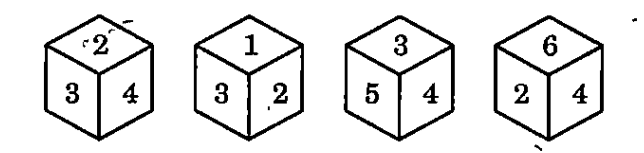
The number on the face opposite to 2 is:- Communication can be seen as processes of information transmission governed by three levels of semiotic rules:
- Which one of the following models use only three elements to explain the process of communication ?



