
Signs are considered as secondary products of :
Message
To answer the question of what signs are considered as secondary products of, it's necessary to understand the role and function of 'signs' in the context of communication. In communication, a 'message' refers to the information or meaning that a sender wants to convey to a receiver. Signs are symbols, icons, or indicators that carry specific meanings within the context of the message being conveyed.
Here is a breakdown of the options provided:
- Message: A message is the primary vehicle through which information is communicated. Signs are often used to represent or convey the message, functioning as secondary elements that carry meaning. Thus, signs are indeed secondary products of a message, as they aid in effectively transmitting the intended information or meaning to the audience.
- Infotainment: This term refers to a blend of information and entertainment but doesn't inherently involve the creation of signs as secondary products. Hence, it does not directly relate to the role of signs in communication.
- Channelization: Channelization involves routing or directing messages through various communication channels, but it does not focus on signs themselves. It is more about the medium than the symbols used.
- Semantic Accuracy: This refers to the correctness and clarity of meaning in communication, focusing on the directness and precision of meanings between signifiers and signifieds. While important, it is not about the production of signs.
Therefore, the correct answer is Message. Signs serve as tools that represent aspects of the message being communicated, making them secondary products of that message.
Similar Questions
Given below are two statements:
Statement I : The linear model of communication is used for generating intentional results.
Statement II : The linear model of communication was the basis of propaganda during the World War II.
In the light of the above statements, choose the correct answer from the options given below:
Swapping of encoder-decoder roles in communication happens due to
In the communication process, signs derive meanings through:
Match the following.
Set – I (Communication elements) Set – II (Description of process part) (a) Sender (i) Brain (b) Receiver (iv) Sensory organs (c) Message (ii) Electro-magnetic impulses (d) Medium (iii) The central nervous system
Choose the correct answer from the options given below:Choose the correct sequence of communication from the options given below:
In a classroom situation, a teacher organizes group discussion to help arrive at a solution of a problem. In terms of a model of communication used, it will be called
Which of the following sequence correctly depicts the linear communication model between teacher and students.
Find the odd one from below:
Feedback makes the classroom communication process:
(a) Linear
(b) Circular
(c) Complete
(d) Interactive
(e) Disorganized
Communication variables involved in a model of performance are:
(a) Encoding
(b) Decoding
(c) Passive resistance
(d) Channelisation
(e) Indifference
Select the correct option from the code given below:
Important Questions from Process of Communication
- Arrnage the steps of message development in sequential order:
A. Encoding message
B. Transmission message
C. Formulation of meaning
D. Submitting message
E. Development of message
Choose the correct answer from the options given below: - Arrange the elements of Westley and MacLean Model in sequential order:
A. Feedback
B. Senders Sensory experience
C. Environment
D. Message to the reciever
E. Gate keeper who controls the flow of information
Choose the correct answer from the options given below: The faces of a cube are numbered 1 to 6. Four different positions of the cube are shown below :
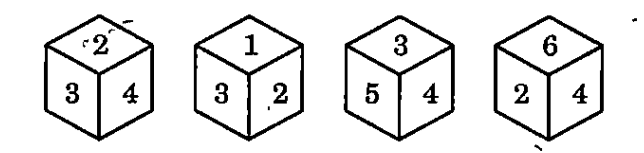
The number on the face opposite to 2 is:- Communication can be seen as processes of information transmission governed by three levels of semiotic rules:
- Which one of the following models use only three elements to explain the process of communication ?



