
Aristotle Model Elements
Aristotle's communication model is one of the earliest known models. It simplifies the communication process into three fundamental elements:
- Speaker: The source of the communication.
- Speech: The message being delivered.
- Audience: The recipient of the message.
This model focuses on public speaking and persuasion, outlining a direct, linear path from the speaker to the audience through the speech.
Why Aristotle's Model Fits
By defining only these three core components, Aristotle's model uniquely satisfies the condition of using just three elements to explain the communication process among the given options.
Comparison with Other Models
Other communication models, such as Berlo's SMCR (Source, Message, Channel, Receiver) or Westley and Maclean's, involve more than three elements, including factors like the channel, feedback, noise, and fields of experience.
Therefore, Aristotle's model is the correct answer as it adheres strictly to the three-element structure specified in the question.
Important Questions from Process of Communication
- Arrnage the steps of message development in sequential order:
A. Encoding message
B. Transmission message
C. Formulation of meaning
D. Submitting message
E. Development of message
Choose the correct answer from the options given below: - Arrange the elements of Westley and MacLean Model in sequential order:
A. Feedback
B. Senders Sensory experience
C. Environment
D. Message to the reciever
E. Gate keeper who controls the flow of information
Choose the correct answer from the options given below: The faces of a cube are numbered 1 to 6. Four different positions of the cube are shown below :
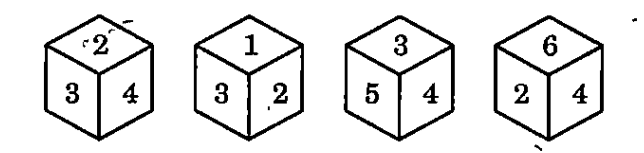
The number on the face opposite to 2 is:- Communication can be seen as processes of information transmission governed by three levels of semiotic rules:
- Match the elements of communication process in List I with their important characteristics in List II :
List - I List - II (a) Communicator (i) Needs (b) Message (ii) Availability (c) Channel (iii) Relative advantage (d) Receiver (iv) Credibility (v) Fidelity
code :


