The term representing electron-nucleus interaction in Hamiltonian operator for many electron atom is proportional to :
\(-\sum_{i} \frac{Ze^{2}}{r_{i}}\)
The Hamiltonian for a many-electron atom has three parts — electronic kinetic energy, electron-nucleus attraction, and electron-electron repulsion — and the question is to identify the middle one. Three features single it out.
The sign must be negative. The nucleus is positive and the electrons negative, so the interaction is attractive, and attractive potential energy is negative by convention. This immediately eliminates the positive terms.
The distance must be \(r_i\), not \(r_{ij}\). The subscript matters: \(r_i\) is the distance of electron i from the nucleus, whereas \(r_{ij}\) is the distance between two electrons i and j. Any term containing \(r_{ij}\) describes electron-electron repulsion, not electron-nucleus attraction.
The charges must be \(Ze^{2}\). Coulomb's law multiplies the two charges: the nuclear charge \(+Ze\) and the electronic charge \(-e\), giving \(Ze^{2}\). A term carrying only \(Ze\) has the wrong dimensions for an energy.
The sum runs over all electrons, since every electron is attracted to the nucleus.
Putting these together gives \(-\sum_{i}\frac{Ze^{2}}{r_{i}}\).
It is worth noting that it is the other term, the \(\sum_{i \lt j}\frac{e^{2}}{r_{ij}}\) repulsion, that makes the many-electron Schrödinger equation unsolvable exactly, because it couples the coordinates of different electrons and prevents separation of variables. That is precisely why approximate methods such as Hartree-Fock, which replace it by an averaged field, are needed.
Hence the electron-nucleus term is proportional to \(-\sum_{i}\frac{Ze^{2}}{r_{i}}\).
Similar Questions
The species that contain a vacant d x2 - y2 orbital is :
FeCl2 . 4H2O and FeCl3 . 6H2O can be distinguished by 57Fe Mössbauer spectroscopy. The INCORRECT statement from the following is :
The solutions of
(i) [Cr(OH2)6]3+ ions are pale blue-green, but the chromite ion
(ii) [CrO4]2- is an intense yellow due to :
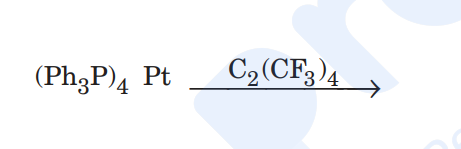
The major product of the following reaction in :
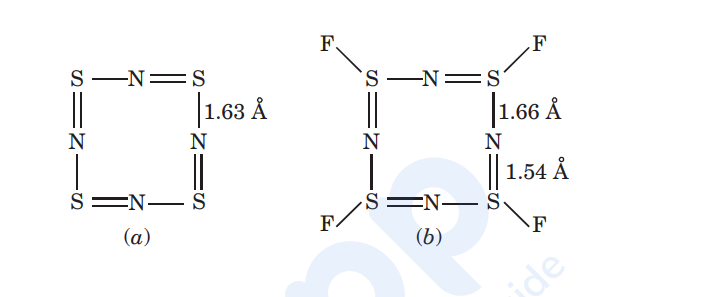
The structures of tetrasulphur tetranitride (a) and tetrathiazyl tetrafluoride (b) are given below. The statement that correctly describes the structures is :
In an axially symmetric field, the first NQR transition energy for I = $\frac{3}{2}$ is :
In the 19F NMR spectrum of ClF3, the number of signals and multiplicity at room temperature are (19F; I = \(\tfrac{1}{2}\)) :
Between NF3 and NH3 :
Identify (X) and (Y) in the following transformation :

The oxyacids of sulphur having direct S-S bonds are :
Important Questions from Structure of Atom
According to J.J. Thomson model of atom, positive charge is - Idenfity
- How many moles of He atoms are present in its 20 u mass ?
Which of the following electron transition in hydrogen atom will require largest amount of energy?
A species having 8 electrons in the third shell is very reactive while the other species having 8 electrons in the third shell is very inactive they are :
Which of the following is the general formula for saturated hydrocarbons?