In the 19F NMR spectrum of ClF3, the number of signals and multiplicity at room temperature are (19F; I = \(\tfrac{1}{2}\)) :
Two, a doublet and a triplet
Start from the geometry. ClF3 has a central chlorine with three bond pairs and two lone pairs, so its electron geometry is trigonal bipyramidal. The two lone pairs occupy equatorial positions, giving the familiar T-shaped molecule.
That leaves two chemically distinct fluorine environments: two axial fluorines, which are equivalent to each other, and one equatorial fluorine. Two environments means two signals, in a 2 : 1 intensity ratio.
Now apply the n+1 rule, remembering that coupling is only observed between inequivalent nuclei and that 19F has \(I = \tfrac{1}{2}\).
The two axial fluorines couple to the single equatorial fluorine. With n = 1 neighbour, they appear as a doublet.
The equatorial fluorine couples to the two equivalent axial fluorines. With n = 2 neighbours, it appears as a triplet.
So the spectrum shows two signals, one a doublet and the other a triplet. The single quartet in the last option would require all three fluorines to be equivalent and coupling to some fourth spin, which the T-shaped geometry rules out; and rapid exchange averaging the environments would instead collapse everything to one singlet, which is what happens only at elevated temperature.
Hence the answer is two signals, a doublet and a triplet.
Similar Questions
The oxyacids of sulphur having direct S-S bonds are :
The point group of Cis - [PtCl2(NH3)2] is :
Covalent multinuclear bonds are found in the solid state structures of :
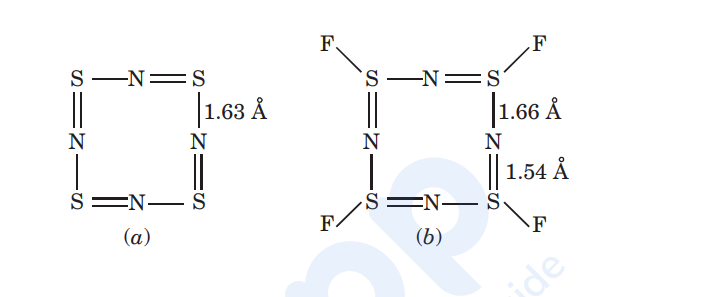
The structures of tetrasulphur tetranitride (a) and tetrathiazyl tetrafluoride (b) are given below. The statement that correctly describes the structures is :
Between NF3 and NH3 :
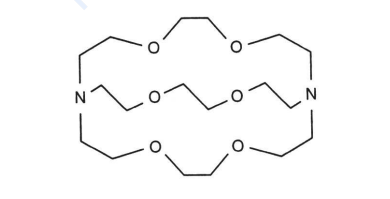
Alkali metals form strong complexes with cryptate ligands. The structure of one such crypt given below is of :
Identify (X) and (Y) in the following transformation :

For the reaction with [Cr(OH2)6]2+, the inner-sphere redox reaction proceeds the fastest for :
Kurnakov test addition of thiourea (Th) to cis-Platin yields [Pt(Th)4]Cl2. In a similar process, trans-Platin will react with thiourea to yield :
A particular metal complex has an electronic configuration of np1 nf1. The number of microstates possible in an isolated gaseous state for this metal complex is :
Important Questions from Structure of Atom
- How many moles of He atoms are present in its 20 u mass ?
Which of the following electron transition in hydrogen atom will require largest amount of energy?
A species having 8 electrons in the third shell is very reactive while the other species having 8 electrons in the third shell is very inactive they are :
Which of the following is the general formula for saturated hydrocarbons?
Which one of the following is the average atomic mass of chlorine atom?