
For the reaction with [Cr(OH2)6]2+, the inner-sphere redox reaction proceeds the fastest for :
[CoI(NH3)5]2+
An inner-sphere electron transfer requires a ligand that can bridge the two metal centres, forming a binuclear intermediate through which the electron passes. This is the classic Taube chemistry, and [Cr(OH2)6]2+ is the standard reductant because it is substitution-labile as Cr(II) and becomes inert as Cr(III), so the transferred bridging ligand ends up trapped on chromium as proof of the mechanism.
[Co(NH3)6]3+ is eliminated immediately. Ammonia has no lone pair left once coordinated and cannot bridge, so this complex can only react by the slower outer-sphere path.
The other three all carry a potential bridging ligand, so the comparison is about how good a bridge each one makes. The decisive property is polarisability — a soft, diffuse donor forms the bridge more readily and conducts the electron better.
Among the halides the rate rises steadily down the group, I- > Br- > Cl- > F-. Fluoride is small, hard and holds its electrons tightly, so [CoF(NH3)5]2+ is the slowest of the bridged set. Iodide is the largest and most polarisable, forms the bridge most easily and gives the fastest transfer.
Thiocyanate can bridge and does so well, but as an N-bonded ligand here it is a poorer conductor than iodide in this comparison.
Hence the inner-sphere reaction is fastest for [CoI(NH3)5]2+.
Similar Questions
The oxyacids of sulphur having direct S-S bonds are :
The point group of Cis - [PtCl2(NH3)2] is :
Covalent multinuclear bonds are found in the solid state structures of :
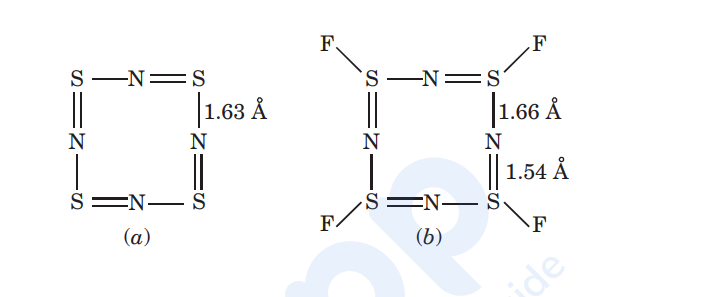
The structures of tetrasulphur tetranitride (a) and tetrathiazyl tetrafluoride (b) are given below. The statement that correctly describes the structures is :
Between NF3 and NH3 :
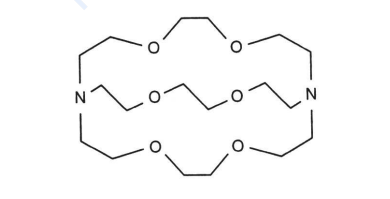
Alkali metals form strong complexes with cryptate ligands. The structure of one such crypt given below is of :
In the 19F NMR spectrum of ClF3, the number of signals and multiplicity at room temperature are (19F; I = \(\tfrac{1}{2}\)) :
Identify (X) and (Y) in the following transformation :

Kurnakov test addition of thiourea (Th) to cis-Platin yields [Pt(Th)4]Cl2. In a similar process, trans-Platin will react with thiourea to yield :
A particular metal complex has an electronic configuration of np1 nf1. The number of microstates possible in an isolated gaseous state for this metal complex is :
Important Questions from Structure of Atom
- How many moles of He atoms are present in its 20 u mass ?
Which of the following electron transition in hydrogen atom will require largest amount of energy?
A species having 8 electrons in the third shell is very reactive while the other species having 8 electrons in the third shell is very inactive they are :
Which of the following is the general formula for saturated hydrocarbons?
Which one of the following is the average atomic mass of chlorine atom?



