The structures of tetrasulphur tetranitride (a) and tetrathiazyl tetrafluoride (b) are given below. The statement that correctly describes the structures is :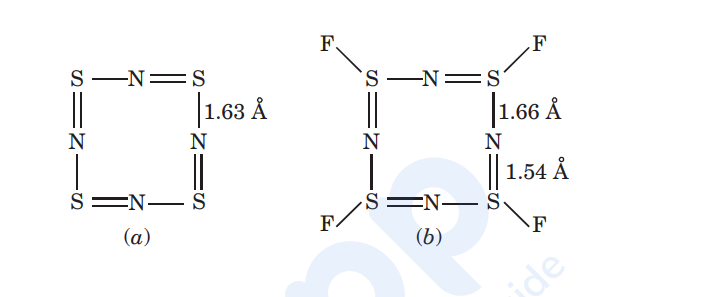
Compound (b) satisfies Hückel rule and is more stable than (a)
The stem carries drawn structures with marked bond lengths; the four options are text and are reproduced in full above.
Compound (a) is S4N4, tetrasulphur tetranitride. It is not a planar aromatic ring at all but a cradle-shaped cage: the eight-membered S-N ring folds so that the two pairs of sulphur atoms bend towards each other, giving cross-ring S···S contacts of about 2.58 Å. The S-N distances are all similar (around 1.62-1.63 Å), showing delocalisation around the ring, but the folded geometry means the π system is not a planar Hückel system. S4N4 is also endothermic and shock sensitive — it detonates on grinding or heating.
Compound (b) is S4N4F4, tetrathiazyl tetrafluoride, obtained by fluorinating S4N4. Adding fluorine to each sulphur uses up the sulphur lone pairs and converts the cage into an eight-membered ring that adopts a puckered, crown-like conformation. The alternating bond lengths marked on the structure (about 1.54 Å and 1.66 Å) are the diagnostic point: unequal, alternating S-N distances mean localised single and double bonds rather than a delocalised system.
So neither compound is a genuine planar aromatic ring obeying the Hückel 4n+2 rule, and the bond-length alternation in (b) specifically rules out extensive delocalisation there.
Per the official final answer key the answer is option (C).
Similar Questions
The oxyacids of sulphur having direct S-S bonds are :
The point group of Cis - [PtCl2(NH3)2] is :
Covalent multinuclear bonds are found in the solid state structures of :
Between NF3 and NH3 :
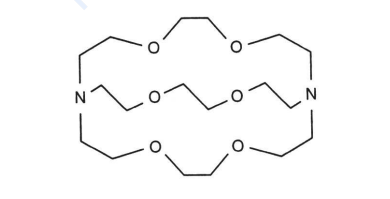
Alkali metals form strong complexes with cryptate ligands. The structure of one such crypt given below is of :
In the 19F NMR spectrum of ClF3, the number of signals and multiplicity at room temperature are (19F; I = \(\tfrac{1}{2}\)) :
Identify (X) and (Y) in the following transformation :

For the reaction with [Cr(OH2)6]2+, the inner-sphere redox reaction proceeds the fastest for :
Kurnakov test addition of thiourea (Th) to cis-Platin yields [Pt(Th)4]Cl2. In a similar process, trans-Platin will react with thiourea to yield :
A particular metal complex has an electronic configuration of np1 nf1. The number of microstates possible in an isolated gaseous state for this metal complex is :
Important Questions from Structure of Atom
- How many moles of He atoms are present in its 20 u mass ?
Which of the following electron transition in hydrogen atom will require largest amount of energy?
A species having 8 electrons in the third shell is very reactive while the other species having 8 electrons in the third shell is very inactive they are :
Which of the following is the general formula for saturated hydrocarbons?
Which one of the following is the average atomic mass of chlorine atom?