
Kurnakov test addition of thiourea (Th) to cis-Platin yields [Pt(Th)4]Cl2. In a similar process, trans-Platin will react with thiourea to yield :
Trans-[Pt(NH3)2(Th)2]Cl2
The Kurnakov test distinguishes cis- from trans-platin, and the whole difference comes from the trans effect — the ability of a ligand to labilise whatever sits opposite it. Thiourea is a soft, strongly π-accepting sulphur donor with a very high trans effect, far greater than that of ammonia or chloride.
In cis-platin, the two chlorides are adjacent and each is trans to an ammonia. Thiourea first replaces the two chlorides. Now each incoming thiourea is trans to an NH3, and its powerful trans effect labilises that ammonia, so both ammines are displaced in turn. The result is complete substitution to [Pt(Th)4]2+, as the stem states.
In trans-platin, the geometry changes the outcome. The two chlorides are trans to each other, and the two ammines are likewise mutually trans. Thiourea again displaces the two chlorides — but now each thiourea finds itself trans to the other thiourea, not to an ammonia. Its trans effect is therefore directed at another thiourea, which is itself firmly bound, and the ammines are left untouched because nothing with a strong trans effect is opposite them.
Substitution therefore stops after two ligands, giving trans-[Pt(NH3)2(Th)2]Cl2, with the original trans arrangement of the ammines preserved.
That is exactly what makes the test diagnostic: the cis isomer loses all four original ligands while the trans isomer retains its two ammines, and the two products are readily told apart.
Hence trans-platin yields trans-[Pt(NH3)2(Th)2]Cl2.
Similar Questions
The oxyacids of sulphur having direct S-S bonds are :
The point group of Cis - [PtCl2(NH3)2] is :
Covalent multinuclear bonds are found in the solid state structures of :
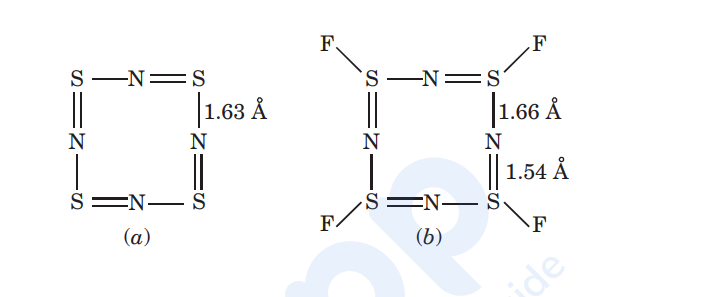
The structures of tetrasulphur tetranitride (a) and tetrathiazyl tetrafluoride (b) are given below. The statement that correctly describes the structures is :
Between NF3 and NH3 :
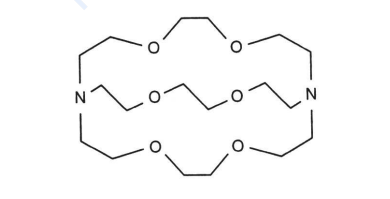
Alkali metals form strong complexes with cryptate ligands. The structure of one such crypt given below is of :
In the 19F NMR spectrum of ClF3, the number of signals and multiplicity at room temperature are (19F; I = \(\tfrac{1}{2}\)) :
Identify (X) and (Y) in the following transformation :

For the reaction with [Cr(OH2)6]2+, the inner-sphere redox reaction proceeds the fastest for :
A particular metal complex has an electronic configuration of np1 nf1. The number of microstates possible in an isolated gaseous state for this metal complex is :
Important Questions from Structure of Atom
- How many moles of He atoms are present in its 20 u mass ?
Which of the following electron transition in hydrogen atom will require largest amount of energy?
A species having 8 electrons in the third shell is very reactive while the other species having 8 electrons in the third shell is very inactive they are :
Which of the following is the general formula for saturated hydrocarbons?
Which one of the following is the average atomic mass of chlorine atom?



