The point group of Cis - [PtCl2(NH3)2] is :
C2v
Platinum(II) is d8, so [PtCl2(NH3)2] is square planar, not tetrahedral. That alone eliminates Td.
In the cis isomer the two chlorides occupy adjacent corners of the square and the two ammines occupy the other two. Now find the symmetry elements.
E — the identity, always present.
C2 — one two-fold axis, lying in the molecular plane and passing between the two Cl ligands and between the two NH3 ligands. Rotating by 180° swaps the two chlorides with each other and the two ammines with each other, restoring the molecule.
Two mirror planes containing that axis — the molecular plane itself, and the plane perpendicular to it that contains the C2 axis.
An element set of E, one C2 and two vertical mirror planes is exactly the definition of C2v.
Crucially, the cis isomer has no centre of inversion: inversion through platinum would carry a chloride onto an ammine position. That rules out both C2h and D2h, since each requires a centre of symmetry. The trans isomer, by contrast, does have a centre and belongs to D2h — which is precisely why the two isomers can be told apart by their vibrational spectra, the polar cis form showing more IR-active Pt-Cl stretches.
Hence cis-[PtCl2(NH3)2] belongs to the C2v point group.
Similar Questions
The oxyacids of sulphur having direct S-S bonds are :
Covalent multinuclear bonds are found in the solid state structures of :
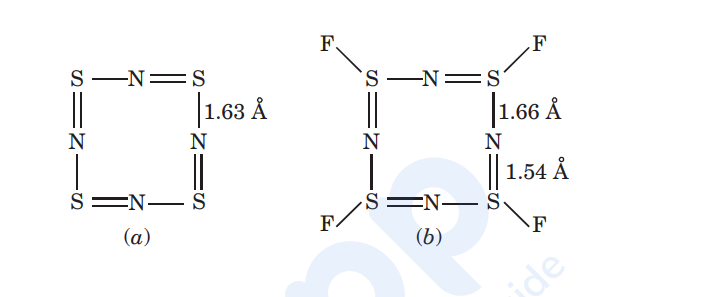
The structures of tetrasulphur tetranitride (a) and tetrathiazyl tetrafluoride (b) are given below. The statement that correctly describes the structures is :
Between NF3 and NH3 :
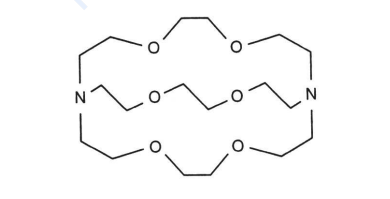
Alkali metals form strong complexes with cryptate ligands. The structure of one such crypt given below is of :
In the 19F NMR spectrum of ClF3, the number of signals and multiplicity at room temperature are (19F; I = \(\tfrac{1}{2}\)) :
Identify (X) and (Y) in the following transformation :

For the reaction with [Cr(OH2)6]2+, the inner-sphere redox reaction proceeds the fastest for :
Kurnakov test addition of thiourea (Th) to cis-Platin yields [Pt(Th)4]Cl2. In a similar process, trans-Platin will react with thiourea to yield :
A particular metal complex has an electronic configuration of np1 nf1. The number of microstates possible in an isolated gaseous state for this metal complex is :
Important Questions from Structure of Atom
- How many moles of He atoms are present in its 20 u mass ?
Which of the following electron transition in hydrogen atom will require largest amount of energy?
A species having 8 electrons in the third shell is very reactive while the other species having 8 electrons in the third shell is very inactive they are :
Which of the following is the general formula for saturated hydrocarbons?
Which one of the following is the average atomic mass of chlorine atom?