In an axially symmetric field, the first NQR transition energy for I = $\frac{3}{2}$ is :
\(+\frac{e^{2}Qq}{2}\)
Nuclear quadrupole resonance arises because a nucleus with spin \(I \ge 1\) has a non-spherical charge distribution, described by the quadrupole moment \(Q\), which interacts with the electric field gradient \(q\) set up by the surrounding electrons.
For an axially symmetric field the asymmetry parameter is zero, and the quadrupole energy levels depend only on the magnitude of the magnetic quantum number, \(|m_I|\). The standard expression is
\(E_{Q} = \frac{e^{2}Qq\,[\,3m_I^{2} - I(I+1)\,]}{4I(2I-1)}\).
For \(I = 2\) the denominator is \(4 \times 2 \times 3 = 24\) and \(I(I+1) = 6\), so the levels are obtained by substituting \(|m_I| = 0, 1, 2\). Because the energy depends on \(m_I^{2}\), states of equal \(|m_I|\) stay degenerate, leaving three distinct levels.
The selection rule for NQR is \(\Delta m_I = \pm 1\), so the first transition is the one between the two lowest-lying of these levels, and taking the difference of the corresponding energies leaves a simple fraction of \(e^{2}Qq\).
Per the official final answer key the answer is option (C).
Similar Questions
The oxyacids of sulphur having direct S-S bonds are :
The point group of Cis - [PtCl2(NH3)2] is :
Covalent multinuclear bonds are found in the solid state structures of :
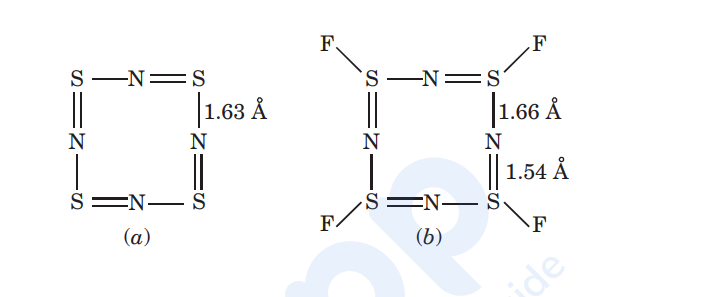
The structures of tetrasulphur tetranitride (a) and tetrathiazyl tetrafluoride (b) are given below. The statement that correctly describes the structures is :
Between NF3 and NH3 :
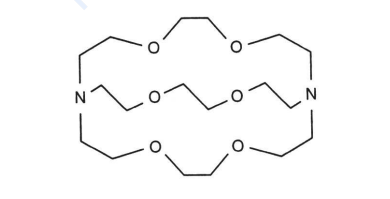
Alkali metals form strong complexes with cryptate ligands. The structure of one such crypt given below is of :
In the 19F NMR spectrum of ClF3, the number of signals and multiplicity at room temperature are (19F; I = \(\tfrac{1}{2}\)) :
Identify (X) and (Y) in the following transformation :

For the reaction with [Cr(OH2)6]2+, the inner-sphere redox reaction proceeds the fastest for :
Kurnakov test addition of thiourea (Th) to cis-Platin yields [Pt(Th)4]Cl2. In a similar process, trans-Platin will react with thiourea to yield :
Important Questions from Structure of Atom
- How many moles of He atoms are present in its 20 u mass ?
Which of the following electron transition in hydrogen atom will require largest amount of energy?
A species having 8 electrons in the third shell is very reactive while the other species having 8 electrons in the third shell is very inactive they are :
Which of the following is the general formula for saturated hydrocarbons?
Which one of the following is the average atomic mass of chlorine atom?