Directions : Question numbers 31 and 32 are based on the following information :
Out of 20 villages in a certain state, salesman A visited 14 villages, salesman B visited 12 villages. None of them visited 2 villages.
8
Start from the total and remove the villages nobody reached, to find how many were visited by at least one salesman.
\(n(A \cup B) = 20 - 2 = 18\) villages were visited by A, by B, or by both.
Now apply the inclusion-exclusion principle, \(n(A \cup B) = n(A) + n(B) - n(A \cap B)\). Simply adding 14 and 12 counts every village visited by both men twice, so the overlap has to be subtracted once to correct that double count.
Substituting the values gives \(18 = 14 + 12 - n(A \cap B)\), so \(n(A \cap B) = 26 - 18 = 8\).
The result is consistent, since 8 villages were visited by both, \(14 - 8 = 6\) by A alone and \(12 - 8 = 4\) by B alone, and \(6 + 8 + 4 + 2 = 20\) accounts for every village exactly once.
Hence 8 villages were visited by both the salesmen.
18
"At least one salesman" means visited by A only, by B only, or by both — in set terms it is the union \(n(A \cup B)\).
The information given states that out of the 20 villages, none of them visited 2 villages. Those 2 are exactly the villages lying outside the union.
So the union is the remainder: \(n(A \cup B) = 20 - 2 = 18\). The answer follows straight from the total without needing the individual figures 14 and 12 at all.
A useful check is that the union can never exceed the 20 villages available, which is why simply adding 14 and 12 to get 26 cannot be a count of villages — that sum double-counts the villages both salesmen reached.
Hence 18 villages were visited by at least one salesman.
Important Questions from Venn Diagram Problems
In a group of 73 friends, 14 friends go to Gym and Karate classes both, whereas 7 friends neither go to Gym class nor to Karate class. If a total of 36 friends go to Gym class, then how many friends go to only Karate class?
In an examination 20% students failed in Mathematics and 15% failed in English. If 10% failed in both and those who passed in both numbered 300, then the total number of students who appeared in the examination was
In the following diagram, the 'circle' stands for 'soldiers', the 'square' stands for 'Indians', and the 'triangle' stands for 'singers'. The numbers given in the different segments represent persons belonging to that category.
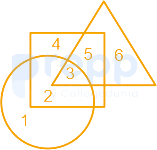
Which category is represented by the number '5'?
- In the following diagram, the circle stands for 'policemen', the square stands for 'sportspersons' and the 'triangle' stands for 'tax-payers' the numbers given in the different segments represent the number of persons in that category.
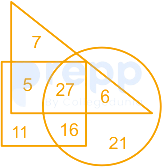
How many policemen are tax-payers but are NOT sportspersons?
Which of the following Venn diagrams represents the relationship between Lions, Deers and Carnivores?