Directions : Question numbers 31 and 32 are based on the following information : Out of 20 villages in a certain state, salesman A visited 14 villages, salesman B visited 12 villages. None of them visited 2 villages.
How many villages were visited by at least one salesman ?
18
"At least one salesman" means visited by A only, by B only, or by both — in set terms it is the union \(n(A \cup B)\).
The information given states that out of the 20 villages, none of them visited 2 villages. Those 2 are exactly the villages lying outside the union.
So the union is the remainder: \(n(A \cup B) = 20 - 2 = 18\). The answer follows straight from the total without needing the individual figures 14 and 12 at all.
A useful check is that the union can never exceed the 20 villages available, which is why simply adding 14 and 12 to get 26 cannot be a count of villages — that sum double-counts the villages both salesmen reached.
Hence 18 villages were visited by at least one salesman.
Similar Questions
Directions : Question numbers 31 and 32 are based on the following information :
Out of 20 villages in a certain state, salesman A visited 14 villages, salesman B visited 12 villages. None of them visited 2 villages.
How many villages were visited by both the salesmen ?
Important Questions from Venn Diagram Problems
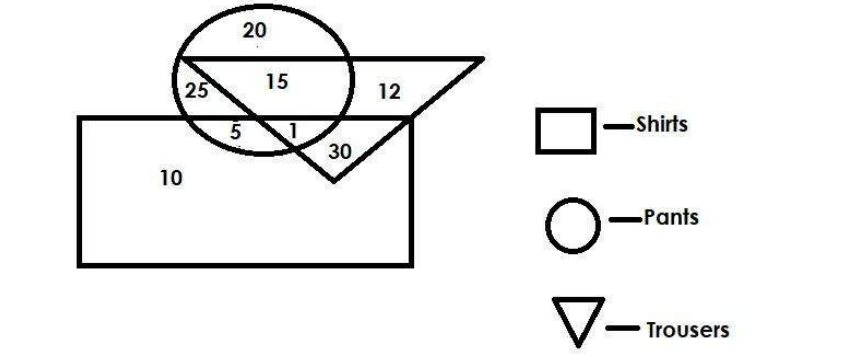
Which of the following numbers in the Venn Diagram represents only 'Shirts and Pants'?
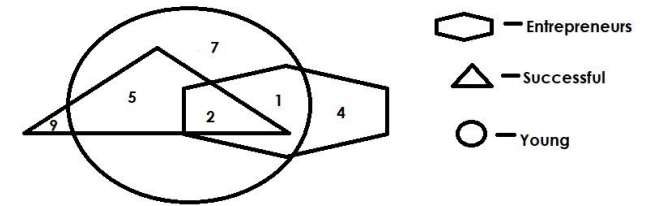
Which of the following numbers in the Venn Diagram represents young and successful entrepreneurs?
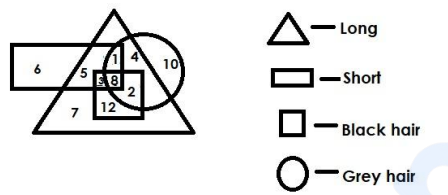
Which of the following numbers in the Venn Diagram represents only long and black hair?
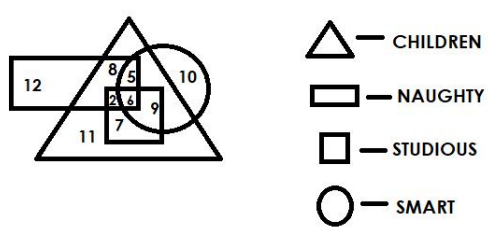
Which of the following numbers in the Venn Diagram represents only children who are studious and naughty?
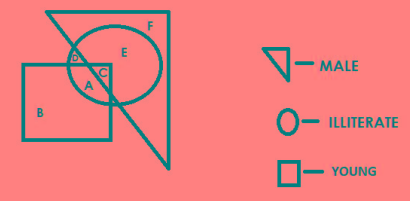
Which of the following alphabets in the Venn Diagram represents only 'male who are illiterate'?