
In a group of 73 friends, 14 friends go to Gym and Karate classes both, whereas 7 friends neither go to Gym class nor to Karate class. If a total of 36 friends go to Gym class, then how many friends go to only Karate class?
30
Solving the Friends and Classes Problem
Let's break down the problem about friends going to Gym and Karate classes using set theory concepts.
Understanding the Given Information
We are given the following details about a group of 73 friends:
- Total number of friends in the group: 73
- Number of friends who go to both Gym and Karate classes: 14
- Number of friends who go to neither Gym nor Karate class: 7
- Total number of friends who go to Gym class: 36
We need to find the number of friends who go to only Karate class.
Setting up the Problem with Set Notation
Let:
- U be the set of all friends in the group. So, $|U| = 73$.
- G be the set of friends who go to Gym class. So, $|G| = 36$.
- K be the set of friends who go to Karate class.
- $G \cap K$ be the set of friends who go to both Gym and Karate classes. So, $|G \cap K| = 14$.
- $(G \cup K)^c$ be the set of friends who go to neither Gym nor Karate class. So, $|(G \cup K)^c| = 7$.
We want to find the number of friends who go to only Karate class, which is $|K \text{ only}|$. This can be calculated as the total number of friends in Karate minus those who also go to Gym: $|K \text{ only}| = |K| - |G \cap K|$.
Finding Friends Attending at Least One Class
The friends who go to at least one class are those in the set $G \cup K$. The number of friends who go to neither class is 7. So, the number of friends who go to at least one class is the total number of friends minus those who go to neither:
$|G \cup K| = |U| - |(G \cup K)^c|$
$|G \cup K| = 73 - 7 = 66$
So, 66 friends go to either Gym or Karate or both.
Using the Principle of Inclusion-Exclusion
The formula for the union of two sets is:
$|G \cup K| = |G| + |K| - |G \cap K|$
We know $|G \cup K| = 66$, $|G| = 36$, and $|G \cap K| = 14$. We can plug these values into the formula to find $|K|$ (the total number of friends who go to Karate class):
$66 = 36 + |K| - 14$
Simplify the right side:
$66 = (36 - 14) + |K|$
$66 = 22 + |K|$
Now, solve for $|K|$:
$|K| = 66 - 22$
$|K| = 44$
So, a total of 44 friends go to Karate class (this includes those who also go to Gym).
Calculating Friends Going Only to Karate
We want to find the number of friends who go to only Karate class. This is the total number of friends in Karate minus those who also go to Gym:
$|K \text{ only}| = |K| - |G \cap K|$
$|K \text{ only}| = 44 - 14$
$|K \text{ only}| = 30$
Therefore, 30 friends go to only Karate class.
Alternative Approach: Calculating Only Gym First
We can also find the number of friends who go to only Gym class:
$|G \text{ only}| = |G| - |G \cap K|$
$|G \text{ only}| = 36 - 14 = 22$
Now, we know the total number of friends is the sum of those in only Gym, only Karate, both, and neither:
$|U| = |G \text{ only}| + |K \text{ only}| + |G \cap K| + |(G \cup K)^c|$
$73 = 22 + |K \text{ only}| + 14 + 7$
$73 = (22 + 14 + 7) + |K \text{ only}|$
$73 = 43 + |K \text{ only}|$
Solving for $|K \text{ only}|$:
$|K \text{ only}| = 73 - 43$
$|K \text{ only}| = 30$
Both approaches give the same result.
Summary of Results
| Category | Number of Friends |
|---|---|
| Total Friends | 73 |
| Go to Gym and Karate (Both) | 14 |
| Go to Neither Gym nor Karate | 7 |
| Go to Gym (Total) | 36 |
| Go to Gym Only | 22 |
| Go to Gym or Karate or Both (At Least One) | 66 |
| Go to Karate (Total) | 44 |
| Go to Karate Only | 30 |
The number of friends who go to only Karate class is 30.
Revision Table: Key Concepts
| Concept | Description | Formula/Relation |
|---|---|---|
| Total Group | All elements in the universal set. | $|U|$ |
| Intersection | Elements common to two sets (e.g., Both Gym and Karate). | $|A \cap B|$ |
| Complement of Union | Elements not in either set (e.g., Neither Gym nor Karate). | $|(A \cup B)^c| = |U| - |A \cup B|$ |
| Union | Elements in either set or both (e.g., At least one class). | $|A \cup B| = |A| + |B| - |A \cap B|$ |
| Only A | Elements in set A but not in set B (e.g., Only Gym). | $|A \text{ only}| = |A| - |A \cap B|$ |
| Total = Only A + Only B + Both + Neither | Partitioning the universal set. | $|U| = |A \text{ only}| + |B \text{ only}| + |A \cap B| + |(A \cup B)^c|$ |
Additional Information on Set Problems
Problems like this involving groups of people and activities are common applications of set theory, specifically using Venn diagrams and the Principle of Inclusion-Exclusion. A Venn diagram visually represents the sets and their overlaps.
In this case, a Venn diagram would have two overlapping circles, one for Gym (G) and one for Karate (K), inside a rectangle representing the total group (U).
- The overlapping region represents $G \cap K$ (Both). We know this is 14.
- The part of the G circle outside the overlap represents $|G \text{ only}|$. We calculated this as 22.
- The part of the K circle outside the overlap represents $|K \text{ only}|$. This is what we needed to find, and we found it to be 30.
- The area outside both circles represents $(G \cup K)^c$ (Neither). We know this is 7.
Adding all these parts should give the total number of friends:
Only Gym + Only Karate + Both + Neither = Total
$22 + 30 + 14 + 7 = 73$
This confirms our calculations are correct and align with the total number of friends given in the problem.
Important Questions from Venn Diagram Problems
In an examination 20% students failed in Mathematics and 15% failed in English. If 10% failed in both and those who passed in both numbered 300, then the total number of students who appeared in the examination was
In the following diagram, the 'circle' stands for 'soldiers', the 'square' stands for 'Indians', and the 'triangle' stands for 'singers'. The numbers given in the different segments represent persons belonging to that category.
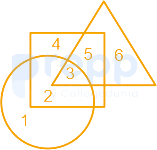
Which category is represented by the number '5'?
- In the following diagram, the circle stands for 'policemen', the square stands for 'sportspersons' and the 'triangle' stands for 'tax-payers' the numbers given in the different segments represent the number of persons in that category.
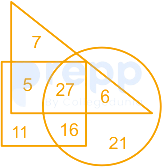
How many policemen are tax-payers but are NOT sportspersons?
Which of the following Venn diagrams represents the relationship between Lions, Deers and Carnivores?
Which of the following indicates 'Some hard workers are smart workers'?


