
Which of the following indicates 'Some hard workers are smart workers'?
Some smart workers are not hard workers.
Analyzing Logical Statements about Workers
The question asks us to identify which statement is indicated by the statement, 'Some hard workers are smart workers'. This is a question involving the interpretation and relationships of logical propositions, specifically dealing with categories and quantifiers like 'Some', 'All', and 'No'.
Understanding the Main Statement: 'Some hard workers are smart workers'
The statement 'Some hard workers are smart workers' is a particular affirmative proposition. In categorical logic, this is often represented as an 'I' type proposition. It asserts that there is at least one individual who belongs to both the category of 'hard workers' and the category of 'smart workers'. Using set notation, if H represents the set of hard workers and S represents the set of smart workers, this statement means the intersection of the two sets is not empty, i.e., \(H \cap S \neq \emptyset\).
Examining the Options
Let's analyze each given option:
- 'No smart workers are hard workers.' This is a universal negative proposition (E type). It asserts that there is no individual who is both a smart worker and a hard worker. In set notation, this means the intersection \(S \cap H\) is empty, i.e., \(S \cap H = \emptyset\). This statement is the contradictory of 'Some smart workers are hard workers' (which is equivalent to 'Some hard workers are smart workers'). If 'Some hard workers are smart workers' is true, then 'No smart workers are hard workers' must be false. Thus, the main statement indicates that this option is false.
- 'Some smart workers are not hard workers.' This is a particular negative proposition (O type). It asserts that there is at least one individual who is a smart worker but not a hard worker. In set notation, this means the set difference \(S \setminus H\) is not empty, i.e., \(S \setminus H \neq \emptyset\).
- 'All smart workers are hard workers.' This is a universal affirmative proposition (A type). It asserts that every individual who is a smart worker is also a hard worker. In set notation, this means the set of smart workers is a subset of the set of hard workers, i.e., \(S \subseteq H\). If this statement is true, and there is at least one smart worker, then 'Some smart workers are hard workers' (equivalent to 'Some hard workers are smart workers') is also true. However, 'Some hard workers are smart workers' being true does not necessarily imply 'All smart workers are hard workers' is true.
- 'All hard workers are smart workers.' This is a universal affirmative proposition (A type). It asserts that every individual who is a hard worker is also a smart worker. In set notation, this means the set of hard workers is a subset of the set of smart workers, i.e., \(H \subseteq S\). If this statement is true, and there is at least one hard worker, then 'Some hard workers are smart workers' is also true. Similar to option 3, 'Some hard workers are smart workers' being true does not necessarily imply 'All hard workers are smart workers' is true.
Relating 'Some hard workers are smart workers' to the Options
In standard logic, the statement 'Some hard workers are smart workers' (Some H are S) has direct logical relationships (like contradiction or subalternation) with other standard propositional forms (A, E, I, O types) involving H and S. For example, 'Some H are S' contradicts 'No H are S' (which is equivalent to 'No S are H', Option 1). 'All H are S' (Option 4) implies 'Some H are S' (assuming hard workers exist). 'All S are H' (Option 3) implies 'Some S are H' (which is equivalent to 'Some H are S', assuming smart workers exist). There is no direct standard logical implication or equivalence between 'Some H are S' and 'Some S are not H' (Option 2). Their truth values can vary independently depending on the distribution of individuals in the categories H and S.
| Statement Type | Proposition | Set Notation | Relationship to 'Some H are S' |
|---|---|---|---|
| Main Statement (I) | Some hard workers are smart workers. | \(H \cap S \neq \emptyset\) | Reference |
| Option 1 (E) | No smart workers are hard workers. (No S are H) | \(S \cap H = \emptyset\) | Contradictory of main statement (if main is true, this is false). |
| Option 2 (O) | Some smart workers are not hard workers. (Some S are not H) | \(S \setminus H \neq \emptyset\) | No standard direct logical implication. Can be true or false when main statement is true. |
| Option 3 (A) | All smart workers are hard workers. (All S are H) | \(S \subseteq H\) | Does not imply main statement. Main statement does not imply this. |
| Option 4 (A) | All hard workers are smart workers. (All H are S) | \(H \subseteq S\) | Implies main statement (assuming H is not empty). Main statement does not imply this. |
Interpreting "Indicates" based on the provided answer
Given that the provided answer is 'Some smart workers are not hard workers' (Option 2), the term "indicates" in the question is likely not used in the strict sense of logical implication or equivalence. Since 'Some hard workers are smart workers' (Some H are S) being true does not logically imply 'Some smart workers are not hard workers' (Some S are not H) is true, there might be a different intended meaning.
A possible interpretation, aligning with the provided answer, is that establishing the existence of an overlap between hard workers and smart workers ('Some hard workers are smart workers') naturally leads to considering whether the sets are entirely identical or if there are individuals in one set who are not in the other. The statement 'Some smart workers are not hard workers' highlights a possible distinction within the group of smart workers – specifically, the portion who do not fall into the category of hard workers. While not a logical consequence, the existence of a non-empty intersection (\(H \cap S \neq \emptyset\)) might prompt consideration of whether the rest of the 'Smart Workers' set (\(S \setminus H\)) is also non-empty. In many real-world scenarios where some overlap exists between categories, it is also true that there are members of one category not in the other.
Therefore, based on the provided answer and interpreting "indicates" in a looser sense of prompting consideration or highlighting a potential distinction within the categories involved when overlap exists, 'Some smart workers are not hard workers' is presented as the statement indicated by 'Some hard workers are smart workers'.
Conclusion
The statement 'Some hard workers are smart workers' is a particular affirmative proposition affirming the existence of individuals in the intersection of hard workers and smart workers. While it logically contradicts 'No smart workers are hard workers' (Option 1) and is implied by 'All hard workers are smart workers' (Option 4) or 'All smart workers are hard workers' (Option 3) under existential import, it does not logically imply 'Some smart workers are not hard workers' (Option 2). However, if we interpret "indicates" in a sense of prompting consideration of distinct subsets within the categories when overlap exists, then 'Some smart workers are not hard workers' presents such a distinction within the set of smart workers.
Revision Table: Key Logical Relationships
| Original Statement | Statement from Option | Standard Logical Relationship |
|---|---|---|
| 'Some hard workers are smart workers' (Some H are S) | 'No smart workers are hard workers' (No S are H) | Contradictory (If original is True, this is False) |
| 'Some smart workers are not hard workers' (Some S are not H) | Independent (Truth values can vary) | |
| 'All smart workers are hard workers' (All S are H) | Independent (Neither implies the other) | |
| 'All hard workers are smart workers' (All H are S) | Original is implied by this (assuming H exists) |
Additional Information: Categorical Propositions and the Square of Opposition
Categorical propositions are statements that relate two categories or classes. The four standard types are:
- A (Universal Affirmative): All S are P. (\(\forall x (S(x) \rightarrow P(x))\))
- E (Universal Negative): No S are P. (\(\forall x (S(x) \rightarrow \neg P(x))\) or \(\neg \exists x (S(x) \land P(x))\))
- I (Particular Affirmative): Some S are P. (\(\exists x (S(x) \land P(x))\))
- O (Particular Negative): Some S are not P. (\(\exists x (S(x) \land \neg P(x))\))
The Square of Opposition illustrates the logical relationships between these standard forms when they have the same subject and predicate terms (e.g., S and P). Key relationships include:
- Contradictory: A and O are contradictories; E and I are contradictories. If one is true, the other must be false, and vice versa. (e.g., 'Some H are S' is contradictory to 'No H are S' / 'No S are H').
- Contrary: A and E are contraries. They cannot both be true, but can both be false.
- Subcontrary: I and O are subcontraries. They cannot both be false, but can both be true (in existential import).
- Subalternation: A implies I, and E implies O (assuming existential import for A and E). The universal implies the particular of the same quality.
In this question, the main statement ('Some hard workers are smart workers' - Some H are S) is an I proposition. Option 1 ('No smart workers are hard workers' - No S are H) is an E proposition, which is the contradictory of 'Some S are H', and since 'Some H are S' is equivalent to 'Some S are H', Option 1 is the contradictory of the main statement.
Option 2 ('Some smart workers are not hard workers' - Some S are not H) is an O proposition, but with the subject and predicate terms switched compared to the main statement's structure if we considered 'hard workers' as the subject term of the primary proposition (Some H are S). Standard relationships on the Square of Opposition apply when the subject and predicate terms are the same across the propositions being compared (e.g., comparing Some H are S with No H are S, All H are S, Some H are not S).
The relationship between 'Some H are S' and 'Some S are not H' is not a standard one illustrated directly on the simple Square of Opposition because the subject and predicate terms are switched and one is affirmative while the other is negative.
Important Questions from Venn Diagram Problems
In a group of 73 friends, 14 friends go to Gym and Karate classes both, whereas 7 friends neither go to Gym class nor to Karate class. If a total of 36 friends go to Gym class, then how many friends go to only Karate class?
In an examination 20% students failed in Mathematics and 15% failed in English. If 10% failed in both and those who passed in both numbered 300, then the total number of students who appeared in the examination was
In the following diagram, the 'circle' stands for 'soldiers', the 'square' stands for 'Indians', and the 'triangle' stands for 'singers'. The numbers given in the different segments represent persons belonging to that category.
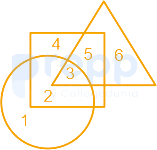
Which category is represented by the number '5'?
- In the following diagram, the circle stands for 'policemen', the square stands for 'sportspersons' and the 'triangle' stands for 'tax-payers' the numbers given in the different segments represent the number of persons in that category.
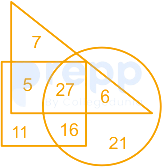
How many policemen are tax-payers but are NOT sportspersons?
Which of the following Venn diagrams represents the relationship between Lions, Deers and Carnivores?


